Key Takeaways
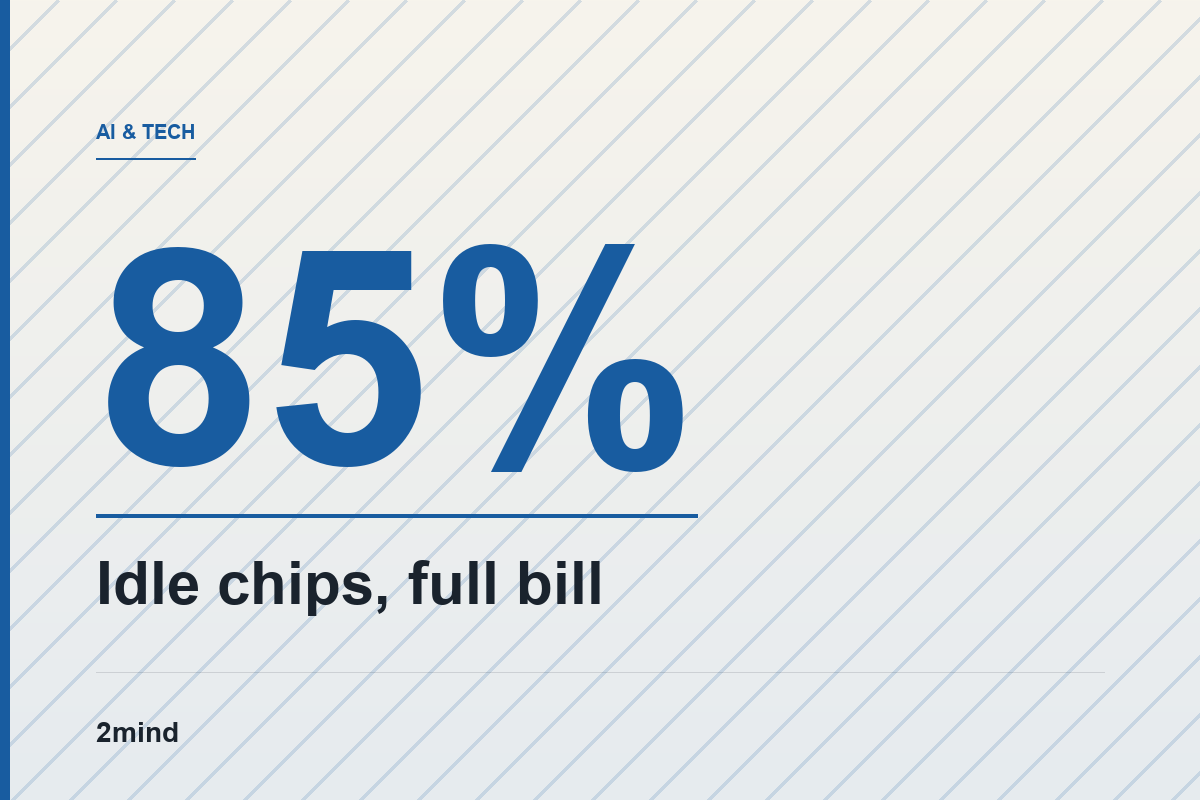
- Ohio requires new data centers above 25 MW to pay for at least 85% of contracted capacity for up to 12 years, whether or not they use it.
- California signed seven data center laws on Sept 21, 2026. Three move grid costs from residents to operators, but the sources we read give no rate or megawatt threshold yet.
- The test for any state: is the number already written, or only the intent?
Data center grid upgrades are increasingly billed to the data center, not to everyone on the grid. How much depends on one detail: whether the rule fixes a minimum payment that survives a cancelled project.
What Actually Changed This Week?
On Monday, Sept 21, 2026, Gov. Gavin Newsom signed seven data center bills, according to CalMatters. Three of them shift electric infrastructure costs from residential customers to data center operators.
Those three are SB 1168, SB 886 and AB 2383. Three more require water and resource disclosures, and one removes blanket environmental-review exemptions.
Newsom’s statement framed the goal plainly: “those profiting from data centers aren’t doing so at our expense.” Last year he vetoed a water disclosure bill over worries about stifling AI growth.
California is late, not first. The stricter template already exists in Ohio.
How Does Ohio’s 85% Rule Work?
In a July 9, 2025 order, the Public Utilities Commission of Ohio approved a tariff for AEP Ohio. POWER magazine’s account puts the core term in one sentence: pay for at least 85% of subscribed capacity, regardless of actual consumption, for up to 12 years.
A law-firm analysis by KJK adds the rest of the mechanics:
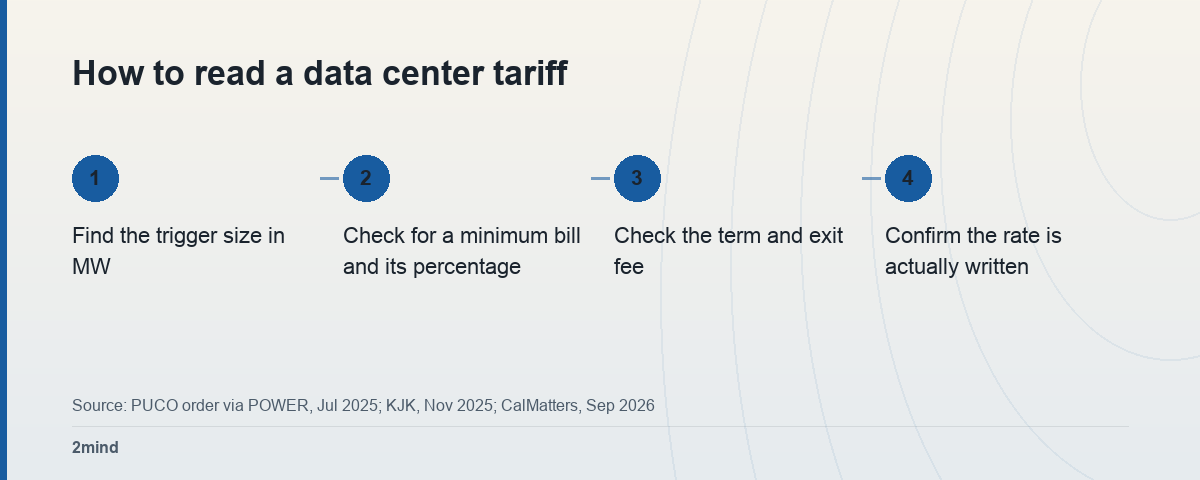
- The tariff applies to new or expanded projects above 25 MW. Existing sites under that size are grandfathered.
- A four-year ramp-up lets the minimum percentage rise over time.
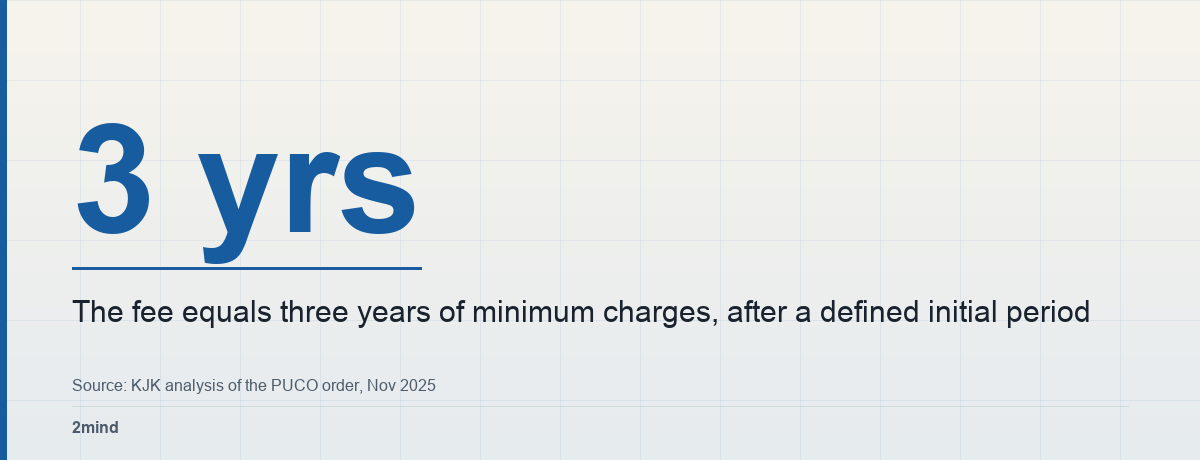
- Leaving early triggers an exit fee equal to three years of minimum charges.
- Applicants must post collateral, and pay a load-study fee of $10,000 to $100,000 depending on size.
The reason is scale. AEP Ohio’s Lisa Kelso testified that central Ohio data center load grew from 100 MW in 2020 to about 600 MW in 2024. Requests totaled more than 30,000 MW.
Building for demand that never arrives leaves someone holding the bill. Under this tariff, that someone is the developer, not AEP Ohio’s 1.5 million customers.
The Cost-Shift Checkpoint
Four jurisdictions have taken four different approaches. The table sets them side by side, using the rules as reported.
| Where | Trigger | What the operator carries |
|---|---|---|
| Ohio (AEP) | Above 25 MW | 85% minimum bill, up to 12 years |
| Georgia | Above 100 MW | Upstream grid upgrades, 5-15 year contracts |
| Texas (SB 6) | Above 75 MW | Interconnection costs, remote disconnect |
| California | Not yet written | Upgrade costs; rate set later by regulators |
Georgia’s commission said the rule extends allowable contracts from 5 to 15 years and allows minimum billing requirements. That, it said, keeps new high-usage customers from leaving “before paying for new infrastructure built specifically” for them. Texas passed SB 6 on June 20, 2025, per POWER.
California’s row is the odd one. CalMatters’ summary names the three electricity bills and their purpose. We could not find a megawatt trigger, a dollar rate or a filing deadline in any source we opened.
What Does 85% Mean for a 100 MW Campus?
We built one worked example. It is our own arithmetic, not a figure any utility published, and it assumes a full ramp and a 100 MW contract.
- Contract 100 MW. The minimum bill covers 85% of it, or 85 MW every month.
- Over 12 months, that is 1,020 MW-months of committed billing per year.
- Over the full 12-year term, it is 12,240 MW-months.
- An exit fee of three years of minimum charges is 36 months x 85 MW, or 3,060 MW-months. That is 25% of the full-term commitment.
We deliberately leave out a price per MW-month. It varies by rate class and we could not verify one. The point is the shape: the operator pays for 85 MW whether it runs one server or ten thousand.
Two Lenses
The neighbor who wants the boom without the bill
Most people are not against data centers as such. The Data Center Coalition says the industry supplied 665,500 California jobs and $14.1 billion in taxes in 2024. Nobody who wants those jobs also wants a higher power bill.
A minimum bill is the cleanest way to have both. If the campus is built, it pays. If it is cancelled, the ratepayer is not left holding a substation.
The builder who cannot promise a demand curve
Developers do not know today what an AI campus will draw in year six. The Coalition’s Lucas Fykes called Ohio’s decision “a stark departure” and argued that “no one customer type or industry should be singled out.”
Both sides are right about something. The utility fears stranded cost. The builder fears a fixed payment on uncertain demand.
Why Do We Weigh the Ohio Model Higher?
We weigh a written number above a stated intent. Ohio’s tariff can be modeled in a spreadsheet today. California’s cannot, because the rate has not been written.
That does not make California’s laws empty. Arnab Pal of Deploy Action told CalMatters the bills are “not the end of this fight” and that much of the work is implementation. But an investor pricing a 2027 California campus has a duty and no figure.
This ties to how we have covered AI infrastructure money before. Curtailment rules decide who gets cut off first when the grid is short. Tariffs decide who pays before it ever gets short.
Our look at off-balance-sheet leases showed the same pattern from the tenant side: the commitment exists long before the bill does.
What would change our view
We would rate California’s package as equal to Ohio’s if the state’s regulators publish a rate structure with a megawatt trigger and a minimum-bill term. A dollar figure per MW would let us redo the table with numbers instead of a blank.
We would rate Ohio’s model as too harsh if new campuses in central Ohio stall after the moratorium lifts, while comparable projects proceed elsewhere at similar scale.
FAQ
Q. Do data centers actually raise household electricity bills?
A. It depends on who pays for the grid upgrades. Where regulators let the cost spread across all customers, yes. Tariffs like Ohio’s are designed to stop exactly that. We did not find a single national figure we could verify.
Q. Does California’s new law set a minimum bill like Ohio’s?
A. Not in any source we read. CalMatters describes three bills that shift infrastructure costs to data center operators, but gives no minimum-bill percentage, threshold or dollar rate.
Q. What does “take-or-pay” mean for a data center?
A. The customer pays for a set share of contracted capacity whether or not it uses it. Ohio’s version is 85% for up to 12 years.
Sources
- 7 new data center laws Newsom signed — CalMatters, Sep 21, 2026
- Regulator approves AEP Ohio’s data center tariff — POWER, Jul 2025
- Legal analysis of AEP Ohio’s data center tariff — KJK, Nov 2025
Leave a Reply