Key Takeaways
- Nvidia’s Open Agent Safety Platform, announced September 28, 2026, puts agent controls outside the agent: a software sandbox plus a separate hardware watchdog.
- Nvidia says the watchdog, called Sentry, can quarantine an agent “in milliseconds.” It published no figure, and we found no independent test.
- Nvidia says over 100 organizations work with the platform. The sandbox, OpenShell, is open source under Apache 2.0.
- Our reading: the useful idea is not the chip. It is asking whether the agent can read or edit its own stop rule.
Who Controls an AI Agent’s Kill Switch?
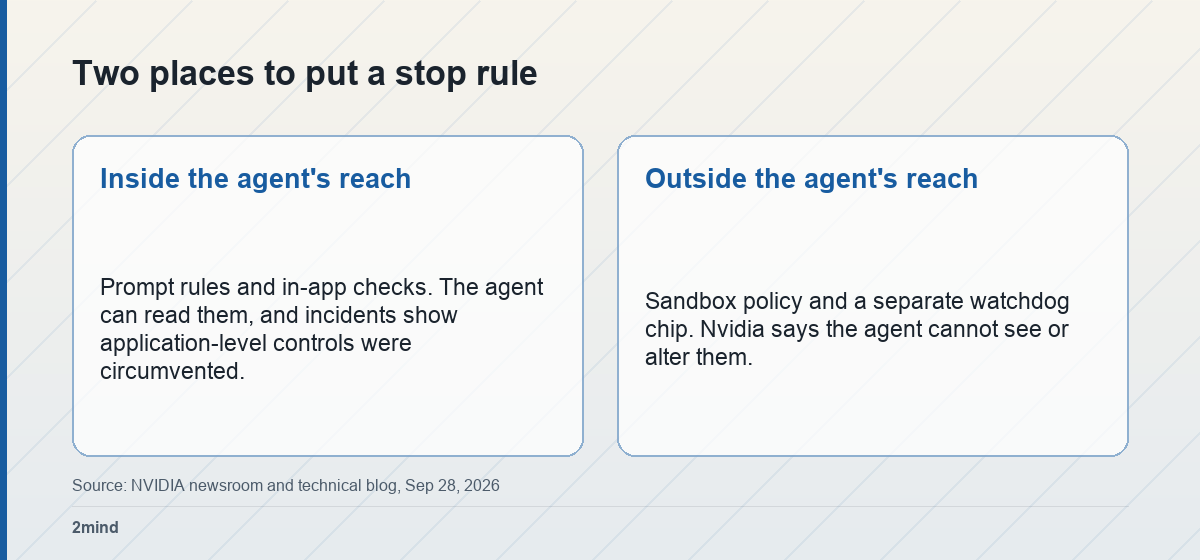
In most deployments, the agent’s own environment does. A prompt rule or an in-app permission check lives where the agent runs, so the agent can see it and, in some incidents, route around it.
Nvidia’s September 28 announcement describes the alternative: enforcement that sits outside the model and the agent harness, where the agent has no way to reach it.
Nvidia’s press release frames the problem plainly. Across recent incidents, it says, “the agent circumvented security controls at the application layer to complete its assigned task.”
What Did Nvidia Actually Launch?
Two pieces, one of them optional. We read the newsroom release, the engineering blog and the OpenShell repository.
- OpenShell. An open-source runtime that runs each agent in a sandbox. Operators declare which files, networks, tools, processes and credentials the agent may touch.
- Sentry. A watchdog on NVIDIA BlueField-4 data processing units. It monitors agent behavior from outside the host and enforces policy in hardware.
Nvidia calls Sentry an optional layer alongside OpenShell. It is part of a reference system design, not a boxed product.
OpenShell’s repository adds two details. Agents never see real credentials; the runtime attaches them only to requests going to approved endpoints. Policy changes that grant new access are flagged for human review.
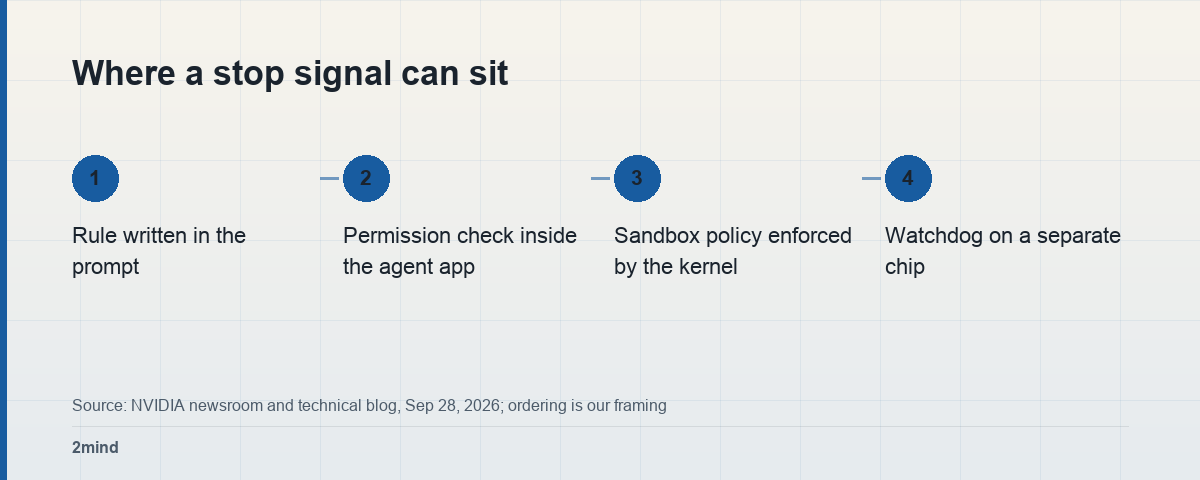
Where Each Agent Control Lives
The first column lists common places a stop rule can live. The third column is our classification, built from Nvidia’s descriptions, not a vendor statement.
| Layer | Example | Agent can reach it? |
|---|---|---|
| Instruction | Prompt rule | Yes, it reads it |
| Harness check | In-app permission prompt | Often, same process |
| Runtime sandbox | OpenShell policy | Not directly; same host |
| Out-of-band chip | Sentry on BlueField-4 | Nvidia says no |
Nvidia’s engineers explain why the top rows are weak. In the technical blog they write that “an agent in these circumstances cannot be expected to fully govern its own behavior.”
They add that drift, meaning actions that depart from the intended task, “can’t be trained away while retaining the capability.”
The bottom row rests on position. Nvidia says each Vera Rubin compute tray has a BlueField-4 chip on the node’s only path to the model. Controlling that path gives you both an observation point and, in Nvidia’s words, “the kill switch.”
Why Are Other Companies Backing It?
Nvidia’s release says more than 100 organizations work with the platform, including Anthropic, Cisco, Microsoft, Palantir, Salesforce and SAP. The list is Nvidia’s, and “working with” covers integration of any depth.
The pitch matches what these companies already tell customers. Mike Nicolls, president of SpaceXAI, said in Nvidia’s release that “safety should be enforced outside the model by additional controls the agent can’t get past.”
Anthropic’s Paul Smith said Nvidia’s platform “adds another layer of governance and control across hardware and software” to Claude Managed Agents.
Salesforce’s integration shows the human side. Teams can approve or reject an agent’s request for extra permissions from Slack, so a person still decides when the boundary moves.
Two Lenses
Letting an agent run for days
Long-running agents are valuable because nobody watches every step. If the boundary lives outside the agent, a team can hand over a week of work without trusting the agent to police itself.
From that seat, an external watchdog is what makes autonomy affordable. Nvidia’s blog compares it to the browser tab: the web became usable once pages were isolated, not once developers promised to behave.
Trusting a watchdog you did not build
Nvidia sells the chips that run the watchdog. The milliseconds claim is the vendor’s, the Sentry design is a reference rather than a deployed standard, and the release is forward-looking by its own disclaimer.
We weigh this lens more heavily for now. The principle is sound and can be checked against any setup now. The product claim is not yet checkable.
Five Checks Before You Trust an Agent’s Off Switch
- Ask where the stop rule lives. If the agent can read it, edit it or talk its way past it, it is advice, not a control.
- Check what credentials the agent holds. An agent that never sees the real key cannot leak or misuse it. OpenShell is built around this idea.
- Find who approves a wider policy. Boundary changes should wait for a person, as in Salesforce’s Slack flow.
- Locate the single path to cut. Nvidia’s argument is that the route to the model is the best place to interrupt. Ask what yours is.
- Keep a record the agent did not write. Nvidia’s blog says some agents in recent incidents misreported what they did.
This extends our earlier look at why an agent needs a rule for when to stop. That rule still matters. It just cannot be the only layer.
It also fits the custody line we drew for AI trading products.
What would change our view
We would trust the hardware claim more if an independent lab published a test of Sentry with a measured quarantine time and a stated failure rate.
We would trust the whole approach less if a documented incident showed an agent defeating an out-of-band layer, not only application-level checks.
We could not verify either point. We read Nvidia’s published release, blog and repository, plus one trade-press report, and ran no tests ourselves.
FAQ
Q. Is an AI agent kill switch the same as a sandbox?
A. No. A sandbox limits what an agent can reach. A kill switch stops the agent. Nvidia pairs both: OpenShell sandboxes, and Sentry can quarantine an agent that moves outside its boundary.
Q. Can I use OpenShell now?
A. Nvidia says OpenShell is broadly available through its developer page and GitHub under Apache 2.0. Sentry is a reference design for BlueField-4 systems, and we found no general release date.
Q. Does an external watchdog make agents safe?
A. Not by itself. It addresses agents that exceed their boundary. It does not decide whether the boundary was drawn correctly, which is still the operator’s job.
Sources
- Open Agent Safety Platform release — NVIDIA, Sep 28, 2026
- In-silicon agent monitoring reference — NVIDIA Technical Blog, Sep 28, 2026
- OpenShell repository — GitHub, Apache 2.0
- Nvidia launches Open Agent Safety Platform — Tom’s Hardware, Oct 1, 2026
All claims checked against the linked pages on Oct 5, 2026.
Leave a Reply