
I noticed something interesting this week: while one major bank turned more cautious on Bitcoin’s near-term path, Ethereum’s founder was busy sketching out where the network should be in 2030.
Key Takeaways
- Citi lowered its 12-month Bitcoin price outlook, citing weak ETF inflows and stalled U.S. regulatory clarity, according to Blockmedia.
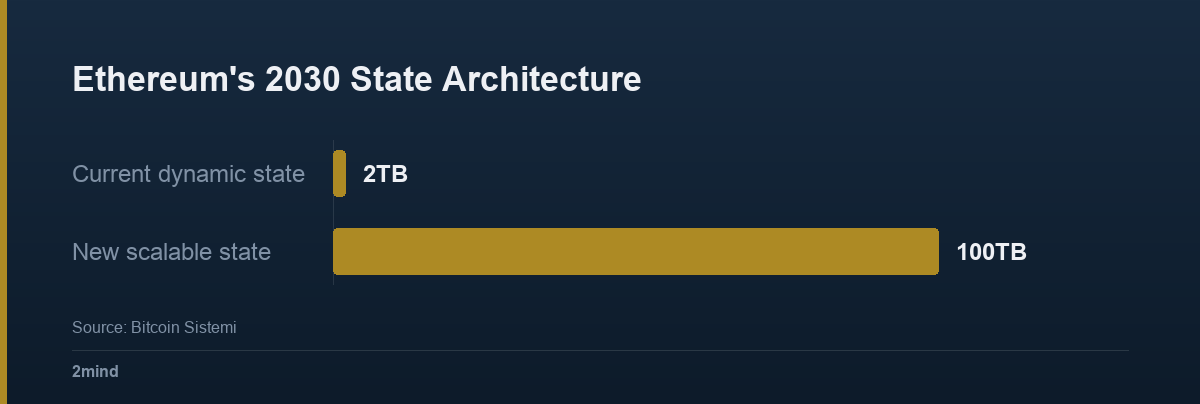
- Vitalik Buterin outlined a 2030 architecture concept combining 2 TB of current-style dynamic state with 100 TB of new, more scalable state for tokens and NFTs, per Bitcoin Sistemi.
- The 2mind read: short-term institutional sentiment and long-term protocol design are moving on completely different timelines right now.

What happened
| Citi (Bitcoin, near-term) | Buterin (Ethereum, 2030) | |
|---|---|---|
| Focus | 12-month price outlook | Long-term network architecture |
| Signal | Lowered outlook citing weak ETF inflows, stalled regulation | 2 TB + 100 TB dual-state design, up to 10x fee cuts for ERC-20s |
Citi, one of the largest global investment banks, revised its Bitcoin price outlook downward, according to Blockmedia’s reporting.
The bank pointed to softening investor sentiment, outflows from U.S. spot Bitcoin ETFs, and a regulatory environment that hasn’t moved forward as quickly as markets had hoped.
Citi reportedly expects ETF inflows to be close to flat over the coming period — a notable shift from the more optimistic institutional-adoption narrative that dominated headlines earlier in the cycle.
On a separate but related front, Ethereum co-founder Vitalik Buterin described a possible network architecture for 2030, as reported by Bitcoin Sistemi. The design pairs today’s dynamic state model (roughly 2 TB) with a new, more scalable state type capable of holding up to 100 TB of data.
Buterin said this new state format could suit ERC-20 tokens, NFTs, and many DeFi applications well, though it may be less suited to more complex structures like Uniswap contracts or on-chain order books.
He also noted that migrating an ERC-20 token to a new UTXO-style storage design could cut transaction fees by more than tenfold — though rewriting existing implementations wouldn’t be mandatory.
Flat ETF inflows are a different signal than outflows, and it’s worth being precise about which one Citi is actually forecasting. Flows near zero suggest existing holders aren’t rushing for the exit, but new capital also isn’t arriving at the pace that powered earlier rounds of the institutional-adoption narrative — a stall rather than a reversal.
Buterin’s 100 TB state design is aimed at a specific bottleneck: storage growth outpacing what individual node operators can reasonably run.
Pairing a smaller, fast-access state with a larger, cheaper one is a common systems-design pattern — the tradeoff being that not every application fits cleanly into the cheaper tier, which is why he flagged complex contracts as a weaker fit.
The dual-state design also isn’t presented as a finished proposal — Buterin describes it as a 2030 concept, meaning years of design review, community debate, and testing likely sit between this description and any live implementation, which is standard for architecture-level changes at Ethereum’s scale.
The two lenses
Lens one: Institutional caution is a temporary weather system. Citi’s downgrade reflects current flow data and regulatory friction — both of which are conditions, not permanent features. ETF inflows have been genuinely volatile over the past year, swinging from strong monthly accumulation to net outflows within weeks.
Regulatory clarity, especially in the U.S., has also historically moved in fits and starts rather than a straight line. Under this lens, a bank revising a 12-month price outlook says more about the next two or three quarters of sentiment than about the underlying trajectory of crypto adoption.
Institutional capital tends to be reactive to headlines and flow data, and Citi’s own framing — “ETF inflows near zero” — is itself a forecast, not a fact yet in evidence.
Lens two: The technology roadmap doesn’t erase the funding gap. Buterin’s 2030 vision is compelling engineering, but it’s also a reminder that Ethereum’s biggest challenges have never really been about clever state architecture — they’ve been about capital flows, custody trust, and regulatory acceptance from the institutions Citi represents.
A 10x fee reduction on ERC-20 migrations is meaningful for developers, but it doesn’t directly address why ETF demand cooled or why regulators have been slow to act. Long-term protocol design and short-term capital allocation are, in this sense, two different conversations happening in parallel, and conflating them risks either excessive optimism or excessive pessimism.
Lens one’s point about ETF flow volatility is testable against the recent record — inflows and outflows have swung across weeks before, sometimes sharply, without a corresponding change in the network’s underlying usage. That history is exactly why a single 12-month outlook revision shouldn’t automatically be read as a verdict on the asset class.
Lens two’s point cuts the other way: engineering roadmaps have a long history of shipping later than proposed, and even a fully realized 2030 architecture doesn’t by itself solve custody trust or the compliance questions that shape whether institutions like the ones Citi represents actually allocate capital.
There’s a version of both lenses being correct simultaneously: Citi’s near-term caution and Buterin’s long-term roadmap can both be accurate descriptions of their respective time horizons without either one predicting what happens to the other. That’s arguably the more honest reading than picking a side.
Why it matters
For everyday holders, this divergence matters because price outlooks and technical roadmaps answer different questions.
Citi’s report is aimed at institutional allocators asking “should we increase Bitcoin exposure this quarter.” Buterin’s roadmap is aimed at developers and validators asking “will Ethereum still be usable at global scale in 2030.” Both audiences should watch different indicators: ETF flow data on a weekly basis for the institutional question, and Ethereum core developer calls for the protocol question.
As we’ve noted in earlier coverage of ETF flow volatility, short-term sentiment swings have repeatedly diverged from underlying network fundamentals — this appears to be another instance of that pattern.
The honest takeaway is that neither story alone tells you what to do next. They’re simply two clocks running at different speeds.
The practical split for readers is which question they’re actually trying to answer. ‘Should I adjust exposure this quarter’ and ‘will this network still work at scale in 2030’ draw on almost entirely different evidence, and conflating a bank’s short-term note with a developer’s long-term roadmap tends to produce whiplash rather than clarity.
It’s also a reminder that the loudest crypto headlines in a given week often aren’t actually in conversation with each other, even when they get bundled into the same news cycle. Reading them as competing signals about ‘crypto sentiment’ broadly can obscure more than it reveals.
The most useful thing either report offers isn’t a directional call — it’s a reminder to separate the timeframe of the question being asked before treating any single data point as decisive for either Bitcoin or Ethereum broadly.
FAQ
Q. Does Citi’s downgrade mean institutions are leaving crypto entirely?
A. No — Citi’s report specifically addresses a 12-month price outlook and ETF flow expectations, not a broader institutional exit from the asset class.
Q. Will Ethereum’s 2030 architecture change how the network works today?
A. Not immediately — Buterin described this as a conceptual model for future scaling, and he explicitly noted that rewriting existing implementations would not be mandatory.
What would change our view
If ETF inflows recover meaningfully in the next reporting period, Citi’s cautious outlook would look more like a temporary flow-driven call than a structural downgrade.
If Buterin’s proposed architecture stalls in developer discussions or gets meaningfully scaled back, that would weaken the case that Ethereum’s roadmap is proceeding on the timeline described here.
Sources
- [Another Major Update Is Coming to Ethereum: Vitalik Buterin Announced] — Bitcoin Sistemi
Leave a Reply