
I’ve been watching crypto miners diversify into AI for a while now, but Bitdeer’s latest numbers make the shift feel less like a hedge and more like a second business line.
Key Takeaways
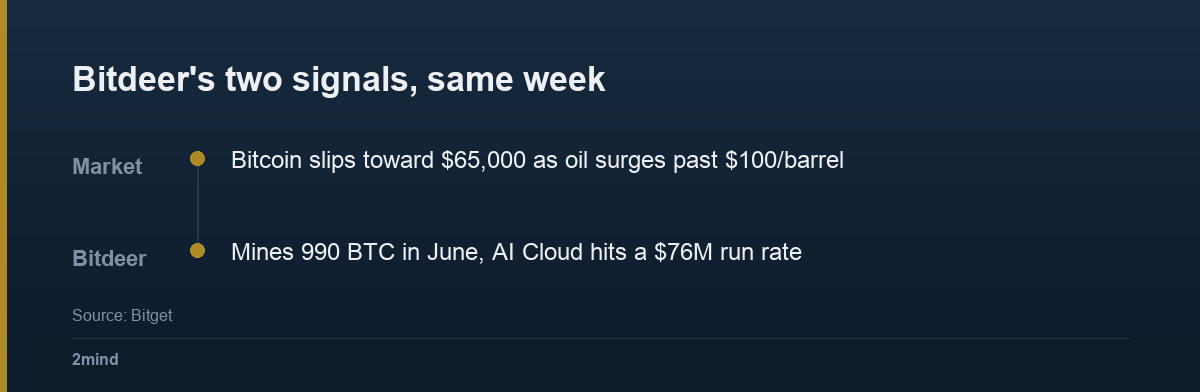
- Bitdeer mined 990 bitcoins in June while its AI Cloud unit reached an annualized revenue run rate of $76 million.
- Bitcoin itself fell toward the $65,000 range amid a broader risk-off move tied to Middle East tensions and surging oil prices.
- The 2mind read: mining profitability is no longer the only metric that matters for miner stocks — AI infrastructure revenue is becoming a parallel growth story.

What happened
Bitdeer, a publicly traded bitcoin mining company, reported that it mined 990 BTC in June.
Separately, the company disclosed that its AI Cloud division — which rents out GPU compute capacity — reached an annualized revenue run rate of $76 million.
That figure isn’t a full-year confirmed revenue number; it’s a run-rate projection based on current monthly performance, which is worth keeping in mind before drawing bigger conclusions.
The disclosure came the same week broader crypto markets wobbled. Bitcoin slipped toward the $65,000 level as Brent crude pushed past $100 a barrel on Middle East supply concerns, dragging risk assets — including the Nasdaq, which fell over 2% — down with it.
Several mining companies have been repurposing idle power and data center capacity for AI workloads over the past year.
| Segment | Metric |
|---|---|
| Bitcoin mining | 990 BTC mined in June |
| AI Cloud | $76M annualized revenue run rate |
The distinction between a run rate and confirmed revenue is worth dwelling on. A $76 million annualized figure comes from taking a recent period and multiplying it out to a full year.
A single strong or weak month can swing that number meaningfully before any audited annual figure exists.
The same-week timing with oil crossing $100 a barrel and the Nasdaq falling over 2% is also worth separating out.
Bitcoin sliding toward $65,000 during that broader risk-off move isn’t necessarily connected to Bitdeer’s AI disclosure — the two stories happened to land in the same reporting window.
Several mining companies repurposing idle power and data center capacity for AI over the past year is itself a broader trend Bitdeer’s numbers slot into.
Bitget’s report is the sole source cited for both the mining figure and the AI Cloud number, which is worth flagging given how much weight the run-rate figure is carrying in this story.
The two lenses
Lens one: mining is diversifying into a real infrastructure business. Bitcoin mining has always been a brutal, margin-thin industry — halving events cut rewards, energy costs fluctuate, and difficulty adjustments constantly squeeze profitability.
Bitdeer’s AI Cloud run rate suggests that the same data centers, power contracts, and cooling infrastructure built for mining rigs can be repointed toward GPU rental, which currently commands far steeper margins than bitcoin mining does.
If this trend holds, miners with access to cheap power and existing data center footprints have a genuine structural advantage in the AI compute shortage — one that pure-play AI cloud startups without owned infrastructure don’t have. This isn’t a marketing pivot; it’s a hardware and power arbitrage that happens to fit both industries.
Lens two: it’s a hedge born of necessity, not strategy. A more skeptical read is that miners are diversifying because bitcoin mining alone has become an increasingly unreliable revenue source, especially with price pullbacks like the one seen this week.
A $76 million run rate is a meaningful number, but it’s still a fraction of what large-scale AI cloud providers report, and run-rate figures can be volatile month to month depending on contract renewals. Framing this as a “pivot to AI” may overstate how central the AI business actually is to Bitdeer’s balance sheet today.
It could just as easily be read as risk management — a way to smooth out bitcoin’s price volatility rather than a genuine reinvention of the company.
The arbitrage argument depends on one assumption holding: that GPU rental margins stay meaningfully above mining margins for long enough to matter.
Bitcoin mining margins compress predictably around halving events and difficulty adjustments, while AI compute pricing is a newer, less-tested market.
There’s also a sequencing question worth asking: did Bitdeer build AI Cloud capacity because bitcoin economics were already weakening, or was the AI opportunity independently attractive?
The article doesn’t resolve which came first, and that ordering matters for whether this is a strategic bet or a reactive pivot.
Why it matters
For investors watching miner stocks, this matters because it changes what metrics are worth tracking. Hash rate and BTC mined per month used to be the whole story; now AI Cloud run rate is becoming a second line item that can move valuations independently of bitcoin’s price.
For the broader crypto industry, it’s a signal that infrastructure built for mining has optionality beyond crypto cycles — which could matter a lot if bitcoin prices stay depressed for an extended period, as they did this week amid the oil-driven risk-off move.
What to watch next: whether Bitdeer’s AI Cloud revenue keeps scaling in subsequent months, and whether other public miners disclose similar diversification numbers. If several miners report comparable AI revenue growth simultaneously, that would suggest an industry-wide structural shift rather than one company’s isolated experiment.
I’ll be watching whether this becomes a pattern across the sector or stays a Bitdeer-specific story.
For miner-stock investors, the practical shift is in what to model. A company reporting both hash rate and an AI Cloud run rate now has two revenue drivers that can move independently.
A bad month for Bitcoin doesn’t automatically mean a bad quarter for the stock, and vice versa.
The ‘other public miners’ comparison is also worth tracking over a longer window than one earnings cycle. A single company reporting these numbers is a data point.
Three or four doing it in the same quarter, with comparable run-rate growth, would be closer to confirmation of a genuine industry pivot.
For the broader crypto industry, it’s a signal that infrastructure built for mining has optionality beyond crypto cycles — which matters if bitcoin prices stay depressed for an extended stretch.
FAQ
Q. Is Bitdeer still primarily a bitcoin mining company?
A. Yes, mining remains its core disclosed activity, with 990 BTC mined in June, but the AI Cloud segment is now large enough to be reported as a separate revenue metric.
Q: Does a rising AI Cloud run rate mean Bitdeer is less exposed to bitcoin price swings?
A: Partially — diversified revenue can cushion volatility, but the company’s overall valuation and core business are still closely tied to bitcoin mining economics.
What would change our view
If Bitdeer’s AI Cloud run rate flattens or declines over the next two quarters rather than continuing to scale, the ‘second business line’ framing needs walking back.
It would look more like a temporary capacity-utilization play than a durable pivot. We’d also revisit this if Bitcoin mining margins recover sharply, reducing the incentive to repoint capacity toward AI.
Leave a Reply