
It’s a strange kind of admission when a company jumps 9% on the news that its own AI product isn’t using up all the computing it built.
Key Takeaways
- Meta shares rose 9.3% after the company announced plans to sell excess AI computing capacity externally, following a model similar to SpaceX’s cloud approach.
- The move suggests Meta’s internal AI demand hasn’t kept pace with the infrastructure it has already built out, prompting a search for ways to monetize the surplus.
- This connects to a broader pattern this week of AI infrastructure spending facing scrutiny over whether it can actually pay for itself.

What happened
| Company | Same-Day Stock Move | Why |
|---|---|---|
| Meta | +9.3% | Announced plan to sell excess AI computing capacity |
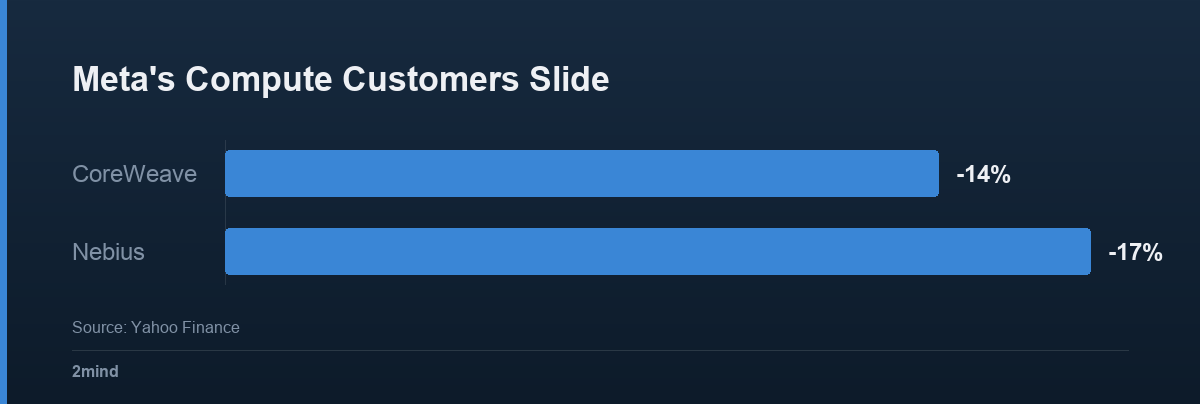
| CoreWeave | -14% | Risk of losing Meta as a compute customer |
| Nebius | -17% | Same risk |
On July 2, Meta shares jumped 9.3% after the company disclosed plans to build a cloud computing business around its excess AI infrastructure, according to Yahoo Finance.
Sizing the “excess capacity” claim against Meta’s own capex
Meta’s actual 2025 capital expenditure was $72.22 billion, according to its Q4/FY2025 earnings release. For 2026, Meta raised its guidance twice this year to a current range of $125-145 billion — up from an initial $115-135 billion forecast, per Yahoo Finance and Fortune reporting on the April 2026 earnings call. At the midpoint ($135 billion), that’s an 87% increase over 2025 spending; at the high end, it’s just over double.
| Year | Capex | Change vs. prior year |
|---|---|---|
| 2025 (actual) | $72.22B | — |
| 2026 (guidance, low end) | $125B | +73% |
| 2026 (guidance, high end) | $145B | +101% |
That trend matters for reading the “excess capacity” announcement correctly: even a low single-digit percentage of a $125-145 billion 2026 build sitting underused is billions of dollars of idle GPU capacity — enough to make selling it externally a rational capital-allocation move on its own, independent of whether Meta’s internal AI demand is falling short. The scale of the buildout, not just the demand shortfall, is why this decision is happening now.
The approach mirrors what SpaceX has done with Starlink’s spare capacity — rather than letting expensive GPU clusters sit underutilized, Meta intends to sell that computing power externally, alongside offering its AI models as a direct service.
The plan reportedly comes as Meta’s own AI products haven’t generated demand strong enough to justify the scale of infrastructure investment the company has already committed to.
This lands amid a week where AI infrastructure economics have come under closer examination more broadly. Palantir CEO Alex Karp separately criticized the “token-based” pricing model used by companies like OpenAI and Anthropic, arguing that enterprises are paying heavily for API access while handing over valuable data without getting proportional value in return.
Meanwhile, Nvidia unveiled a new continual-learning robotics system called Aspire, designed to let robots write and debug their own control code — a sign that infrastructure providers are still pushing hard on new AI applications even as demand questions swirl around existing ones.
Why CoreWeave and Nebius fell harder than Meta rose
A 9.3% jump for Meta against a 14% and 17% drop for CoreWeave and Nebius on the same day isn’t a symmetric market reaction. Investors read this less as “Meta found a smart use for spare capacity” and more as a direct competitive threat.
That asymmetry is itself a data point. Markets rewarding Meta more modestly than they punished its GPU cloud partners implies genuine uncertainty about how large a threat Meta’s move actually represents, not universal enthusiasm for the pivot.
CoreWeave and Nebius built their businesses partly on the assumption that hyperscalers like Meta would keep buying rather than building enough capacity to compete. This announcement tests that assumption directly, in public, on a single trading day.
The two lenses
Lens one: the pragmatic monetization case. Under this reading, Meta is doing exactly what any capital-intensive infrastructure operator should do — treating spare capacity as an asset rather than a sunk cost.
Data centers and GPU clusters are enormously expensive to build and maintain; if internal workloads don’t use 100% of that capacity around the clock, renting it out is simply smart capital allocation.
Cloud providers like AWS and Azure built entire empires on exactly this principle: sell compute as a service, let demand from many customers smooth out utilization. Under this view, the market’s positive reaction reflects investors rewarding capital discipline, not punishing Meta for a strategic misstep.
Lens two: the demand-shortfall warning. Under this reading, the timing matters more than the mechanism. Companies don’t typically pivot into selling infrastructure externally unless their own use case has fallen short of projections.
Meta has poured tens of billions into AI infrastructure over the past two years on the premise that its own products — recommendation engines, Llama models, advertising tools — would consume that capacity. If that’s not happening fast enough, opening a cloud business is as much a hedge against overbuilding as it is an opportunity.
This reading treats the stock jump less as celebration of a smart pivot and more as relief that management found a use for capacity that might otherwise sit idle.
The market’s reaction to Meta wasn’t universal, either — GPU cloud specialists CoreWeave and Nebius, both major Meta compute customers, fell 14% and 17% respectively the same day, as investors weighed the risk of their biggest client becoming a direct competitor.
What Karp’s criticism adds to this story
Palantir CEO Alex Karp’s complaint about token-based pricing lands on a related but separate problem: even companies not overbuilding infrastructure are questioning whether they get proportional value from what they pay AI vendors for API access.
Put together with Meta’s capacity announcement, the week’s news reads less like one company’s story and more like an industry-wide reckoning with how AI gets priced and paid for at every layer of the stack.
It’s worth noting Karp runs a company with its own stake in how enterprises spend AI budgets, so his framing isn’t disinterested. Still, the underlying complaint — that paying per token doesn’t guarantee proportional value — is one worth separating from who happens to be voicing it this week.
Why it matters
For investors, this is a signal worth tracking across the whole hyperscaler cohort, not just Meta — if internal AI demand is falling short of infrastructure buildout even at a company with Meta’s user base and ad business, it raises the question of whether the entire sector’s capex assumptions need revisiting.
For enterprise AI buyers, Karp’s criticism of token-based pricing adds a separate but related thread: the economics of consuming AI services, not just building them, are under fresh scrutiny.
Watch whether other hyperscalers follow with similar external monetization plans, and whether Meta’s upcoming earnings calls show whether this cloud pivot is generating meaningful revenue or is still an early-stage experiment.
The infrastructure boom hasn’t stopped, but the free ride on faith alone may be ending.
What Nvidia’s Aspire announcement quietly signals
Infrastructure providers unveiling new applications — like Nvidia’s Aspire robotics system — in the same stretch that demand questions swirl around existing AI products is worth noting. It suggests the industry’s answer to soft demand in one area is more product surface area, not less spending.
Whether that surface area translates into revenue Meta can point to, separate from its core advertising business, is a different question than whether the technology itself works. Both things can be true — the tech works, and the market for it is still unproven.
FAQ
Q. Why is Meta selling its AI computing capacity?
A. Meta’s own AI products reportedly haven’t generated enough demand to fully utilize the infrastructure it built, so the company is opening that capacity to external customers to help recoup investment costs.
Q. Is this similar to what other tech companies have done?
A. Yes, the approach resembles SpaceX’s model of monetizing excess capacity, and it echoes how AWS and Azure originally grew out of internal infrastructure needs.
What would change our view
If Meta’s upcoming earnings show its cloud pivot generating meaningful, growing external revenue rather than a one-time announcement, the pragmatic-monetization reading in Lens one gains real support.
It would also change if Meta’s own AI products show a sharp jump in internal compute demand in coming quarters, undercutting the idea that this move was driven by a shortfall rather than opportunism.
Sources
- [Meta Jumps 9.3% on Plans for AI Cloud Infrastructure Business] — Yahoo Finance
- [Meta Reports Fourth Quarter and Full Year 2025 Results] — Meta Investor Relations
- [Meta just bumped its 2026 capex forecast up to as much as $145 billion] — Fortune
Related from 2mind
- Meta May Rent Its AI Data Centers to Rival Anthropic
- Meta Wants to Sell Anthropic’s Claude. Why That’s Odd
- The Scientists Building AI for Scientists: Why Mirendil’s Seed Round Is More Than a Funding Story
- When Does AI CapEx Pay Back? Watch Four Clocks
- What Is Meta’s AI Strategy? Own the Assistant, Not Just the Model
Leave a Reply