I find it striking that Meta, a company that has poured tens of billions into building its own AI infrastructure, might end up renting that capacity to a direct competitor.
Key Takeaways
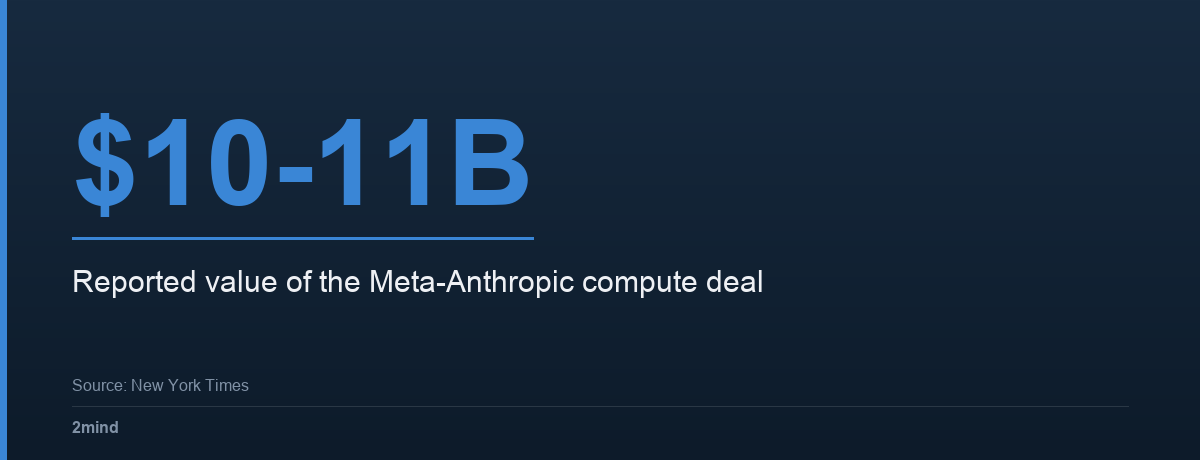
- Meta is reportedly in talks to lease high-performance AI computing capacity to Anthropic in a deal valued at roughly $10–11 billion, according to sources cited by the New York Times.
- If finalized, this would mark Meta’s first entry into the cloud computing market as an infrastructure provider rather than just an internal user.
- The deal surfaces the same day U.S. chip stocks broadly sold off, showing how tightly AI infrastructure sentiment and semiconductor markets are now linked.
What happened
The New York Times reported, citing people familiar with the matter, that Meta is in discussions to rent out substantial AI computing capacity from its data centers to Anthropic, the AI lab behind Claude and a leading rival to Meta’s own Llama models.
Meta has spent enormous sums building out data center infrastructure to support its own AI ambitions, and this potential deal would see some of that capacity monetized by leasing it to an outside party — something Meta has not done before at this scale.
If the arrangement goes through, it would effectively make Meta a cloud infrastructure provider for the first time, putting it in a position adjacent to Amazon Web Services, Microsoft Azure, and Google Cloud, all of which already lease GPU capacity to AI labs including Anthropic and OpenAI.
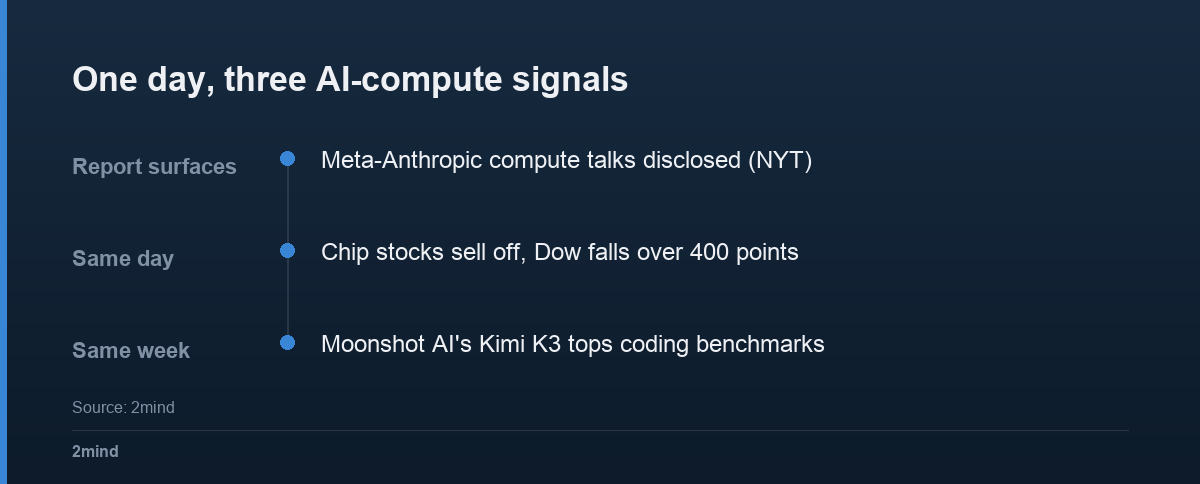
The news landed the same day U.S. markets absorbed a broad semiconductor selloff tied to renewed doubts about the AI investment cycle, compounded by escalating U.S.-Iran tensions.
The Dow fell over 400 points and the Nasdaq dropped 1.40%, with chip stocks leading the decline.
Separately, China’s Moonshot AI released an open-weight model called Kimi K3 that reportedly topped coding benchmarks ahead of both Anthropic and OpenAI’s models, rattling sentiment further.
| Company | Role in AI Infrastructure | Notable 2026 Move |
|---|---|---|
| Meta | Builder, potential new lessor | Reported talks to rent capacity to Anthropic |
| Anthropic | Model developer, compute buyer | Reportedly seeking capacity from Meta |
| AWS/Azure/Google | Established cloud lessors | Existing compute suppliers to AI labs |
What the reported range signals
One detail worth sitting with is that the reported figure isn’t a single number — it’s a range, $10 billion to $11 billion.
Deals of this scale rarely land on an exact price this early in negotiations, and a spread that wide usually means the structure, duration, capacity guarantees, pricing floors, is still being worked out between the two sides.
That the New York Times’ sourcing produced a range rather than a fixed figure is itself a sign that no contract has been signed yet.
The Kimi K3 release lands awkwardly next to this. Moonshot AI’s open-weight model reportedly topped coding benchmarks ahead of both Anthropic’s and OpenAI’s own models, the same day chip stocks sold off on renewed doubts about the AI investment cycle.
If open-weight models out of China can match or beat frontier closed models on real tasks, the premium buyers are willing to pay for exclusive compute access to labs like Anthropic gets harder to justify.
A $10-11 billion compute lease is, in part, a bet that Anthropic’s models remain worth paying a premium to run — a bet that looks slightly less certain on a week when a free alternative claims to be competitive.
The two lenses
Lens one: Smart capital efficiency. Meta has built out data center capacity aggressively to support Llama development and its broader AI ambitions, and infrastructure of this scale is enormously expensive to leave idle even partially.
Renting excess capacity to Anthropic, even a competitor, is a rational way to generate revenue from sunk costs while the market for AI compute remains tight. Every major cloud provider already profits by hosting rival AI labs — Microsoft hosts OpenAI, Amazon hosts Anthropic, Google hosts multiple labs.
Meta entering that business simply mirrors an established, profitable model. It also signals confidence that Meta’s own compute needs are being met well enough that surplus capacity exists to lease out at all.
Lens two: A tacit admission of strategic distance. The more uncomfortable reading is that this deal implicitly acknowledges Meta’s own AI models haven’t generated demand sufficient to fully absorb the infrastructure it built.
Renting compute to a rival lab that could out-compete Llama in enterprise and consumer markets is an unusual position for a company that has publicly framed AI as central to its future.
It also raises a question about where the real value sits in the AI stack — if the entity holding the physical infrastructure ends up profiting mainly as a landlord to model developers, that’s a different business than the one Meta originally set out to build.
Why it matters
This matters most for enterprise AI buyers and investors trying to gauge where compute scarcity is loosening or tightening.
If Meta, a company with its own massive AI ambitions, has excess capacity to lease, that’s a data point suggesting the GPU shortage narrative from 2024-2025 may be easing in certain segments, even as chip stocks sold off on renewed uncertainty about the investment cycle.
It also matters for Anthropic, which gains a new compute source outside the traditional AWS-Azure-Google triangle, potentially improving its negotiating leverage with existing cloud partners.
What to watch: whether this deal is finalized and disclosed with actual dollar figures, whether other model developers pursue similar arrangements with hyperscalers that have their own AI ambitions, and whether chip stock volatility continues to diverge from underlying compute demand signals.
The lines between AI lab and cloud provider are blurring faster than most forecasts assumed.
Who actually carries the downside if this doesn’t close
It’s worth being precise about what’s actually confirmed here: talks, not a signed contract. If the arrangement falls apart, Meta keeps data center capacity it already built and would need to find another buyer or absorb the idle cost itself.
Anthropic hasn’t committed capital yet by any account in the reporting, so Meta is the party carrying the downside risk if this doesn’t close.
That asymmetry matters for how to read both lenses above.
If Meta is more exposed to this deal not closing, its economic logic for pursuing the lease is stronger than a simple nice-to-have — it suggests Meta’s compute buildout has already outpaced what its own model roadmap currently needs, at least for now.
Whether Meta discloses a specific reason for that gap, rather than leaving it to be inferred from a lease with a rival, is one of the more revealing things to watch for once, or if, the deal is announced formally.
FAQ
Q. Has the Meta-Anthropic deal been officially confirmed?
A. No. The New York Times reported the talks citing unnamed sources familiar with the matter, and neither Meta nor Anthropic has publicly confirmed the terms or finalization of any agreement.
Q: Would this make Meta a direct competitor to AWS or Microsoft Azure?
A: If finalized, it would mark Meta’s entry into leasing AI compute externally for the first time, positioning it adjacent to established cloud providers, though the reported scale is far smaller than AWS or Azure’s existing AI infrastructure businesses.
What would change our view
Our reading would shift if the deal closes at a figure well below the reported $10–11 billion range, since that would suggest less genuine compute scarcity than the framing implies.
It would also change if Meta announces a pattern of similar leases to other AI labs rather than a one-off arrangement with Anthropic — that would confirm infrastructure leasing as an actual business line rather than opportunistic offloading of surplus capacity.
Sources
- CNN Business — 2026-07-17. Meta is reportedly in talks to lease AI computing capacity to Anthropic in a deal valued at roughly $10–11 billion
- CNBC — 2026-07-17. China's Moonshot AI released an open-weight model called Kimi K3 that reportedly topped coding benchmarks ahead of
Leave a Reply