I noticed something odd this week: the same month Wall Street calls AI spending a “multi-year super cycle,” Microsoft quietly disclosed the largest batch of security flaws in its history.
Key Takeaways
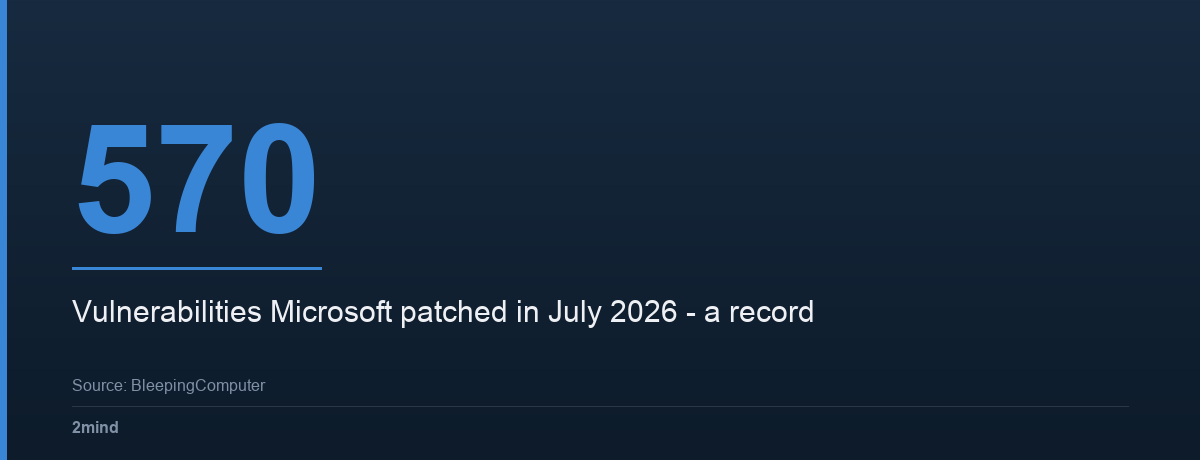
- Microsoft’s July 2026 Patch Tuesday fixed a record 570 vulnerabilities, including three zero-days already exploited in the wild and 59 rated “Critical.”
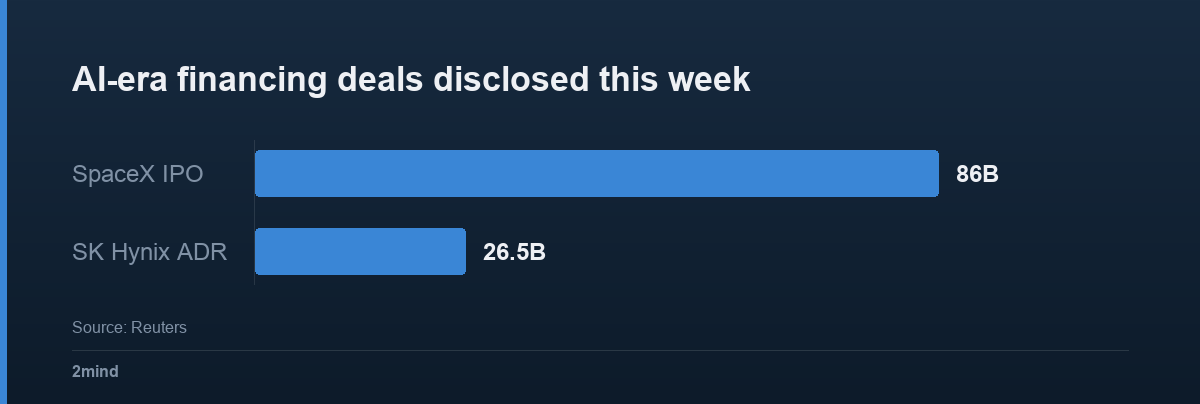
- The disclosure lands the same week Wall Street banks describe AI infrastructure spending as a “multi-year investment cycle,” with deals like SK Hynix’s $26.5 billion ADR offering and SpaceX’s $86 billion IPO fueling record banking fees.
- I read these two stories together as a warning sign: infrastructure buildout is outpacing security hardening, and nobody is being asked to slow down.
What happened
Microsoft’s July 2026 Patch Tuesday addressed 570 flaws — nearly triple June’s already-elevated count, according to CyberScoop, which described it as “the mother of all” vulnerability loads.
Of these, 48 remote code execution bugs and 59 Critical-rated issues stood out, alongside three zero-days that attackers had already found and used before the patch shipped.
BleepingComputer confirmed the same tally, noting the scale is unprecedented even by recent standards, where monthly patch batches have been trending upward for over a year.
Separately, and seemingly unrelated on the surface, Reuters reported that Wall Street banks are experiencing a surge in fee income tied to AI infrastructure financing.
Citigroup reportedly earned over $70 million from SK Hynix’s $26.5 billion ADR sale alone, and Bank of America extended OpenAI a $520 million credit line.
Goldman Sachs’ CEO called the current wave of AI infrastructure spending a “multi-year investment cycle” — language meant to reassure investors that this isn’t a short-term bubble.
| Metric | Figure |
|---|---|
| Total flaws patched (July 2026) | 570 |
| Zero-days exploited before patch | 3 |
| Critical-rated vulnerabilities | 59 |
| SK Hynix ADR offering size | $26.5 billion |
Why 570 is a number worth sitting with
Patch Tuesday releases are supposed to feel routine — a monthly cadence IT teams have built entire processes around for years. A batch this size breaks that rhythm entirely. Triaging 570 fixes, including 48 that allow remote code execution, isn’t a checklist task anymore. It becomes a full sprint.
The three zero-days matter more than their raw count suggests. Two were already being exploited before Microsoft shipped a fix, which means defenders were reacting to attacks already underway rather than closing a theoretical gap. That timing gap is usually where the real damage happens.
CyberScoop’s own framing — calling it “the mother of all” vulnerability loads — is telling on its own. Reporters who track Patch Tuesday every single month don’t reach for language like that casually. When the outlet closest to the beat calls a release unprecedented, I take that description at face value.
The two lenses
Lens one: this is normal growing pains, not a crisis. Software complexity always grows faster than the ability to fully audit it, and Microsoft’s ecosystem — spanning Windows, Azure, Office, and now a growing set of AI-integrated services — is simply larger and more interconnected than it was a few years ago.
More code surface naturally means more discovered vulnerabilities, and the fact that Microsoft is finding and patching them systematically, rather than ignoring them, is arguably a sign the disclosure process is working as intended.
Monthly vulnerability counts have been climbing steadily for over a year, and this month’s record may simply reflect better detection tooling — including AI-assisted vulnerability scanning — rather than a sudden collapse in software quality.
Lens two: infrastructure spending is outrunning security investment. The less comfortable reading is that the same AI boom generating record banking fees — SpaceX’s $86 billion IPO, SK Hynix’s $26.5 billion ADR, OpenAI’s $520 million credit line — is also expanding the attack surface faster than defenders can keep pace.
Three zero-days were already being exploited before Microsoft even shipped a fix, meaning attackers found the weaknesses first. When capital floods into AI infrastructure at this pace, security review cycles, penetration testing, and patch management don’t automatically scale at the same rate.
It’s a pattern security researchers have flagged before: rapid infrastructure growth without matching investment in defensive tooling tends to produce exactly this kind of vulnerability pileup.
Who ends up absorbing the cost
Microsoft doesn’t carry the operational weight of 570 fixes by itself. Enterprise security teams do — reading changelogs, testing patches against internal systems, and deciding what gets deployed first when three items are already being actively exploited in the wild.
None of the financing deals in this story — SK Hynix’s ADR, SpaceX’s IPO, OpenAI’s credit line — carry a line item for security review capacity growing at the same pace as the infrastructure itself. That mismatch doesn’t show up in a quarterly earnings report. It shows up in a Patch Tuesday like this one.
Why it matters
Enterprise IT teams now face one of the largest single-month patch loads in Microsoft’s history, and prioritizing which of the 570 fixes to deploy first — especially the three actively exploited zero-days — is a real operational burden this week.
For the broader AI infrastructure narrative, this is worth watching alongside the financing boom: as more capital pours into AI-linked hardware, cloud, and software stacks, the question of who is auditing security at the same pace becomes harder to ignore.
I’d watch whether next month’s patch counts continue climbing, and whether any of the actively exploited zero-days get tied back to AI-related enterprise tools specifically.
Neither of these stories, on their own, is alarming. Together, they’re a reminder that growth and security don’t automatically move in lockstep.
The pattern this echoes
This isn’t the first time infrastructure spending and security investment have diverged. Whenever capital floods a sector fast — cloud migration in the 2010s, mobile app growth before app-store review matured — audits and testing tend to catch up only after avoidable incidents force the issue.
The AI financing boom described in the banking numbers this week doesn’t have that grace period yet. If patch loads like this one become a recurring feature rather than a one-off, the catch-up phase arrives sooner rather than later, and probably at a higher cost than doing it proactively would have been.
FAQ
Q. Were the Microsoft zero-days used in real attacks?
A. Yes — Microsoft confirmed that two of the three zero-days had already been exploited in active attacks before the patch was released, with a third publicly disclosed but not yet confirmed as exploited.
Q. Is this Patch Tuesday connected to the AI investment boom directly?
A. Not directly confirmed — there’s no official link stated by Microsoft, but both stories reflect the same underlying dynamic of rapid technology infrastructure expansion outpacing traditional oversight processes.
What would change our view
If next month’s patch count drops back toward historical norms, or Microsoft attributes this spike to a one-time clearing of previously unreported issues, the security-blind-spot reading gets weaker. It would also change if the exploited zero-days turn out unrelated to any AI-adjacent product, since that would sever the link we’re drawing here.
Sources
- [Microsoft July 2026 Patch Tuesday fixes massive 570 flaws, 3 zero-days] — BleepingComputer
- [Microsoft discloses ‘the mother of all’ vulnerability loads, tripling June’s previous record] — CyberScoop
- [Wall Street banks see AI ‘super cycle’ set to boost deals, financing] — Reuters
Leave a Reply