
There’s something slightly uncomfortable about a company that spent billions building its own model turning around to sell a rival’s.
Key Takeaways
- Meta is reportedly exploring direct distribution of Anthropic’s Claude model, positioning itself as a neocloud provider alongside Microsoft, AWS, and Google.
- A separate industry metric tracking total AI token spending has posted its first-ever decline, sparking debate over whether this reflects a bubble or a natural demand shift.
- Together, these signals suggest the AI industry’s competitive battleground is quietly shifting from “who builds the best model” to “who controls distribution and pricing.”
What happened
| Company | Model strategy |
|---|---|
| Microsoft (AI Foundry) | Hosts multiple third-party models |
| AWS (Bedrock) | Hosts multiple third-party models |
| Google (Vertex AI) | Hosts multiple third-party models |
| Meta (reportedly) | Exploring offering Anthropic’s Claude alongside its own Llama |
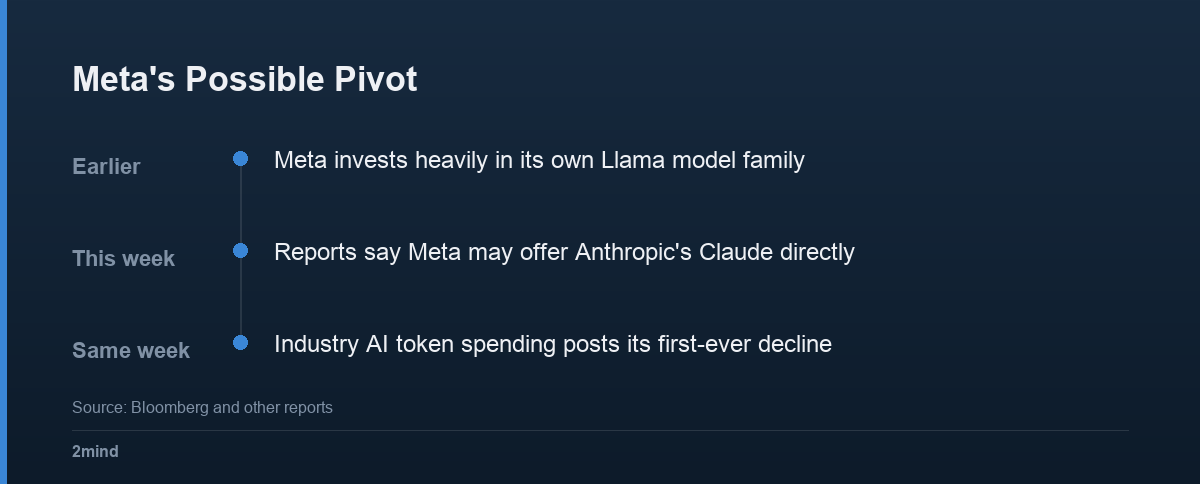
Reports this week suggest Meta is preparing to offer Anthropic’s Claude model directly through its own infrastructure, following earlier speculation that Meta might enter the neocloud market altogether.
If accurate, this would put Meta in the same business as Microsoft’s AI Foundry, AWS’s Bedrock, and Google’s Vertex AI — platforms that host and resell top-tier third-party models rather than relying solely on in-house development.
Meta has invested heavily in its own Llama model family, which makes a pivot toward reselling a competitor’s model a notable strategic shift, even if it’s additive rather than a replacement.
Separately, a closely watched industry metric tracking total spending on AI tokens — the units companies pay for when running AI model queries — has posted its first decline, according to Bloomberg. The interpretation is split.
Some analysts point to weakening pricing power among AI vendors, a shift toward cheaper models, and tightening government regulation as the drivers. Others read it as a natural correction rather than evidence of a broader bubble popping.
Where Meta would sit next to Microsoft, AWS, and Google
The comparison makes the strategic shift concrete: Microsoft, AWS, and Google all built their neocloud businesses around hosting multiple third-party models rather than betting exclusively on one in-house family.
Meta following that path with Claude alongside Llama would put it in the same business model as three companies it competes with directly for enterprise AI spending.
That’s a different competitive posture than trying to win purely on model quality — it’s a bet on owning distribution regardless of whose model a customer ultimately prefers.
It’s also worth noting this remains a report, not a confirmed launch. Meta has invested heavily in Llama, and a shift like this would be a meaningful reversal even if the two efforts run in parallel.
If it happens, developers choosing between Llama and Claude on the same infrastructure would effectively be voting with usage data on which model they trust more for a given task.
Enterprise buyers, for their part, would gain a genuine side-by-side comparison instead of relying on separate marketing claims from Meta and Anthropic about which model performs better.
The two lenses
Lens one: this is smart, capital-light diversification. If Meta becomes a neocloud reseller of Claude, it doesn’t need to abandon Llama — it can offer both, capturing revenue from developers who prefer Anthropic’s model while still investing in its own.
This mirrors what Microsoft and Amazon already do successfully: hosting infrastructure is a business model distinct from model development, and the margins on distribution can be attractive even without owning the underlying IP.
Combined with softer AI token spending, this could actually represent healthy market maturation — enterprises becoming more price-sensitive and diversifying which models they use, rather than blindly scaling spend on any single provider. That’s a sign of a market growing up, not breaking down.
Lens two: this is a hedge born of uncertainty, not confidence. A company reselling a competitor’s flagship product is also a tacit admission that its own model isn’t winning enough enterprise mindshare on its own.
Pair that with the first-ever drop in AI token spending, and a less comfortable reading emerges: demand for premium AI compute may be softening faster than headline enthusiasm suggests, pushing even well-capitalized players like Meta toward diversified, lower-risk revenue streams instead of doubling down on proprietary model supremacy.
If token spending continues declining through the next quarter, that would be a much harder signal to explain away as a mere “correction.”
What a ~20% drop from the May peak actually measures
The Silicon Data LLM Token Expenditure Index, down roughly 20% from its May high according to Bloomberg’s reporting, tracks dollars spent on AI queries — not usage volume, and not model quality.
Those are different things that tend to get conflated when a spending index falls. A falling dollar figure is consistent with either explanation on the table.
Enterprises could be running the same volume of queries through cheaper models, which would show up as lower spending without any drop in actual usage.
Or genuine demand could be softening. The index alone can’t distinguish between those two stories.
That’s exactly why this is being described as a first-ever decline worth debating rather than a settled signal of a bubble popping.
None of this settles the bubble debate. It does mean anyone citing the ~20% drop as proof of collapsing demand is filling a gap the index itself doesn’t close.
Why it matters
Enterprise buyers evaluating which AI platform to build on should watch whether more hyperscalers start reselling rival models — it signals commoditization at the model layer, which could eventually translate into lower prices for end users.
Developers and startups relying on token-based pricing should watch the next few months of spending data closely, since a continued decline would affect assumptions baked into current AI infrastructure investment plans.
As we discussed in our recent coverage of AI infrastructure spending, the gap between capex announcements and actual usage data is exactly where the next real story is likely to emerge.
I don’t think this settles the bubble debate either way. But it’s a good reminder that distribution strategy, not just model quality, is where the next phase of competition will actually play out.
FAQ
Q. Does this mean Meta is giving up on its own Llama models?
A. No — reports suggest Meta would offer Claude as an additional option alongside Llama, similar to how other hyperscalers host multiple third-party models without abandoning their own.
Q. What does a decline in “AI token spending” actually measure?
A. It tracks the total dollar amount enterprises and developers spend purchasing AI tokens, the billing unit for running queries through AI models, making it a rough proxy for overall demand and pricing trends across the industry.
What would change our view
My view leans toward this being a demand-and-distribution story worth taking seriously, not dismissing as noise.
That would soften if the token spending index rebounds in the next quarter, which would support the pricing-correction reading over the softening-demand one.
It would also soften if Meta’s reported interest in distributing Claude turns out to be preliminary talk that doesn’t result in an actual launch.
And it would firm up if other hyperscalers follow with their own multi-model resale strategies at the same time spending data stays soft, tying the two threads together more directly.
Sources
- SemiAnalysis — 2026-07-03. Meta is exploring direct distribution of Anthropic's Claude model as neocloud provider
- Bloomberg — 2026-07-03. AI token spending index posted first-ever decline from May peak
- Bloomberg — 2026-07-03. Silicon Data LLM Token Expenditure Index is down ~20% from May high
Leave a Reply