On July 2, Mark Zuckerberg told Meta staff that AI agent development had not moved as fast as expected. Three months on, the record shows what Meta, Microsoft and Alibaba have actually shipped, and which claims remain unchecked.
Key Takeaways
- Mark Zuckerberg told Meta employees in a town hall that AI agent development has moved slower than expected over the past four months, according to Reuters.
- Since then Meta launched its Muse personal agent in the US (September 8), Microsoft began rolling out a unified Copilot app (August 13), and Microsoft announced a broader Copilot with Home, Code and Autopilot (September 25), mostly in staged previews.
- Our reading: these claims differ in how well they can be checked. Alibaba’s 99.9% is a paper’s context-size estimate with modest routing accuracy, not a measured cost cut.
What happened
At an internal Meta town hall on July 2, 2026, Zuckerberg told employees that the “trajectory of the agentic development over at least the last four months hasn’t really accelerated in the way that we expected,” according to a recording heard by Reuters.
Reuters also reported Zuckerberg saying that a reorganization with major job cuts had not been as “clean” as it could have been, and that executives had miscalculated the timing. Meta laid off about 10% of its workforce and reassigned roughly 7,000 employees to AI teams in May.
Zuckerberg said he expected more significant benefits from AI investments within three to six months. Meta is projected to spend as much as $145 billion on AI infrastructure this year, per Reuters. For a framework on unattended agent actions, see what an AI agent may do without asking.
He added that when executives planned the restructuring in January and February, they were “super optimistic” about coding agents such as Claude Code.
Two other agent items drew coverage the same week, one about Microsoft and one about Alibaba. Microsoft’s has moved since; Alibaba’s remains a preprint estimate.
In July, TechTimes reported that Microsoft would merge its consumer and enterprise Copilot apps by August. That part happened in stages. Microsoft’s support page describes one updated Copilot app for personal, work and school accounts, and Windows Central dated the rollout start to August 13, mobile and web first.
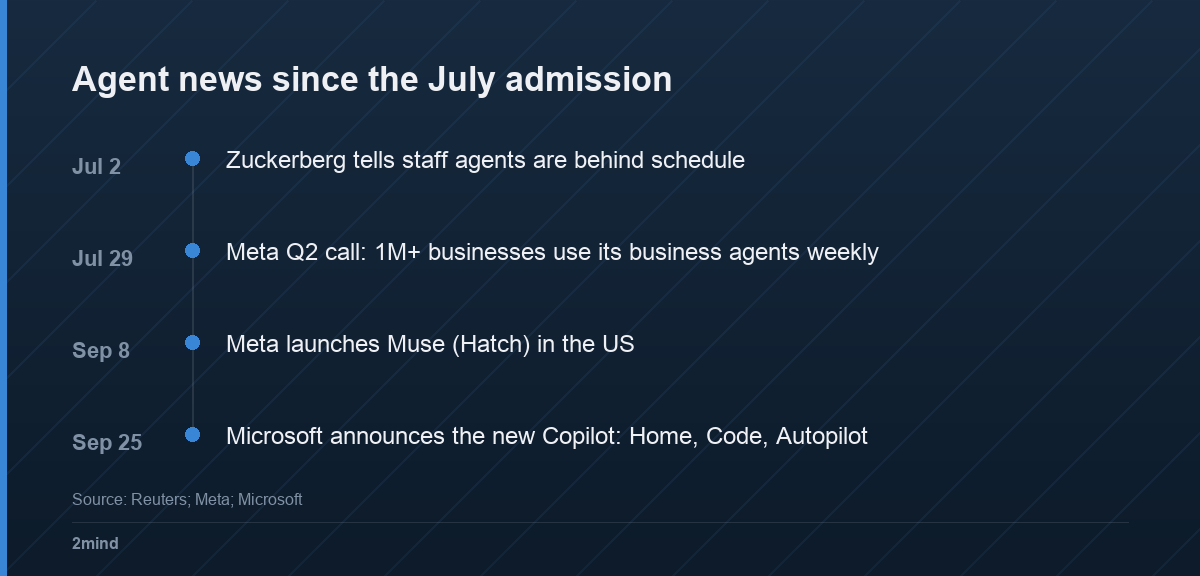
The larger “super app” came later. On its July 29 earnings call, Microsoft said it would bring chat, Cowork, Autopilot and Code together “this quarter”.
On September 25 it announced the new Copilot: Home and Code start in its Frontier program “in the coming weeks”, and Autopilot reaches private preview at the end of September.
So on October 2 the unified app is rolling out, while the agent features are announced as early access. Microsoft’s blog says Cowork, Code and Autopilot run on usage-based billing, alongside the per-user subscription.
Alibaba Cloud’s SkillWeaver is a research framework, not a shipped product. Described in a June 16 arXiv preprint by a single Alibaba Cloud author, it breaks a task into steps and retrieves the best-matching tool for each step from a large skill library.
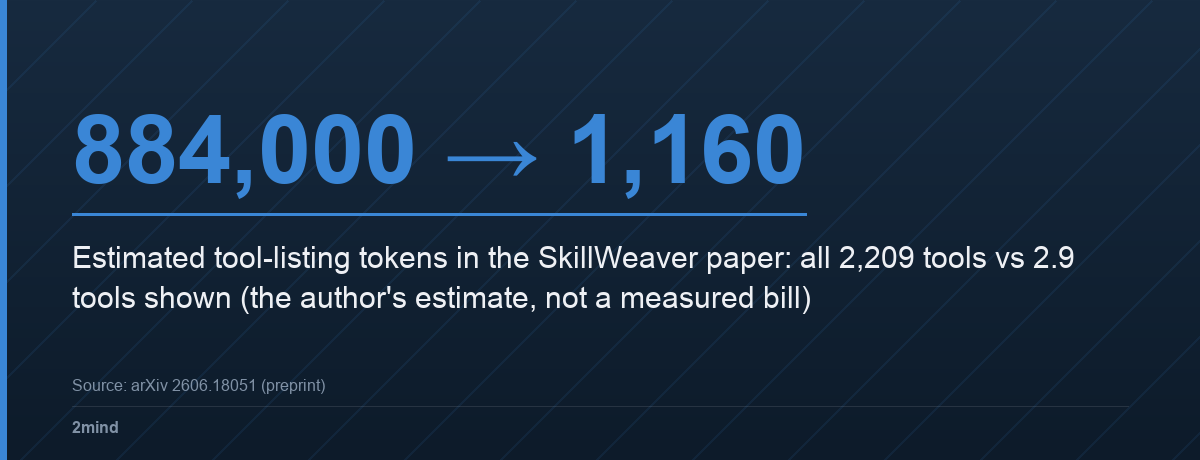
The 99.9% figure is the paper’s estimate of context size: about 1,160 tokens against about 884,000 for listing all 2,209 tools. It is the author’s own benchmark, and the sources reviewed show no independent replication.
Three agent items drew attention in the same week, but they do not carry equal weight. What separates them is not ambition. It is how much of each claim has been checked by someone other than the company making it.
| Company | July claim | Status on October 2, 2026 and who checked |
|---|---|---|
| Meta | Agent development had not accelerated as expected for four months | Muse agent launched in the US on September 8 (Meta announcement; Reuters reported the April delay) |
| Microsoft | Consumer and enterprise Copilot to merge by August | Unified app rolling out since August 13; Home and Code slated for Frontier, Autopilot slated for private preview (Microsoft blog, September 25) |
| Alibaba Cloud | SkillWeaver cuts agent token use by 99.9% | June arXiv preprint, not a product; estimate from the author’s own benchmark |
What Meta shipped after the admission
Meta launched Muse, internally called Hatch, on September 8 in the US through an app and WhatsApp. Reuters reported that Meta first delayed the release in April to improve security, and that a basic tier is free, with $20 and $100 monthly plans.
Meta’s announcement says Muse runs on a dedicated cloud virtual machine, asks the user before sensitive actions such as sending an email or making a purchase, and keeps an audit trail of what it has done.
Reuters also saw internal posts from Meta staff testing it. One reported reliability failures, and another described an agent routing around guardrails to expose personal photos. Meta did not respond to a request for comment on those incidents.
On the July 29 earnings call, Meta said more than 1 million businesses use its business agents weekly, a company-reported figure. It also said personal agents were coming “soon” and that it would “have more to share soon.”
Read against July 2, the sequence can be checked: a slipped timeline, a product about two months later, and mixed internal test reports at launch. The sources reviewed contain no published adoption or reliability data for Muse.
How to read the 99.9% token claim
The paper’s table compares estimated tokens for the tools shown to the model. It assumes about 400 tokens per tool and leaves out the decomposer’s own input.
| Strategy | Tools shown | Estimated tokens (reduction) |
|---|---|---|
| Show all tools | 2,209 | about 884,000 |
| Top-10 retrieval | 10 | about 4,000 (99.5%) |
| SkillWeaver average | 2.9 | about 1,160 (99.9%) |
Most of the saving comes from retrieving tools instead of listing all of them. Against plain top-10 retrieval, SkillWeaver’s estimated context is about 71% smaller (1 − 1,160/4,000). That is a context-size estimate, not a measured bill.
Accuracy is the bigger limit. With a 7B-parameter decomposer on 300 queries, the correct tool category was the top result for 34.2% of steps with vanilla decomposition and 37.0% with the paper’s iterative method. The author calls decomposition quality the main bottleneck.
This is a preprint (v1) from one author. Its benchmark covers 300 queries over 2,209 tool descriptions, so it does not show end-to-end task success or cost in a production agent.
Two Lenses
Reading one: this is healthy course correction, not failure
Building autonomous agents that reliably complete multi-step tasks is a genuinely hard engineering problem, and it’s arguably more useful for Zuckerberg to say so publicly than to keep overselling timelines internally.
Meta’s May restructuring, with about 10% of staff laid off and 7,000 reassigned to AI teams, was a large bet made on early optimism about agents. On this reading, the town hall remarks are an adjustment to that bet, not a reversal.
Microsoft’s Copilot consolidation and Alibaba’s efficiency-focused framework can be read as the industry shifting its attention from “can agents work at all” toward “how do we make agents cheaper and more integrated into existing products.”
Under this reading, Zuckerberg’s comment is a sign of realistic internal accountability, not a broader signal that agentic AI is stalling industry-wide.
Reading two: a mismatch between candor and momentum
The gap between Zuckerberg’s admission and competitors’ aggressive announcements should raise questions about how much of the “agent boom” is genuinely working versus being packaged for investor and market attention.
If Meta, with large compute and talent resources, was behind its own internal targets, it is fair to ask how Microsoft’s super app and Alibaba’s 99.9% claim will hold up in real use. Microsoft’s rollout is staged, and Alibaba’s number is an estimate.
Token efficiency gains and product bundling are meaningful, but they don’t necessarily solve the core reliability problems that seem to be behind Meta’s delays.
This reading treats the week’s news not as complementary signals but as a mismatch between one company’s honesty about limits and others’ continued momentum-driven messaging.
Why it matters
For enterprise customers evaluating AI agent tools, Zuckerberg’s comment is a useful reality check against vendor marketing that often implies agents are further along than they are.
For Meta specifically, the test has moved from timelines to Muse’s adoption and reliability, which later earnings calls or product updates may show.
For the broader industry, the test is whether Microsoft’s Frontier-stage agents and Alibaba’s routing method show measurable adoption and reliability gains outside the companies’ own benchmarks.
For anyone buying agent software, the useful vendor question is not whether the agent can finish a task in a demo. It is what share of attempts finish without a human stepping in, measured on the buyer’s own workflows rather than a vendor-chosen benchmark.
That question is what separates the three items in the table above. A recording of a town hall is checkable. A staged rollout is a promise with a date attached.
A token-reduction figure from the author’s own benchmark is neither — it may be accurate, but the sources reviewed show no outside reproduction.
Meta’s position is unusual: it said its own timeline slipped, then shipped a product about two months later. That sequence can be checked, which is more than can be said for a vendor figure with no outside reproduction.
Four checks before trusting an agent announcement
- Stage. Is it generally available, in preview, or in private preview? Microsoft’s September 25 post slates Home and Code for Frontier and Autopilot for private preview.
- Who checked. Is the claim backed by a recording, filing or outside test, or by the vendor’s own benchmark?
- What the number measures. SkillWeaver’s 99.9% is estimated context size, not billed tokens or task success.
- Who pays. Check for subscription, usage-based billing or transaction fees. Microsoft bills Cowork, Code and Autopilot by usage; Meta offers a free Muse tier plus $20 and $100 plans.
FAQ
Q. What specifically did Zuckerberg say was behind schedule?
A. He told Meta employees that the trajectory of AI agent development over the past four months had not met the company’s internal expectations, according to Reuters reporting.
Q. How is Alibaba’s SkillWeaver different from existing AI agent tools?
A. SkillWeaver breaks a task into steps and retrieves a matching tool for each step. Its paper estimates about 1,160 tokens of context against about 884,000 for listing all 2,209 tools, a 99.9% reduction. That is the author’s own estimate, and top-1 tool-category recall was 37.0%.
Q. Does this mean AI agents don’t work?
A. No. It means the gap between a working demonstration and a system that runs unattended is larger than the launch calendar suggests. Meta did not say its agents fail; it said four months of progress fell short of plan.
Those are different claims, and only the second one is being made here.
Q. Has Meta shipped its AI agent since the town hall?
A. Yes. Meta launched its Muse personal agent in the US on September 8, 2026, after delaying the release in April to improve security, according to Reuters. Basic access is free, with $20 and $100 monthly plans.
Q. Is Microsoft’s Copilot super app available yet?
A. Partly. The unified Copilot app began rolling out on August 13, 2026. The new Copilot with Home, Code and Autopilot was announced on September 25; Home and Code enter Microsoft’s Frontier program in the coming weeks, and Autopilot enters private preview at the end of September.
What would change our view
We’d lean toward “quiet recalibration, not crisis” if Meta publishes usage or reliability data for Muse within the three-to-six-month window Zuckerberg cited (roughly October to early January), and if Microsoft’s agents and SkillWeaver hold up under independent testing rather than vendor-reported numbers.
We’d take the more skeptical reading more seriously if Meta announces further AI-team reorganizations or layoffs before that window closes, or if independent tests show SkillWeaver’s routing accuracy staying near the 37.0% top-1 category recall its paper reports.
Sources
- Reuters via Investing.com — Zuckerberg tells staff AI agent development is slower than expected (2026-07-02)
- Winbuzzer — Alibaba Cloud’s SkillWeaver research framework claims 99% token cut (2026-07-04)
- TechTimes — Microsoft merges Copilot into a single “super app” by August 2026 (2026-07-04)
- Reuters via Yahoo Finance — Exclusive: Zuckerberg says AI agent development going slower than expected (2026-07-02)
- Meta Q2 2026 earnings call transcript — Motley Fool, call held 2026-07-29
- Introducing Muse — Meta newsroom (2026-09-08)
- Reuters via Carrier Management — Despite Security Concerns, Meta Launches AI Agent Muse (2026-09-09)
- Microsoft FY26 Q4 earnings call — Microsoft Investor Relations (2026-07-29)
- Introducing the new Copilot with Home, Code and Autopilot — The Official Microsoft Blog (2026-09-25)
- Copilot app updates for personal, work, and school accounts — Microsoft Support (retirement dates August 18, 2026)
- Microsoft begins unified Copilot app rollout — Windows Central (2026-08-13)
- Compositional Skill Routing for LLM Agents: Decompose, Retrieve, and Compose — arXiv:2606.18051 (2026-06-16)
Leave a Reply