
I noticed something odd today: a $216 million bitcoin sale from one of its most loyal corporate holders barely mattered by the end of the day, because eleven words from a politician moved the price more than the sale did.
Key Takeaways
- Strategy sold roughly $216 million worth of bitcoin between June 29 and July 5, its second sale of the year, breaking its long-standing “never sell” narrative.
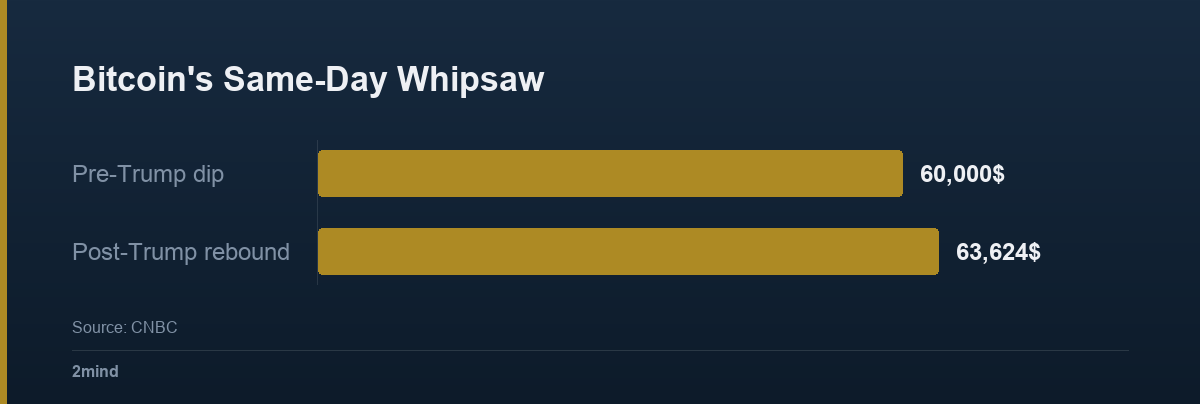
- Bitcoin fell over 2% toward $60,000 on the news, then rebounded 1.5% to $63,624 after President Trump said he’d “become a big crypto guy.”
- The 2mind read: bitcoin’s price action today was driven more by sentiment and single-speaker influence than by any structural or fundamental shift.
What happened
| Period | Amount sold |
|---|---|
| Jun 29-30 | $80.8 million |
| Jul 1-5 | $135.5 million |
| Total | $216 million |
Strategy, the corporate treasury firm led by Michael Saylor, disclosed in a regulatory filing that it sold about $80.8 million worth of bitcoin between June 29 and 30, followed by another $135.5 million between July 1 and 5.
That brings its total holdings to roughly 843,775 bitcoin, worth about $52.1 billion at the time of writing.
Its average cost basis now sits at $75,476 per coin — meaning the firm is holding at an unrealized loss relative to current prices.
The sale rattled markets because Strategy’s entire public identity was built on the promise of never selling. Barclays analyst Ajay Rajadhyaksha called it “a significant hit to sentiment,” noting the company also unveiled a new policy framework permitting future sales “for capital allocation purposes.” Bitcoin dropped over 2% toward the $60,000 level in early trading.
Then, at a news conference, President Trump was asked whether bitcoin might be added to Trump Accounts and responded, “Well… I’ve become a big crypto guy.” Bitcoin reversed course, climbing 1.5% on the day to close at $63,624.44.
The cost-basis detail is easy to skim past, but it’s the number that gives this story its edge. An average cost basis of $75,476 against a price near $60,000-$63,000 means Strategy’s holdings were sitting at an unrealized loss at the moment it sold — a different context than selling from comfortable profit.
The FAQ answer notes these sales were tied to preferred stock dividend obligations. That suggests the sale wasn’t a pure strategy pivot but partly a liquidity mechanism tied to how Strategy has financed its bitcoin accumulation — through debt and preferred equity that carry their own periodic cash requirements, separate from bitcoin’s price.
The $52.1 billion current valuation of the holdings, against roughly $216 million sold, puts the sale at well under half a percent of the total position — worth holding in mind alongside the sentiment reaction, since the market’s response was clearly about what the sale signaled, not its size.
The two lenses
Lens one: the narrative has genuinely cracked. Strategy’s business model was never really about bitcoin’s technology — it was about conviction. Saylor’s promise to buy and hold “at any price” gave institutional investors a psychological anchor: if the largest corporate holder never sells, then bitcoin has a floor built on discipline rather than just demand.

That anchor is now visibly loosened. A “capital allocation” framework that permits future sales is a different company than the one that built its brand on refusal to sell. For investors who bought MSTR stock or bitcoin itself partly on the strength of that discipline, this is a real repricing of risk, not noise.
Lens two: this is a single afternoon’s mood swing, not a structural event. $216 million is a rounding error against Strategy’s $52.1 billion in holdings — it didn’t need to sell for solvency reasons, and the amount is trivial next to bitcoin’s daily trading volume.
That the price recovered fully within hours, on the back of an offhand comment from a politician, suggests the market’s floor right now is sentiment-driven and reactive, not calculated. If a single quote can erase a 2% drop instantly, the drop itself probably wasn’t really “about” fundamentals to begin with.
Lens one and Lens two are really arguing about what ‘never sell’ was supposed to mean. If it described Strategy’s investment philosophy, a $216 million sale tied to dividend obligations doesn’t necessarily contradict it. If it was a specific promise investors priced in, any sale — regardless of size or reason — breaks something that can’t be un-broken.
Barclays’ Rajadhyaksha called it a hit to sentiment rather than to the balance sheet, and that distinction matters. Sentiment repricing can happen even when the underlying numbers are immaterial, because part of what investors were buying was certainty in the policy, not just exposure to bitcoin’s price.
Both lenses can coexist across different time horizons: the sale can be immaterial to Strategy’s solvency this quarter and still mark a real inflection point in how the company talks about its own bitcoin holdings going forward, which is the part markets tend to price first.
Why it matters
Corporate treasury holders of bitcoin, and anyone tracking MSTR as a proxy for institutional conviction, should watch whether this becomes a pattern rather than a one-off.
One sale under a new “capital allocation” policy is notable; a second or third sale under that same framework would confirm a real strategic shift rather than a liquidity event tied to preferred dividend obligations.
Separately, the fact that a presidential soundbite can outweigh an $216 million institutional sale in same-day price action says something about where bitcoin’s price discovery currently sits — closer to headline reaction than to steady accumulation flows.
Retail holders, ETF investors, and anyone using MSTR as a bitcoin proxy should treat today’s volatility as a reminder that sentiment sensitivity remains high, regardless of the medium-term thesis they hold.
I’ll be watching Strategy’s next filing more closely than I would have a month ago.
Trump’s comment reversing a 2% drop within the same session is also a data point about how thin current price discovery can be around headline-driven moments. Eleven words from one public figure outweighing an institutional sale eight figures larger than most retail trades says something about where marginal price-setting currently happens.
For anyone using MSTR as a bitcoin proxy specifically because of the ‘never sell’ thesis, this is the moment to reread the actual investment case rather than the marketing framing — the holdings are still enormous, but the policy that made the stock behave differently from a simple bitcoin wrapper has now formally changed.
I’d also flag the asymmetry in how these two forces get covered. An $216 million institutional sale generated days of analysis; a single quote took hours to move price back. That gap says something about which kind of signal currently carries more weight in bitcoin’s price discovery.
FAQ
Q. Did Strategy sell because it needed cash?
A. The filing indicates the sale was tied to funding preferred stock dividend obligations and liquidity needs, not distress selling of core holdings.
Q: Does this mean Strategy is abandoning its bitcoin strategy?
A. Not based on current disclosures — its holdings remain at roughly 843,775 bitcoin, still one of the largest corporate positions in existence, but the new “capital allocation” framework does formally open the door to future sales.
What would change our view
If Strategy sells again under the new capital allocation framework within the next few filings, that would confirm this as a structural shift rather than a one-off liquidity event tied to dividend timing.
If the next several disclosures show no further sales, the one-off reading in Lens two would hold up better instead.
Sources
- [Bitcoin rebounds after Trump says he’s become ‘a big crypto guy’] — CNBC
- [Crypto SWOT: New nonprofit aims to accelerate institutional Ethereum adoption] — Kitco
Leave a Reply