I keep coming back to one question when I see stablecoin issuance numbers spike: who actually benefits when liquidity concentrates on a single chain?
Key Takeaways
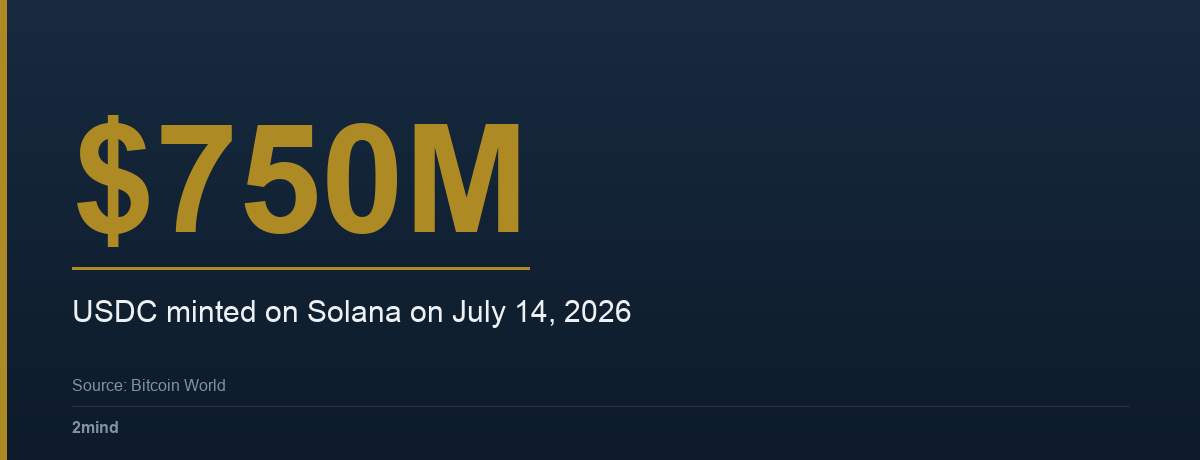
- Circle minted roughly $750 million in USDC on the Solana network on July 14, taking the year’s USDC minted on Solana to about $68 billion.
- It reinforces Solana’s positioning as a stablecoin settlement hub, arriving the same week the UK overhauled its DeFi tax rules and the US and UK issued a joint stablecoin roadmap.
- I read this less as a “Solana pump” story and more as evidence that stablecoin rails are becoming the real battleground beneath the price charts.
What happened
Circle issued approximately $750 million in new USDC directly on Solana on July 14, lifting the year-to-date total minted on the chain to roughly $68 billion. Solana’s native token firmed modestly on the news.
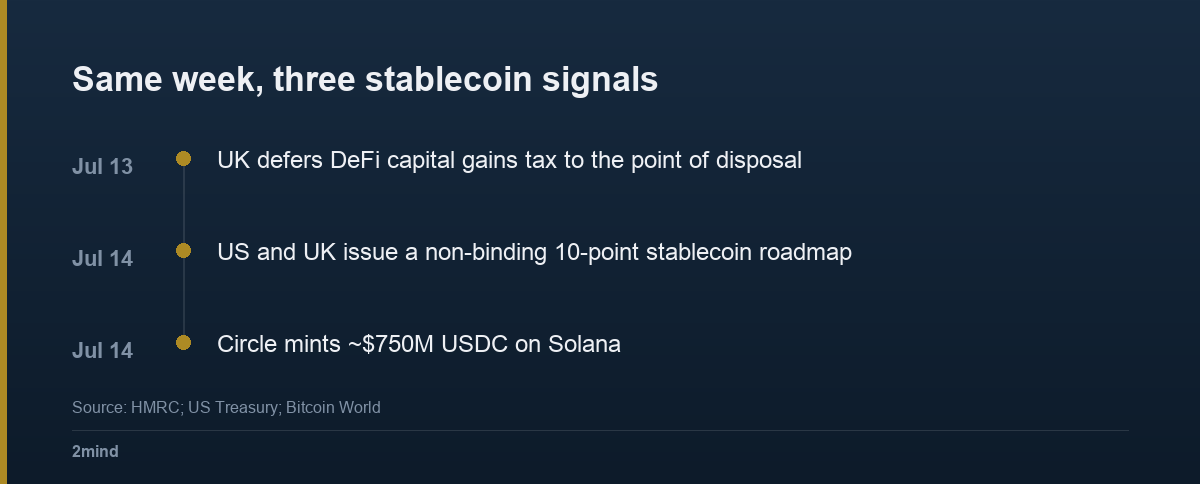
This isn’t Solana’s first large USDC mint, but the size and timing matter — it lands the same day the US and UK Treasuries issued a joint statement on stablecoins, a non-binding 10-point roadmap rather than new rules, and a day after the UK’s tax authority replaced its “dry tax” on DeFi deposits with “no gain, no loss” treatment, deferring capital gains until the position is actually exited.
None of these three events are formally connected. But they point in the same direction: stablecoins are shifting from a crypto-trading convenience into infrastructure that governments and issuers are actively shaping.
| Development | What changed |
|---|---|
| Solana USDC mint | ~$750M issued on July 14 |
| US-UK joint statement | Non-binding 10-point roadmap; no new binding rules |
| UK DeFi tax reform | “No gain, no loss” — tax deferred to disposal, from April 2027 |
Why the timing lines up the way it does
Three announcements landing within 48 hours of each other — Circle’s mint on July 14, the US-UK joint statement the same day, and the UK’s DeFi tax reform the day before — is enough clustering that I looked for a coordinated explanation.
I didn’t find one in the reporting. Circle, the US and UK Treasuries, and the UK’s tax authority answer to different processes and different timelines.
The overlap looks more like several institutions independently treating mid-July as a natural moment to act, rather than a single coordinated push.
None of the three institutions involved has described the timing as deliberate, and treating it that way would be reading more coordination into the calendar than the sources actually support.
The two lenses
Lens one: Solana wins the liquidity race. From this angle, the $750 million mint is a vote of confidence in Solana’s transaction speed and low fees for stablecoin settlement — the exact use case that matters most for payments, remittances, and on-chain trading desks that need to move dollars quickly.
Solana has been steadily closing the gap with Ethereum in stablecoin supply for months.
If issuers keep choosing Solana as a preferred minting venue, it compounds: more USDC on Solana means more liquidity for DEXs, more activity for validators, and a stronger case that Solana is becoming the default settlement layer rather than just a trading chain.
The token price reaction, while modest, reflects that issuers’ choices are read by the market as a signal of where real usage is heading — not just speculation.
Lens two: this is Circle’s decision, not Solana’s victory. The more cautious reading is that USDC minting decisions are made by Circle based on demand from exchanges, market makers, and institutional clients — not as an endorsement of Solana’s technology per se.
Large mints can also be redeemed or bridged elsewhere within days, meaning a single issuance event tells us little about sustained demand.
It’s worth remembering that stablecoin supply on any given chain is fluid; issuers mint and burn based on where their clients want liquidity right now, and that can shift quickly if incentives change on a competing chain. Treating one mint as a structural shift in Solana’s favor risks over-reading a single data point.
What a non-binding roadmap actually commits anyone to
It’s worth being precise about what the US-UK joint statement is: a 10-point roadmap, not new binding rules.
That distinction matters because neither government has actually changed what issuers or exchanges are required to do yet — this is a signal of coordinated intent, not a regulatory shift you’d trade around.
The UK’s DeFi tax change is the more concrete move of the two, since it has an actual effective date, April 2027, and changes real tax treatment rather than stating a shared direction.
Why it matters
For traders and builders on Solana, more USDC liquidity generally means tighter spreads and more usable capital for DeFi protocols — that’s a direct, practical benefit regardless of which lens you favor.
For regulators, the US-UK joint statement and the UK’s DeFi tax reform suggest governments are trying to make stablecoin infrastructure more predictable, which could matter more long-term than any single mint.
What I’d watch next: whether Solana’s USDC supply keeps growing relative to Ethereum’s over the coming months, and whether other jurisdictions follow the UK’s move toward deferring DeFi tax to the point of disposal rather than taxing every transaction.
I don’t think one mint decides anything on its own. But taken together with the regulatory moves this week, it does look like the stablecoin layer is where a lot of quiet structural change is happening right now.
The UK’s two moves, read together
The UK acted twice in two days — deferring DeFi tax on July 13 and co-signing the stablecoin roadmap on July 14.
Read together, both moves lower friction for the same category of activity: holding and moving tokenized dollars and DeFi positions.
Neither move is a full regulatory framework yet, but a government that adjusts tax treatment and signs a bilateral roadmap in the same week is signaling where its attention is, even before formal rules exist.
For now, I’d treat the tax reform as the more durable of the two — it changes an actual rule — while the joint statement remains a stated intention until it’s followed by binding text.
FAQ
Q. Does a large USDC mint mean more people are buying Solana?
A. Not directly — minting USDC is a supply-side action by Circle to meet liquidity demand on a chain, and it doesn’t necessarily reflect retail buying of SOL itself, though the two can be correlated.
Q: How does the UK’s new DeFi tax rule actually work?
A: Under the revised rules, moving tokens into a lending protocol or liquidity pool is treated as “no gain, no loss,” so the capital gains clock does not start until the user actually exits the position — rather than a tax bill landing on paper gains at deposit, as under the previous “dry tax” approach.
The change was announced on 13 July 2026 and takes effect on 6 April 2027.
What would change our view
If Solana’s USDC supply gave back a meaningful share of this mint over the following weeks — through redemptions or bridging to other chains — that would support Lens two’s reading.
If instead the $68 billion year-to-date figure kept climbing as a share of total USDC supply relative to Ethereum, that would be harder to explain as anything other than issuers genuinely preferring Solana’s rails.
Sources
- Bitcoin World, Circle mints an additional $750M USDC on Solana (14 July 2026)
- U.S. Department of the Treasury and HM Treasury, U.S.–UK Joint Statement on Stablecoins (PDF, 14 July 2026)
- Crypto Briefing, US and UK unveil a 10-point roadmap for tokenized asset oversight (14 July 2026)
- Crypto Briefing, UK defers capital gains tax on DeFi (13 July 2026)
Leave a Reply