
I keep coming back to one detail in Bitdeer’s latest disclosure: a Bitcoin miner that mined 227.5 BTC and sold every single coin, ending the week exactly where it started — at zero.
Key Takeaways
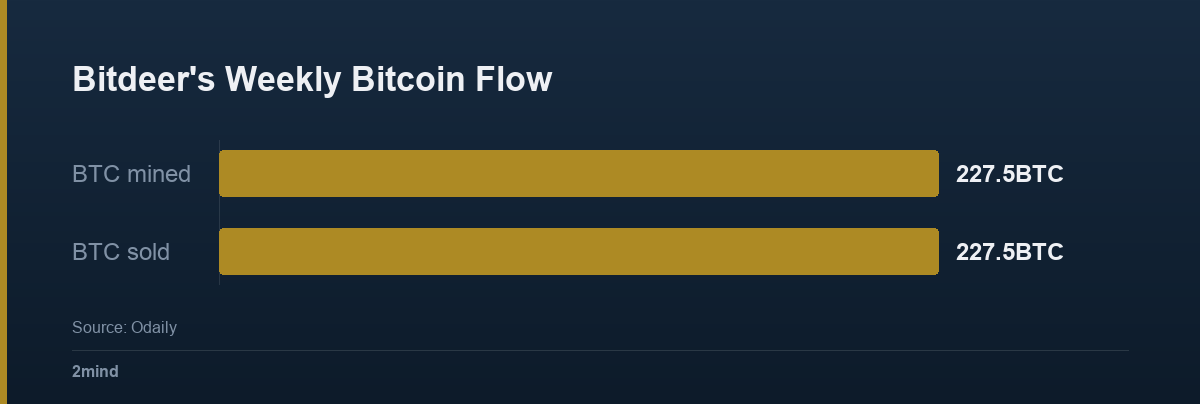
- Bitdeer mined 227.5 BTC in the week ending July 10 but sold the same amount, keeping its net Bitcoin holdings at zero.
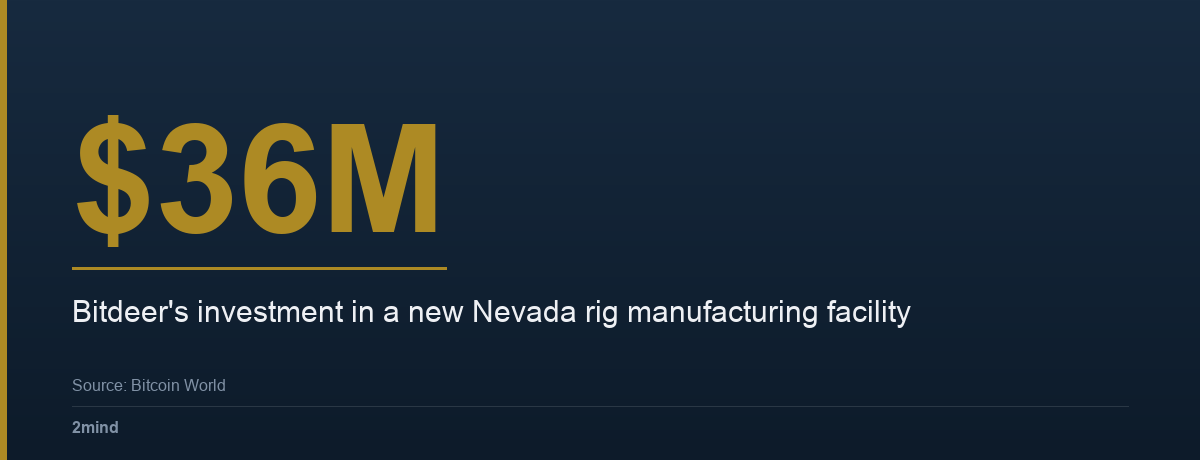
- The company simultaneously announced a $36 million investment in a new mining rig manufacturing facility in Nevada to expand SEALMINER production.
- The pairing suggests Bitdeer is treating Bitcoin as inventory to convert into infrastructure capital, not as a balance-sheet asset to hold.
What happened
Nasdaq-listed Bitdeer released its weekly Bitcoin holdings update on X, reported by Odaily. For the week ending July 10, the company mined 227.5 BTC through its operations but sold the identical amount over the same period, resulting in a net change of zero. Bitdeer currently holds no Bitcoin on its balance sheet, according to the disclosure.
On the same day, Bitcoin World reported that Bitdeer is investing $36 million into a new mining rig manufacturing facility in Nevada, aimed at scaling up production of its proprietary SEALMINER hardware. The facility marks a shift toward building infrastructure domestically in the US rather than relying solely on third-party or overseas manufacturing.
| Metric | Detail |
|---|---|
| BTC mined (week of July 10) | 227.5 BTC |
| BTC sold (same week) | 227.5 BTC |
| Net BTC holdings | Zero |
| New facility investment | $36 million (Nevada) |
A zero Bitcoin balance is a specific accounting choice, not just an absence of activity. Publicly traded miners that hold BTC on their books have to mark that position to market every quarter, so unrealized price swings flow straight into reported earnings. Bitdeer removes that variable by selling everything it mines.
The Nevada facility sits on the other side of that same cash flow. SEALMINER production has so far leaned on manufacturing capacity outside the US, exposing the company to shipping timelines and export policy it doesn’t fully control. A domestic line doesn’t remove that exposure, but it gives Bitdeer an alternative to lean on.
None of this is unique to Bitdeer, but the timing is notable. Announcing a domestic manufacturing investment in the same disclosure as a zero-holdings update ties two separate risk decisions — price exposure and supply-chain exposure — into one coherent story about where the company wants control and where it doesn’t.
The two lenses
Lens one: disciplined operator. Some analysts would read Bitdeer’s zero-holdings policy as financial discipline rather than weakness. Mining companies that hold large unrealized Bitcoin positions can suffer painful mark-to-market losses during downturns — several miners learned this the hard way in prior cycles.
By selling output immediately, Bitdeer converts a volatile asset into a stable input for expansion. The $36 million Nevada facility is a direct product of that cash flow.
In this reading, Bitdeer isn’t avoiding Bitcoin exposure out of pessimism — it’s simply running a manufacturing and mining-services business that happens to produce Bitcoin as a byproduct, and it prefers dollars in hand over coins on a spreadsheet.
This is a meaningfully different model from companies like MicroStrategy, which treat BTC accumulation as the core strategy. The market has increasingly split miners into two camps — holders and sellers — and Bitdeer sits firmly in the latter.
Lens two: no conviction, no upside. The opposing view is less forgiving. A company with zero Bitcoin holdings has zero exposure to future price appreciation — it forgoes the single biggest lever a miner has for building long-term equity value beyond its hash rate.
If Bitcoin trends higher over the coming years, Bitdeer’s shareholders capture none of that upside directly; they’re left holding a manufacturing and services business valued on operating margins alone, competing in a rig-manufacturing space that includes Bitmain and MicroBT.
Under this view, the Nevada investment isn’t proof of strength — it’s a sign the company needs constant cash turnover because it isn’t building a reserve buffer. If mining margins compress due to rising difficulty or falling fees, a zero-BTC miner has no cushion to fall back on.
There’s a version of Lens two worth separating out from missed upside: the downside-cushioning question. A miner sitting on accumulated Bitcoin can sell part of that stockpile during a temporary revenue dip without touching operations.
A miner at zero doesn’t have that option. Every difficulty increase or fee decline shows up directly in cash flow, with nothing set aside to absorb it — which is the real cost of the discipline Lens one praises.
It’s worth noting this isn’t a verdict on which lens is right. Selling everything is a defensible choice in a business with thin, cyclical margins — the same logic that leads other industries to hedge input costs rather than bet on price swings. But defensible isn’t the same as costless, and the cost here is optionality.
Why it matters
This story matters most to investors evaluating publicly traded mining stocks, where the “hold vs. sell” strategy has become a genuine differentiator in valuation models. It also matters to anyone watching US semiconductor and mining-hardware manufacturing policy, since a domestic SEALMINER facility touches supply chain and potential tariff exposure questions.
What’s worth watching next: whether Bitdeer maintains this zero-holdings discipline through a sustained price rally, and whether the Nevada facility actually reduces the company’s dependence on Chinese-manufactured mining rigs — a question with real strategic weight given ongoing trade tensions.
I’d also watch whether other miners follow Bitdeer’s model or continue to accumulate reserves, since a split in strategy across the industry usually precedes consolidation.
It’s a quiet data point, but it says something about how mature the mining business has become — less bet, more logistics.
There’s a broader pattern behind this. Mining companies increasingly sit somewhere on a spectrum rather than a binary — some hold reserves indefinitely, some sell everything immediately, and a growing number sell most output while keeping a small strategic reserve.
Where a miner sits on that spectrum is starting to matter as much to its valuation as raw hash rate does.
For readers weighing whether to treat a miner’s stock as bitcoin-price exposure or as an operating-margin bet, this distinction is the practical takeaway: check the company’s own disclosed holdings policy before assuming it moves in lockstep with BTC’s price.
FAQ
Q. Does Bitdeer still own any Bitcoin at all?
A. According to its own weekly disclosure, no — the company reported zero net Bitcoin holdings as of the week ending July 10, 2026, after selling everything it mined.
Q: What is SEALMINER?
A: SEALMINER is Bitdeer’s proprietary line of Bitcoin mining rig hardware, which the company is now expanding production of through a new $36 million Nevada facility.
What would change our view
If Bitdeer starts holding even a small share of its monthly production going forward, the disciplined-operator reading here would need revisiting — it would suggest the zero-holdings policy was closer to a cash-flow necessity than a considered strategy.
If the Nevada facility stalls well past what the announcement implied, that would weaken the case that this is real infrastructure investment rather than a narrative-driven headline.
Sources
- [Bitdeer maintains zero bitcoin holdings, sells 227.5 BTC this week] — Bitget/Odaily
- [Bitdeer Invests $36M In Nevada Mining Rig Factory To Boost SEALMINER Production] — Bitcoin World
Leave a Reply