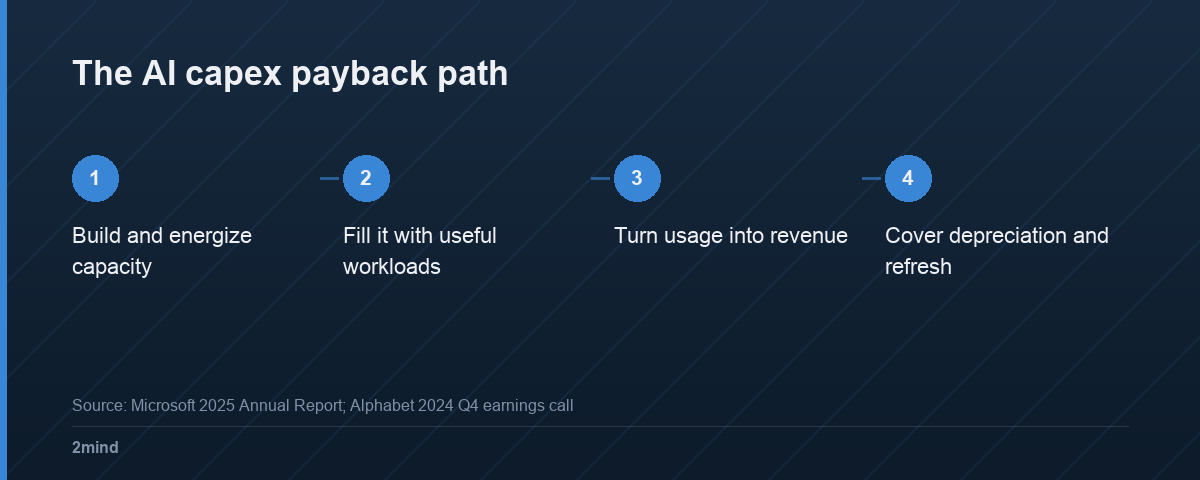
AI capital spending pays back when useful, paid workloads fill the infrastructure fast enough to cover depreciation, power, and the next hardware refresh. There is no single payback date: investors need to watch four clocks—deployment, utilization, monetization, and replacement—because each can move at a different speed.
That is why a rising cloud revenue line is evidence, but not a verdict. A data center can support search, advertising, cloud rentals, internal model training, and future products at once. The same flexibility that makes the asset valuable also makes a clean AI return calculation difficult.
Key Takeaways
- AI capex is recovered through several businesses, not one identifiable “AI revenue” line.
- Deployment and utilization come before monetization; depreciation can arrive before the revenue does.
- Short-lived servers and accelerators create a faster replacement clock than buildings, power, and networking.
- The strongest proof is not spending guidance. It is sustained revenue growth with stable or improving margins and cash flow.
What happened
Big Tech’s infrastructure disclosures show why a simple “capex divided by AI revenue” calculation does not work. Alphabet said its 2025 capital expenditure would be about $75 billion, with the majority directed to technical infrastructure. It described servers as the largest component, followed by data centers and networking.
Microsoft’s 2025 annual report gives the accounting view. The company said additions to property and equipment reached $64.6 billion in fiscal 2025, up from $44.5 billion a year earlier. It also said it would keep investing to support cloud growth and AI infrastructure and training.
| Payback clock | Question to ask | Useful evidence | Warning sign |
|---|---|---|---|
| Deployment | Is capacity online? | Servers installed; data centers energized | Construction or power delays |
| Utilization | Is the fleet busy? | Capacity constraints; growing workloads | Spare capacity sold defensively |
| Monetization | Are users paying? | Cloud revenue, paid seats, ad lift | Usage without disclosed revenue |
| Replacement | Does cash arrive before refresh? | Margin and cash-flow resilience | Depreciation and capex rising faster |
Alphabet’s disclosures illustrate the timing mismatch. On its 2024 fourth-quarter call, the company said Google Cloud revenue rose 30% to $12 billion, while Cloud operating income reached $2.1 billion and operating margin rose to 17.5%. Those are real monetization signals. But the company also warned that cloud growth can vary with the timing of new capacity coming online.
In other words, an asset may be paid for in one period, deployed in another, and begin generating revenue later. Accounting depreciation then spreads its recorded cost across its estimated useful life. Cash spending, reported expense, and customer revenue therefore do not line up neatly quarter by quarter.
Two Lenses
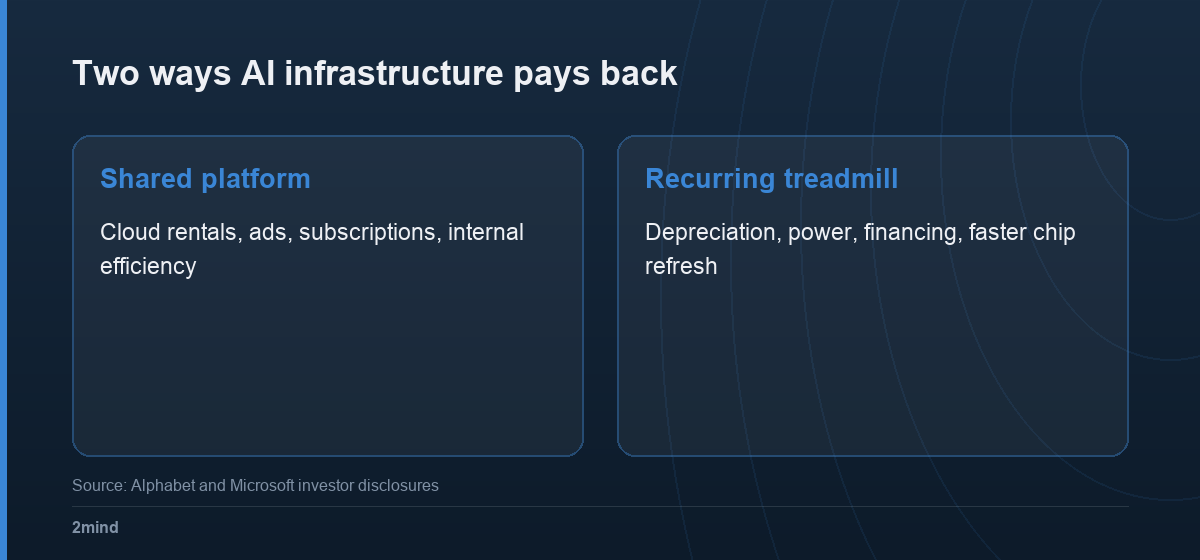
Lens one: The shared platform makes the return stronger
The optimistic case starts with reuse. A GPU cluster is not tied to one chatbot. It can train models, serve inference, support cloud customers, improve advertising systems, and power internal productivity tools. A data center can host several generations of equipment over a much longer life.
That shared platform can produce returns that never appear in a single AI product line. Alphabet, for example, links its technical infrastructure to Google Services, Google Cloud, and DeepMind. If better recommendations raise advertising revenue while cloud customers rent the same broad infrastructure base, the payoff is distributed across the company.
Demand evidence is also becoming more concrete. Our analysis of Microsoft’s hardware refresh test found that paid Copilot seats and Azure growth make monetization more visible even though they do not isolate AI profit. The point is not that every dollar has paid back. It is that workloads are moving from experiments into recurring contracts.
Capacity constraints can strengthen this reading. When a provider says demand exceeds available supply, newly deployed equipment may begin earning quickly. High utilization spreads fixed data-center costs across more billable work and gives newer, more efficient chips a chance to lower cost per task.
Lens two: The refresh cycle can outrun the revenue
The cautious case begins with asset life. Buildings and electrical systems can serve for decades, but accelerators can become economically dated much sooner. New chips may deliver better performance per watt or per dollar, pushing providers to replace functioning equipment to stay competitive.
That is why composition matters more than the headline capex number. In the Microsoft analysis, roughly two-thirds of quarterly capex went to shorter-lived assets, mainly CPUs and GPUs. A company can show strong cloud growth and still face a recurring replacement bill rather than a finished buildout.
Utilization is the second risk. Our earlier piece on Meta selling its own computing power explored two readings of external rentals: disciplined monetization of spare capacity, or evidence that internal demand arrived more slowly than the infrastructure. Both can be true at different moments.
Financing can hide the same problem without removing it. As we discussed in the Nvidia–OpenAI backstop analysis, leases, guarantees, and supplier financing can move risk between balance sheets. They cannot make an underused facility productive.
Why it matters
For investors, the right unit of analysis is not “AI revenue versus AI capex” because companies generally do not disclose either number cleanly. A better test is whether three financial lines improve together over several periods: revenue attached to cloud or paid AI products, segment operating margin, and free cash flow after capital spending.
Cloud revenue without margin improvement may mean demand is real but expensive to serve. Margin improvement without cash-flow resilience may reflect accounting timing while the buildout consumes cash. Strong cash flow without disclosed adoption may simply show that the legacy business is funding the bet.
For customers, payback determines pricing and product stability. A provider with heavily utilized infrastructure can lower unit costs, bundle AI into existing products, or keep prices competitive. A provider facing underutilization may discount capacity first, then cut investment or change product terms later.
For suppliers, the timing is different again. Chipmakers can recognize sales before the buyer proves end-user demand. Construction companies and utilities can earn during the build phase. The infrastructure owner carries the longer question: will enough profitable workloads arrive before the equipment needs another round of spending?
The cleanest dashboard therefore uses four questions. Is capacity entering service on time? Is it staying busy? Is usage producing incremental revenue rather than merely shifting existing revenue? And are margins and post-capex cash flow holding up as depreciation rises?
What would change our view
We would become more confident that AI capex is paying back if hyperscalers disclosed consistent utilization measures and showed cloud or AI-linked revenue growing while segment margins and free cash flow remained durable through a full hardware cycle.
We would become more cautious if depreciation and capital spending kept accelerating after supply constraints eased, while cloud growth slowed and companies increasingly rented out previously internal capacity. That combination would suggest the replacement clock was moving faster than the monetization clock.
A clearer allocation of machine-learning compute between internal products and external cloud customers would also change the analysis. Without it, outside observers can identify direction but cannot calculate a precise payback period honestly.
FAQ
Q. How many years does AI capex take to pay back?
A. Public disclosures do not support one industry-wide number. Buildings, networking equipment, and accelerators have different useful lives, while revenue comes from cloud services, advertising, subscriptions, and internal efficiencies. Any precise universal answer would be invented.
Q. Does rising cloud revenue prove the investment worked?
A. It proves demand and monetization are developing. It does not prove an attractive return unless margins and cash generation also cover depreciation, operating costs, and future equipment replacement.
Q. Is selling spare AI capacity a bad sign?
A. Not automatically. External rentals can improve utilization and turn idle capacity into revenue. They become concerning when they coincide with weak internal demand, falling prices, or margins that deteriorate as more capacity enters service.
Sources
- Microsoft 2025 Annual Report — property and equipment additions, cloud and AI investment, depreciation policy
- Alphabet 2024 Q4 Earnings Call — 2025 capex outlook, infrastructure mix, Google Cloud revenue and operating margin
- Alphabet 2024 Annual Report — audited financial statements and infrastructure investment context
Leave a Reply