Key Takeaways
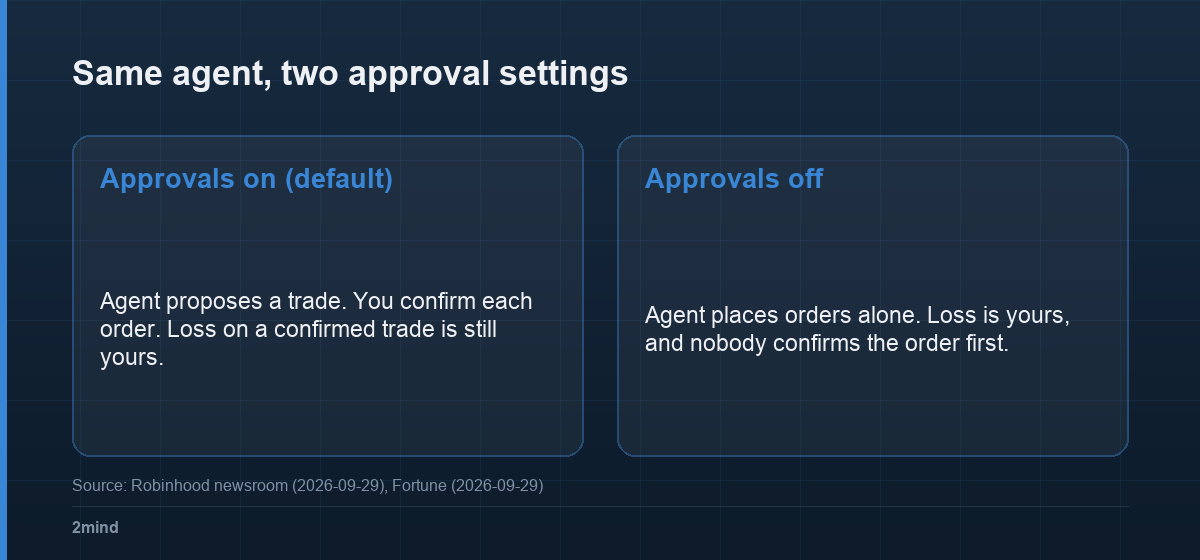
- Robinhood’s disclosure says customers “assume all risk” for trades its AI agents place. Approvals being on or off does not change that.
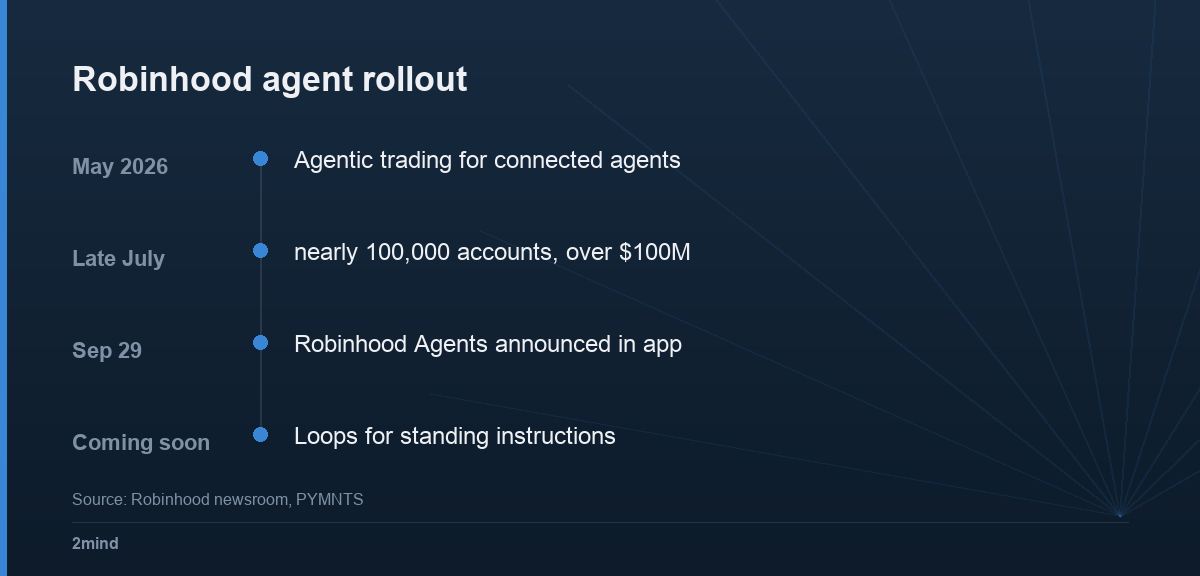
- Per-trade approval is on by default and can be switched off at any time. Loops, announced as coming soon, run while you are away.
- More than 150,000 agentic accounts had opened by late September 2026. Robinhood says it does not supervise, monitor or audit the agents.
- Our reading: the dedicated account caps what an agent can lose. Nothing in the disclosure caps who bears it.
Who Pays When a Robinhood AI Agent Loses Money?
The customer does. Robinhood’s published disclosure says: “You assume all risk for trades executed by AI agents.” It adds that Robinhood “does not control, supervise, monitor, recommend, or audit agents.”
That applies whether the agent asks permission first or not. The company announced Robinhood Agents on September 29, 2026, at its HOOD Summit in Houston.
Robinhood describes the product as an AI experience inside its app that can “analyze the market, build strategies, and trade on your behalf around the clock.” Robinhood says the product is coming soon to eligible U.S. customers. Fortune reported access starting that week, so availability reports differ.
What Each Robinhood Agent Control Covers
We read Robinhood’s announcement and disclosure line by line and set each safety control against what it does and does not do. The third column is our reading, not a Robinhood statement.
| Control | What it does | What it leaves open |
|---|---|---|
| Dedicated account | Agent reaches only that account’s funds | Everything inside is exposed |
| Trade approval | Blocks orders until you confirm | You must judge each order |
| Trade limits | Caps size per trade (Fortune) | Does not cap total loss |
| Loops | Repeats a strategy around the clock | Placed orders are not reversed |
| Supervision | None by Robinhood | No second check exists |
The first row is a real limit. An agent cannot touch your retirement account through this route.
The last row is the one that matters most. Robinhood told customers it will not audit the agents, so the only reviewer is you.
How Big Is This, Really?
Robinhood reports that over 150,000 customers have opened agentic accounts since the May launch. It also says agents use its tools almost 30 million times a day.
We divided those figures. Against Fortune’s roughly 29 million customers, 150,000 accounts is about 0.5%. Thirty million tool uses across 150,000 accounts is at most about 200 per account per day.
Those are tool calls, not trades. The count also includes third-party agents connected through Robinhood’s developer tools, not only the new in-app product. PYMNTS reported that nearly 100,000 accounts held more than $100 million in July, roughly $1,000 each at minimum. That figure comes from Robinhood’s earnings materials as relayed by PYMNTS.
Two Lenses
Letting go at 3 a.m.
Nobody wants to watch a market all night. An agent that checks conditions each morning or trades overnight is exactly the promise, and Robinhood’s own example is a strategy that looks for opportunities “while you sleep.”
From that seat, turning approvals off is not recklessness. It is the point of the product.
Owning every loss
The same person knows that an unconfirmed order that goes wrong cannot be explained away afterward. Robinhood’s disclosure says Loops may trade “while you’re asleep, away from your device, or otherwise not monitoring the market.”
From that seat, approvals are the only moment of human judgment. We weigh this lens more heavily. The convenience is real, but the loss lands on one person with no reviewer.
Five Checks Before Turning Approvals Off
- Fund the account for the loss you can absorb. The dedicated account is the hard cap. Size it as money you could lose entirely.
- Write the instruction like a contract. Robinhood says Loops act on rules “exactly as configured,” including in volatile markets.
- Set the trade-size limit first. Fortune reported users can cap how much an agent trades at a time.
- Review the first week of orders by hand. Keep approvals on until the agent’s pattern matches your instruction.
- Know the turn-off path. Orders already placed are not reversed when you pause a Loop.
This connects to how we drew the line at custody rather than the product name for crypto AI products. It also builds on the earlier test of whether you can trust an agent that repeats a task.
What would change our view
We would soften our reading if Robinhood or a regulator published a loss-allocation rule for agent errors, such as a reimbursement standard for orders that clearly break the user’s written instruction.
We would harden it if disclosed data showed a large share of agentic accounts running with approvals off. We could not verify either point. We read the published announcement and disclosure, not account-level data, and Fortune said the legal landscape for agent trading is still evolving.
FAQ
Q. Does turning trade approvals on protect me from losses?
A. No. Approvals add a confirmation step. Robinhood’s disclosure says customers assume all risk for trades executed by AI agents, and it does not say approval changes that.
Q. Can a Robinhood agent touch my other accounts?
A. Robinhood says an agent can only access the funds in its dedicated agentic trading account. Our reading: that limits exposure but does not reduce loss within that account.
Q. Are crypto trades handled differently?
A. In some states, yes. Robinhood says crypto trade approvals must be enabled in California, Connecticut and New York.
Sources
- HOOD Summit 2026 announcement — Robinhood, Sep 29, 2026
- Robinhood rolled out trading agents — Fortune, Sep 29, 2026
- Robinhood lets AI agents trade without sign-off — PYMNTS, Oct 1, 2026
All figures checked against the linked pages on Oct 2, 2026.
Leave a Reply