The most interesting AI efficiency story this week is not about a new model. It is about making existing infrastructure work twice as hard.
Key Takeaways
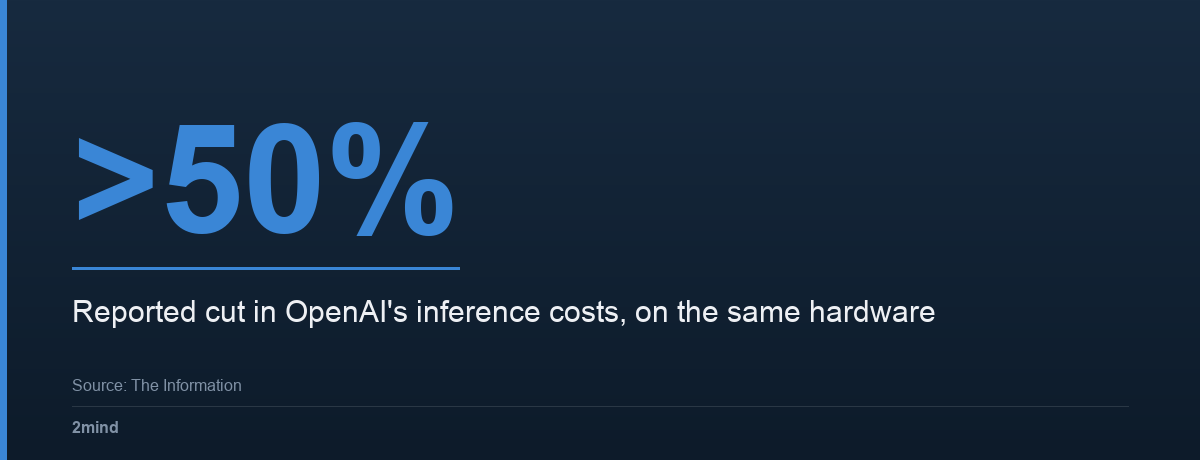
- OpenAI engineers applied a new internal inference optimization that cut the cost of running its models by more than 50% on the same hardware, according to The Information.
- The announcement arrives as the broader AI industry remains locked in a GPU and data center arms race, making OpenAI’s software-first approach a notable strategic divergence.
- If the efficiency gains hold at scale, this shifts the competitive axis in AI from “who has the most compute” to “who uses compute most intelligently” — a distinction that matters enormously for smaller players and enterprise customers.
What Happened
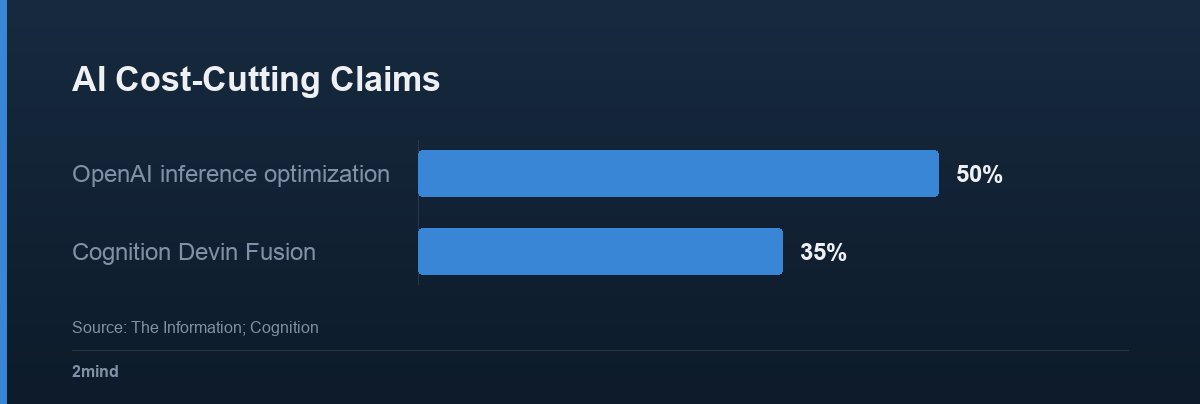
| Technique | Company | Claimed Cost Reduction |
|---|---|---|
| Internal inference optimization | OpenAI | More than 50% (reported, not independently verified) |
| Devin Fusion | Cognition | 35% lower cost per task |
OpenAI engineers shared internally that a new inference optimization had cut the cost of running its models by more than half, according to The Information.
Inference — the process of generating outputs from a trained model — is the ongoing operational cost of an AI product, and the reported gain came from software, on the same underlying hardware. “Compute multiplier” is Anthropic’s term for this class of efficiency work, not OpenAI’s.
The timing is deliberate. The AI industry has spent the last two years in an aggressive race to secure Nvidia GPUs, build out data center capacity, and lock in power contracts. OpenAI’s reported move suggests a parallel track: rather than competing purely on hardware volume, the company is investing in software-level efficiency that extracts more value from existing compute.
This connects to a broader pattern we have been tracking — the shift from raw capability competition toward operational efficiency. This week also saw Cognition release “Devin Fusion,” a multi-model AI coding agent it says reaches frontier-level performance at 35% lower cost per task on its own FrontierCode benchmark. The direction of travel is consistent.
Reading Cognition’s number with the same caution
The same verification gap applies on the other side of this story. Cognition’s 35% figure for Devin Fusion comes from FrontierCode, a benchmark the company built itself, not an independent third party.
That doesn’t make the number wrong, but it means both of this week’s efficiency claims, OpenAI’s inference-cost reduction and Cognition’s cost-per-task figure, currently rest on the word of the company reporting them, evaluated against yardsticks at least partly of their own design.
The two claims aren’t measuring the same thing, and they’re not directly comparable to each other. What they share is a structural incentive: both companies benefit from an efficiency narrative right now, and neither figure has yet been tested by an outside party running it against a workload it didn’t choose.
The Two Lenses
Lens one: The efficiency era begins
The optimistic reading of the Compute Multiplier is that it signals a genuine maturation in AI infrastructure thinking. For the first two years of the large language model boom, the dominant logic was additive: more parameters, more GPUs, more data centers, more power. That logic was expensive, and it was not infinitely scalable.
A 50% reduction in inference costs, if real and reproducible, changes the unit economics of AI deployment substantially. Enterprise customers who have been cautious about AI adoption due to cost unpredictability now have a clearer path to scalable deployment.
Smaller AI companies that cannot compete on raw compute suddenly find themselves on a more level playing field — not because they gained resources, but because the cost of using AI dropped.
There is also a geopolitical dimension here.
Meituan’s release this week of LongCat-2.0 — a 1.6 trillion parameter open-source model trained entirely on Chinese-made chips — demonstrates that the hardware-centric model of AI competition is already being challenged from multiple directions.
OpenAI’s software efficiency play and China’s chip-independence play are different responses to the same underlying constraint: Nvidia GPU supply is finite and expensive.
Lens two: The verification problem
The skeptical reading is simpler: we do not yet have independent verification of the claimed performance. A 50% inference cost reduction is a significant claim. The history of AI benchmarking is full of results that hold under controlled conditions and degrade under real-world enterprise loads.
OpenAI has strong incentives to signal efficiency gains right now.
The company is under pressure on multiple fronts: competition from Anthropic (whose Fable and Mythos models just had U.S. export restrictions lifted, per Reuters), from Google’s Gemini ecosystem, and from open-source alternatives.
An efficiency narrative helps justify pricing, reassures enterprise customers, and counters the perception that AI infrastructure costs are spiraling out of control.
Until the reported gain is validated by third-party enterprise deployments at scale, the 50% figure should be treated as a directional claim rather than a confirmed specification. The direction is credible. The magnitude requires more evidence.
Why It Matters
The people most directly affected by this development are enterprise technology buyers and AI infrastructure investors. For buyers, a genuine 50% reduction in inference costs changes the ROI calculation for AI deployment projects that have been sitting in approval queues.
For infrastructure investors — those with positions in GPU manufacturers, data center operators, and power companies — a software-efficiency wave is a structural headwind worth monitoring.
The U.S. government’s decision to lift export restrictions on Anthropic’s Fable and Mythos models adds another layer to watch. As American AI companies gain broader access to international markets, the competitive pressure on inference efficiency will only increase.
International customers will compare costs across providers, and the company that can deliver the lowest cost per output at acceptable quality will have a significant advantage.
What to watch in the next 90 days: whether enterprise customers begin reporting measurable cost reductions from OpenAI’s updated infrastructure, and whether competitors respond with their own efficiency announcements. If this becomes a race to the bottom on inference pricing, the winners will be the AI users — and the pressure will intensify on every player in the stack.
The GPU arms race is not over. But a parallel race — quieter, less visible, and potentially more consequential — has started.
Why the export decision sharpens the timing
Reuters reported the U.S. lifted export restrictions on Anthropic’s Fable and Mythos models the same week OpenAI’s efficiency claim surfaced.
Removing that barrier widens the pool of international customers who can now access Anthropic’s models, at the same moment OpenAI is reportedly cutting its own running costs.
Both changes point toward the same customers over the next few quarters, enterprises comparing providers on cost and availability together, not either factor alone.
FAQ
Q. What exactly is “inference” in AI, and why does its cost matter?
A. Inference refers to the process of running a trained AI model to generate a response or output — every time you ask ChatGPT a question, that is inference.
It is distinct from training, which is the initial process of building the model. Inference costs are the ongoing operational expense of running AI products at scale, so reducing them directly affects how affordable AI services can be for businesses and consumers.
Q. How does OpenAI’s inference optimization compare to the multi-model approach that Cognition used for Devin Fusion?
A. These are different efficiency strategies. OpenAI’s reported change appears to be a software optimization applied within a single model’s inference pipeline. Cognition’s Devin Fusion combines multiple AI models dynamically, routing tasks to whichever model handles them most cost-effectively. Both aim to reduce cost without sacrificing output quality, but through different architectural approaches.
What would change our view
Our view would shift if OpenAI publishes technical detail on the optimization method or if enterprise customers report matching savings independently, either would move the 50% figure from a directional claim to a verified one. It would also change if the reported gain turns out to depend on trading response quality for speed, a tradeoff the current reporting doesn’t address.
Sources
- heise online, OpenAI reportedly reduced inference costs by more than half — on The Information’s reporting (1 July 2026)
- AI타임스, 오픈AI, 추론 비용 절반으로 줄여 (1 July 2026)
- Cognition, Devin Fusion: frontier performance at 35% lower cost (29 June 2026)
- MarkTechPost, Meituan releases LongCat-2.0, a 1.6T-parameter open MoE model (5 July 2026)
- Reuters, US to lift export controls on Anthropic’s Fable AI model (1 July 2026)
Leave a Reply