It’s rare to see a CEO publicly say a flagship AI initiative isn’t moving as fast as promised, so this one stood out to me.
Key Takeaways
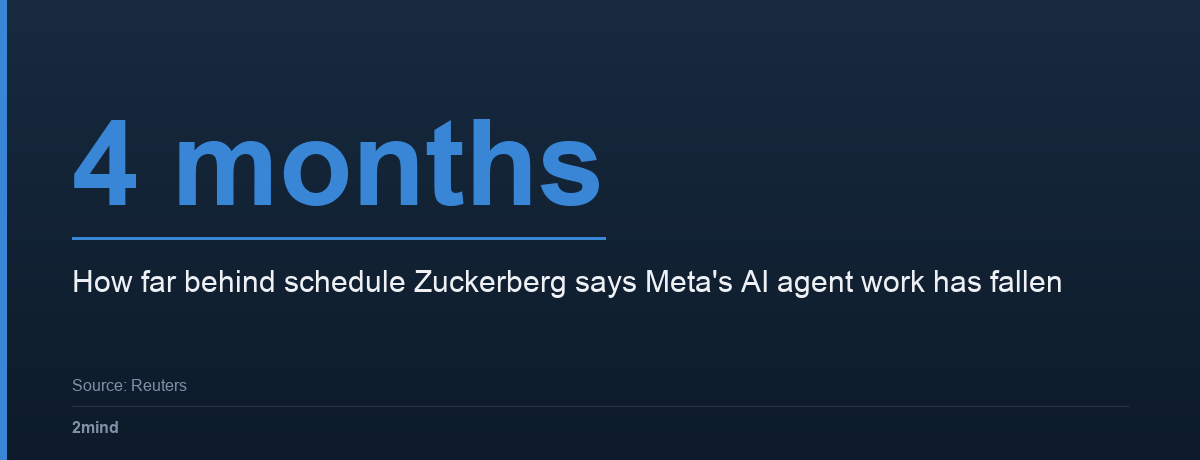
- Mark Zuckerberg told Meta employees in a town hall that AI agent development has moved slower than expected over the past four months, according to Reuters.
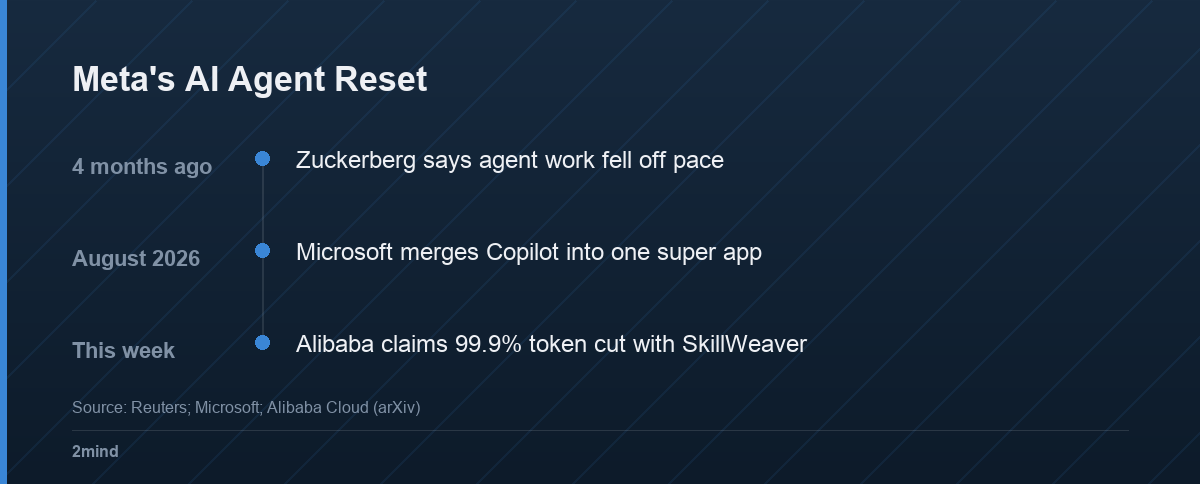
- The admission comes as Microsoft plans to merge its consumer and enterprise Copilot products into a single “super app” by August, and Alibaba released a new agent framework claiming a 99.9% reduction in token usage.
- The contrast suggests the industry is quietly recalibrating what “AI agents” can realistically deliver right now, even while product launches keep accelerating.
What happened
At an internal Meta town hall on July 2, 2026, Zuckerberg told employees that AI agent development over the prior four months “hasn’t accelerated in the way we expected,” according to Reuters, which reviewed a recording of the meeting.
This is a notable departure from the usual corporate messaging around AI progress, where setbacks are rarely stated this directly by the CEO himself.
The admission lands in the middle of a busy week for AI agent products elsewhere.
Microsoft is folding its consumer and enterprise Copilot offerings into one unified platform by August, adding AI coding and autonomous agent capabilities in what’s being described internally as a “super app” push — largely a response to complaints about low adoption and a fragmented product lineup.
Meanwhile, Alibaba Cloud researchers published “SkillWeaver,” a research framework — not yet a shipped product — designed to help AI agents select the right tool from a large toolset more accurately, breaking complex tasks into steps and matching each step to the most suitable tool.
The company claims this cuts token usage by 99.9% compared to existing approaches, though that figure comes from Alibaba’s own announcement rather than independent testing.
Three announcements landed in the same week, but they do not carry equal weight. What separates them is not ambition. It is how much of each claim has been checked by someone other than the company making it.
| Company | What was said | Stage | Checked by whom |
|---|---|---|---|
| Meta | Agent development has not accelerated as expected for four months | Internal town hall remark | Reuters reviewed a recording of the meeting |
| Microsoft | Consumer and enterprise Copilot merge into one "super app" | Planned for August, not yet shipped | Reported, outcome unknown |
| Alibaba Cloud | SkillWeaver cuts agent token use by 99.9% | Research paper, not a product | Company's own benchmark only |
The two lenses
Lens one: This is healthy course correction, not failure.
Building autonomous agents that reliably complete multi-step tasks is a genuinely hard engineering problem, and it’s arguably more useful for Zuckerberg to say so publicly than to keep overselling timelines internally.
Reorganizing teams — which Meta has reportedly done multiple times this year around AI — is a normal response to a technology that turned out to be harder than initial roadmaps assumed.
Microsoft’s Copilot consolidation and Alibaba’s efficiency-focused framework can be read as the industry shifting its attention from “can agents work at all” toward “how do we make agents cheaper and more integrated into existing products.”
Under this reading, Zuckerberg’s comment is a sign of realistic internal accountability, not a broader signal that agentic AI is stalling industry-wide.
Lens two: The gap between Zuckerberg’s admission and competitors’ aggressive announcements should raise questions about how much of the “agent boom” is genuinely working versus being packaged for investor and market attention.
If Meta — with enormous compute and talent resources — is behind its own internal targets, it’s fair to ask whether Microsoft’s August “super app” timeline or Alibaba’s 99.9% token-reduction claim will hold up under real-world use rather than curated demos.
Token efficiency gains and product bundling are meaningful, but they don’t necessarily solve the core reliability problems that seem to be behind Meta’s delays.
This reading treats the week’s news not as complementary signals but as a mismatch between one company’s honesty about limits and others’ continued momentum-driven messaging.
Why it matters
For enterprise customers evaluating AI agent tools, Zuckerberg’s comment is a useful reality check against vendor marketing that often implies agents are further along than they are.
For Meta specifically, repeated reorganizations around AI agents raise questions about internal strategy stability, something worth watching in future earnings calls or product announcements.
For the broader industry, the real test will be whether Microsoft’s August Copilot relaunch and Alibaba’s SkillWeaver framework produce measurable adoption and reliability improvements, or whether they follow a similar pattern of overpromising that Meta now appears to be correcting.
I’d rather see one honest admission like this than five more feature launches dressed up as breakthroughs.
There is a practical version of this for anyone buying agent software right now. The useful question to put to a vendor is not whether their agent can complete a task in a demo. It is what share of attempts finish without a human stepping in, measured on the buyer’s own workflows rather than a benchmark the vendor chose.
That question is what separates the three items in the table above. A recording of a town hall is checkable. A planned August release is a promise with a date attached. A token-reduction figure from a company’s own benchmark is neither — it may well be accurate, but nobody outside the company has tried to reproduce it yet.
Meta’s position is the awkward one here, and that is precisely why the remark is worth attention. A company with that much compute and that many researchers saying its own timeline slipped is a stronger signal about the difficulty of the problem than any number of launch announcements from companies whose results have not been independently tested.
FAQ
Q. What specifically did Zuckerberg say was behind schedule?
A. He told Meta employees that the trajectory of AI agent development over the past four months had not met the company’s internal expectations, according to Reuters reporting.
Q. How is Alibaba’s SkillWeaver different from existing AI agent tools?
A. SkillWeaver breaks complex tasks into steps and selects the most appropriate tool for each step, which Alibaba says reduces token usage by 99.9% compared to prior approaches, though this figure is self-reported by the company.
Q. Does this mean AI agents don’t work?
A. No. It means the gap between a working demonstration and a system that runs unattended is larger than the launch calendar suggests. Meta did not say its agents fail; it said progress over four months came in below what the company had planned for. Those are different claims, and only the second one is being made here.
What would change our view
We’d lean toward “quiet recalibration, not crisis” if Meta’s own agent metrics improve within the three-to-six-month window Zuckerberg cited, and if Microsoft’s August Copilot relaunch or Alibaba’s SkillWeaver hold up under independent, third-party testing rather than vendor-reported numbers.
We’d take the more skeptical reading more seriously if Meta announces further AI-team reorganizations or layoffs before that window closes, or if SkillWeaver’s 99.9% figure fails to replicate outside Alibaba’s own tests.
Sources
- Reuters via Investing.com — Zuckerberg tells staff AI agent development is slower than expected (2026-07-02)
- Winbuzzer — Alibaba Cloud’s SkillWeaver research framework claims 99% token cut (2026-07-04)
- TechTimes — Microsoft merges Copilot into a single “super app” by August 2026 (2026-07-04)
Leave a Reply