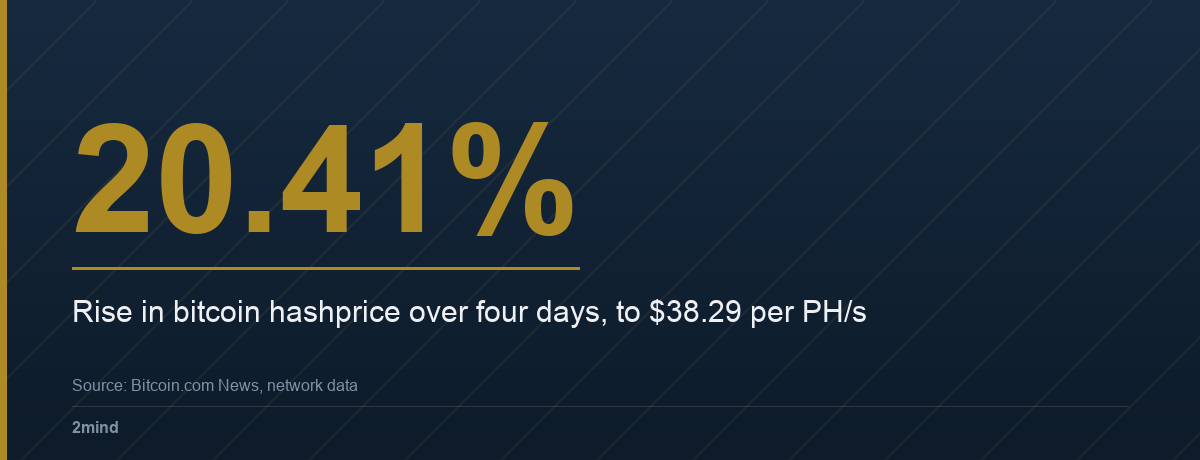
Bitcoin’s hashprice — what miners earn per unit of computing power — jumped 20.4% between August 18 and 22, 2026. That’s real relief after a slow summer, and it feeds into the broader question of whether bitcoin mining is still profitable.
But a revenue rally doesn’t answer what it costs a miner to produce one bitcoin. Three public miners just reported three very different numbers for the same quarter.
MARA disclosed $38,690. Riot disclosed $49,912 on a cash basis and $90,631 once depreciation is added. CleanSpark’s numbers imply something in between. None of these companies is wrong — they’re answering different questions with the word “cost.”
Key Takeaways
- MARA’s purchased energy cost per bitcoin was $38,690 in Q2 2026, per CFO Salman H. Khan on the company’s earnings call.
- Riot Platforms reported a $49,912 cash cost to mine and a $90,631 all-in cost (including depreciation) for the same quarter, ended June 30, 2026.
- CleanSpark didn’t state a direct cost-per-coin figure; from its disclosed 38% gross margin and $72,000 revenue per coin, the implied cost is about $44,600 — our calculation, not the company’s.
- Bitcoin’s hashprice rose 20.41% between Aug. 18–22, 2026, but that measures revenue per unit of computing power, not what it costs to run the machines.
What Do the Filings Actually Say?
MARA Holdings’ Chief Financial Officer, Salman H. Khan, told investors on the company’s Q2 2026 earnings call that “purchased energy cost per Bitcoin for our own mining sites was $38.7 thousand, up from $33.7 thousand in Q2 of 25.” That figure covers electricity only, at owned sites, for the quarter ended June 30, 2026.
Riot Platforms reported a different pair of numbers for the same three months. Its direct cost to mine, excluding depreciation, was $49,912 per bitcoin — up about $920 from the year-ago quarter, driven by higher power costs even after $10.1 million in curtailment credits. Once depreciation and other operating expenses are added, Riot’s all-in cost reached $90,631.
CleanSpark didn’t publish a single cost-per-coin figure for its fiscal third quarter, which also ended June 30, 2026. It reported average revenue of about $72,000 per bitcoin mined and a gross margin near 38%. That implies a cost of revenue close to $44,600 per coin — a figure we calculated, not one CleanSpark stated directly.
Why Does the Same Quarter Produce Different Numbers?
The gap isn’t fraud or sloppy accounting. It’s three companies choosing what to include.
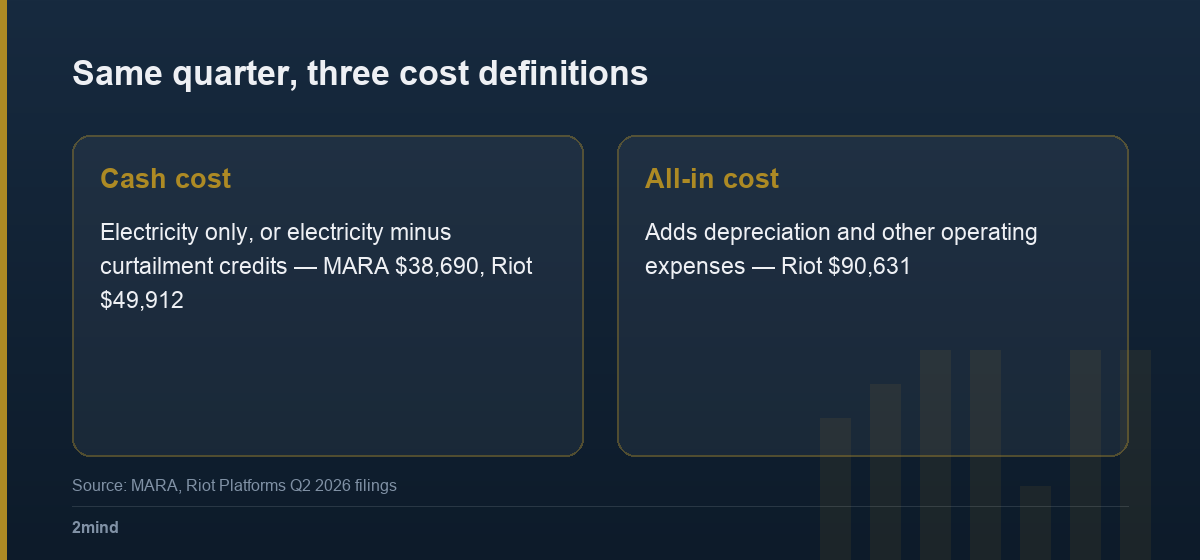
Cash cost counts what a miner actually pays out — mostly electricity — to run machines this quarter. All-in cost adds depreciation on the mining rigs themselves, which can be large given how fast ASIC hardware loses value.
Riot’s own disclosure makes the split explicit: $49,912 in cash costs, rising to $90,631 once depreciation is folded in. A reader who only sees the smaller number would conclude Riot mines well below bitcoin’s current price. A reader who sees the larger number would conclude the opposite.
| Miner (quarter) | Cost per BTC | What’s counted | vs. $78,745 spot (Aug 26) |
|---|---|---|---|
| MARA (Q2 CY2026) | $38,690 | Purchased energy at owned sites | Cost is 49% of spot |
| Riot — cash (Q2 CY2026) | $49,912 | Power, net of curtailment credits | Cost is 63% of spot |
| CleanSpark (Q3 FY2026, our calc) | ≈$44,600 | Implied cost of revenue, 38% gross margin | Cost is 57% of spot |
| Riot — all-in (Q2 CY2026) | $90,631 | + depreciation and other opex | Cost is 115% of spot |
Three of the four rows sit comfortably below bitcoin’s August 26 price of $78,745.95. The fourth — Riot’s fully-loaded number — sits above it. Same company, same quarter, two conclusions depending on which line you read.
Does the Hashprice Rally Change Any of This?
Hashprice measures revenue per unit of hashing power, not cost. When it rose 20.4% in four days, the numerator moved — bitcoin’s price climbed from roughly $62,837 to $77,227 over the same week, according to network data compiled by Bitcoin.com. The denominator, what it costs to run the machines, didn’t move with it.
Network hashrate kept climbing toward 922 exahashes per second, near the 1-zettahash mark, over the same stretch. More computing power competing for the same fixed block reward is what keeps cash costs like MARA’s and Riot’s rising year over year, even when price cooperates.
That’s part of why some smaller operators have pivoted capacity toward AI compute rather than keep expanding mining alone.
A rally in hashprice makes this quarter’s revenue look better. It doesn’t retroactively lower what depreciation already booked against Riot’s Q2 machines, or reduce the electricity MARA already paid for in June.
Two Lenses
Wanting mining stocks to be a clean proxy for bitcoin’s price
Buying a mining stock is supposed to be simpler than running rigs yourself: bitcoin goes up, the miner’s revenue goes up, done. The hashprice rally fits that story — a 20% jump in four days is the kind of number that reads as unambiguous good news.
Knowing the same filing can carry two costs that disagree
Riot’s own numbers don’t let that story stand still. A reader who wants a single answer to “is this miner profitable” has to first decide whether depreciation counts — and Riot’s Q2 filing shows that choice moves the answer from comfortably profitable to underwater.
We lean toward reading the all-in number first. Depreciation on ASIC hardware is a real cost of staying in the game, not an accounting formality — the machines do wear out and get replaced.
Four Questions Before You Trust Any “Cost to Mine 1 BTC” Number
- Does it include depreciation? Cash cost and all-in cost can differ by more than double, as Riot’s own filing shows.
- Which entity and which dates? A company-wide average can hide cheaper and pricier sites within the same quarter.
- Are subsidies or credits netted out? Riot’s $49,912 already reflects $10.1 million in curtailment credits; without them, the figure would be higher.
- Is it disclosed or calculated? MARA and Riot state their cost-per-coin directly. CleanSpark’s figure above is our own calculation from its stated revenue-per-coin and gross margin — not a number the company published.
What Would Change Our View
If CleanSpark starts disclosing a direct cost-per-coin figure the way MARA and Riot do, our calculated estimate above would need to be checked against it rather than derived.
If Riot’s all-in cost stays above bitcoin’s spot price for two more quarters, that would suggest depreciation-heavy miners are structurally underwater even in a rally — not just accounting-underwater on paper.
FAQ
Q. How much does it actually cost to mine one bitcoin right now?
A. It depends on the definition. Public miners’ own Q2 2026 filings put cash cost between roughly $38,700 and $49,900, and all-in cost (including depreciation) as high as $90,631 for at least one large miner, Riot Platforms.
Q. Why did bitcoin miners’ costs go up even though the hashprice rally helped revenue?
A. Hashprice tracks revenue per unit of hashing power, not expenses. Network hashrate kept rising toward 922 EH/s over the same period, which is part of why cash cost per coin rose year over year at both MARA and Riot.
Q. Is bitcoin mining still profitable in August 2026?
A. On a cash basis, yes for the miners in this comparison — their disclosed cash costs sit well below the $78,745.95 spot price on August 26. On an all-in accounting basis that includes depreciation, at least one public miner, Riot, reported a cost above that price for Q2 2026.
Sources
- Bitcoin Miners Get a Lifeline as Hashprice Explodes 20% Higher — Bitcoin.com News, Aug 2026
- MARA Q2 2026 earnings call transcript — The Motley Fool, Aug 2026
- Riot Platforms Reports Second Quarter 2026 Financial Results — Riot Platforms, Aug 2026
- CleanSpark Q3 2026 earnings call highlights — Yahoo Finance, Aug 2026
- Fortune Bitcoin price, August 26, 2026 — Fortune, Aug 2026
Leave a Reply