Amazon AI CapEx is becoming a test of how investors read growth and cash at the same time. Amazon reported strong Q2 sales and faster AWS expansion, yet its trailing free cash flow moved below zero.
I think the useful question is not whether either number is “good” or “bad.” It is whether the cloud growth is becoming strong enough to justify a much larger infrastructure bill—and what evidence would eventually settle that question.
Four signals worth holding together
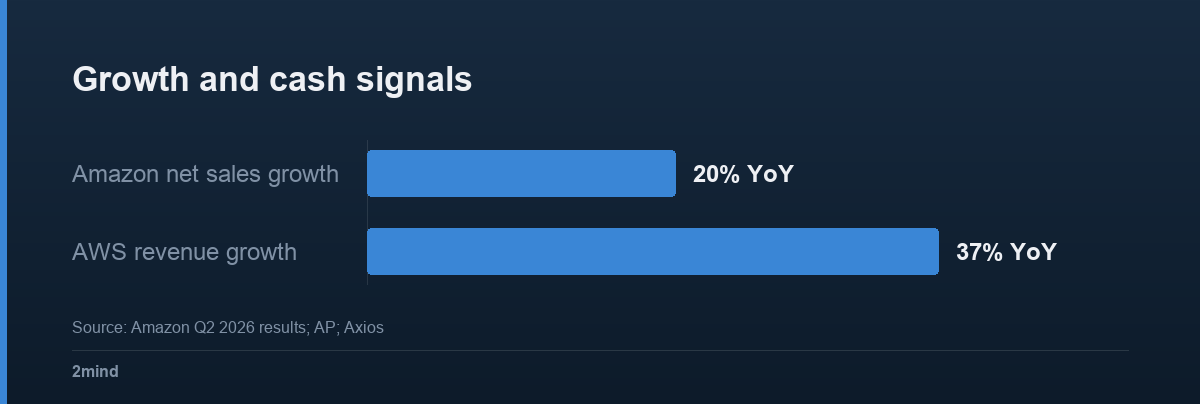
- Amazon’s Q2 net sales reached $200.6 billion, up 20% year over year.
- AWS generated $42.2 billion, up 37%, accelerating from 28% growth in the prior quarter.
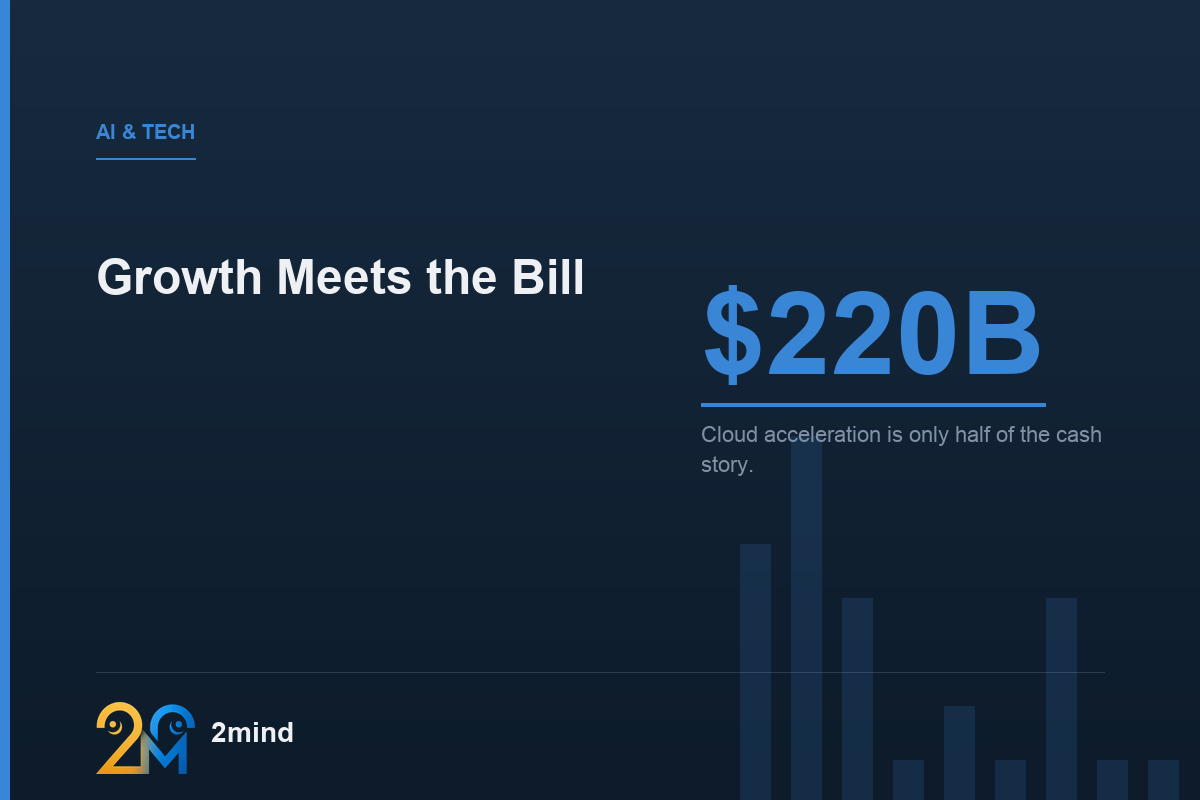
- Expected 2026 cash capital expenditure rose by $20 billion, from about $200 billion to about $220 billion.
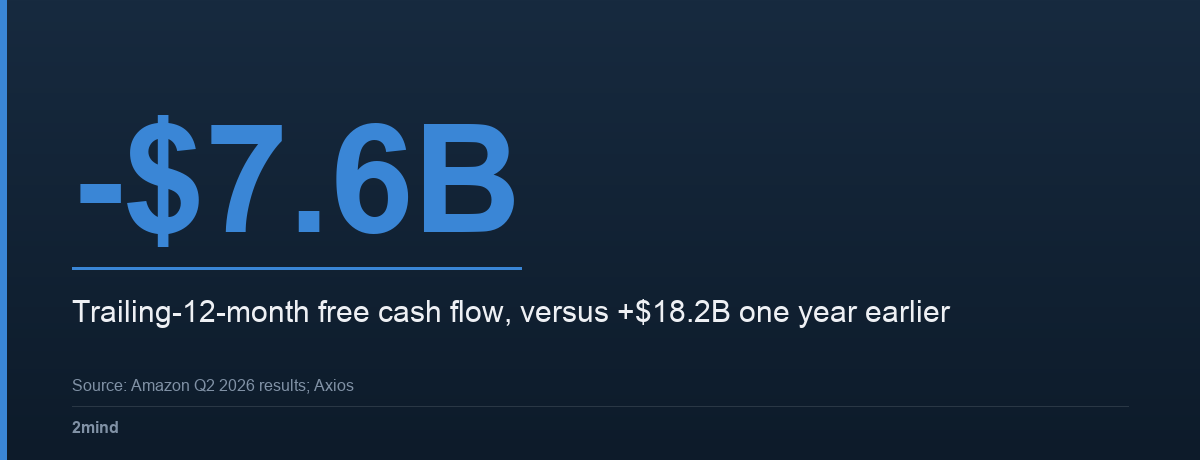
- Trailing-12-month free cash flow flipped from $18.2 billion a year earlier to negative $7.6 billion.
The first two figures show expanding demand. The next two show the size and immediacy of the cash commitment. Neither pair cancels the other. Together, they define the question Amazon now has to answer through future results.
Amazon AI CapEx is larger than one label
The $220 billion figure needs careful wording. It is Amazon’s expected cash capital expenditure for 2026, not a disclosed, stand-alone AI budget. The spending is mainly directed toward technology infrastructure that includes AI, while also covering robotics, semiconductors, and satellites.
That distinction matters because it limits what we can calculate. We cannot take the full $220 billion, compare it with AWS revenue, and call the result an AI return. The spending pool is broader, and the reported figures do not separate revenue or profit produced by each category.
| Reported signal | Current figure | Comparison | What it can tell us |
|---|---|---|---|
| Amazon Q2 net sales | $200.6B | +20% YoY | The overall business is expanding |
| AWS Q2 revenue | $42.2B | +37% YoY | Cloud growth accelerated |
| Expected 2026 cash CapEx | About $220B | Up $20B from about $200B | The infrastructure commitment increased |
| TTM free cash flow | -$7.6B | $18.2B a year earlier | Cash pressure is visible now |
One ratio cannot resolve the debate. These measures do not share the same time frame or scope.
AWS accelerated while the cash meter ran backward
AWS growth rose from 28% in the prior quarter to 37% year over year in Q2. AP described that rate as the fastest in 18 quarters. To me, this is the clearest demand signal in the release: the infrastructure push is arriving alongside faster cloud growth, not in the absence of it.
Yet the cash picture moved in the other direction. Free cash flow for the 12 months ended June 30 was negative $7.6 billion, compared with positive $18.2 billion in the year-earlier period. The direction of travel reversed.
This tension resembles the question I raised in Microsoft AI Returns Face a Hardware Refresh Test: strong demand can be real even when the infrastructure cycle makes near-term cash economics harder to read. Growth evidence and return evidence are related, but they are not interchangeable.
The same distinction sits behind Why AI’s Winners Aren’t the Companies Spending the Most. Spending can create capacity. It does not, by itself, reveal utilization, pricing power, margins, or the timing of cash recovery.
Two readings of the same infrastructure cycle
Lens one: The demand-first reading
The constructive interpretation starts with AWS. Revenue of $42.2 billion and 37% growth suggest that Amazon is expanding infrastructure while its cloud business is accelerating. From this angle, higher capital expenditure may be the necessary cost of serving demand that is already appearing in reported revenue.
The increase can therefore be read as confidence in the opportunity. Amazon raised the estimate by $20 billion. That does not prove a return, but the commitment grew alongside the faster AWS number.
I would not dismiss this view simply because free cash flow is negative. Infrastructure spending uses cash before every economic benefit can become visible. The honest version of the positive case is modest: demand is accelerating, and Amazon is increasing capacity into that acceleration.
Lens two: The cash-discipline reading
The cautious interpretation starts with the same disclosure. A 37% AWS growth rate is impressive, but trailing free cash flow still shifted from positive $18.2 billion to negative $7.6 billion. The immediate, measurable cash effect is therefore clearer than any eventual AI-specific payoff.
This lens asks whether revenue acceleration can translate into durable cash generation after the broader infrastructure bill. The available numbers cannot answer that yet. They do not separate AI revenue, AI operating profit, or the share of CapEx assigned to individual programs.
There is also a scope problem. Robotics, semiconductors, and satellites sit inside the capital plan alongside AI-oriented technology infrastructure. Calling the full amount an AI wager would make the story neater, but less accurate.
The cautious case is not that the spending must fail. It is that the recovery timetable remains undisclosed and unprovable from this quarter’s figures. Faster growth narrows the debate; it does not finish it.
What would change our view
I would watch the relationship among three reported signals rather than search for a single dramatic number: whether AWS growth persists, how the cash CapEx estimate changes, and whether trailing free cash flow begins moving back toward positive territory.
These are not a formula for AI ROI. AWS is the closest disclosed demand signal, cash CapEx shows the funding commitment, and free cash flow captures the wider business.
The sequence matters. A future improvement in free cash flow would be more persuasive if AWS remained strong without another disproportionate increase in the capital plan. Conversely, continued AWS acceleration with continuing cash pressure would keep both lenses alive: commercial momentum would be visible, while the cash conversion question remained open.
I would also resist assigning a payback date. The current disclosures do not support one. A precise forecast would imply knowledge of AI-specific revenue, margins, utilization, and allocated capital that these reported figures do not provide.
This is also why Nvidia and OpenAI’s backstop question belongs in the same broader conversation. Infrastructure demand can move through several companies, but the party funding capacity and the party ultimately capturing cash returns are not always the same analytical question.
The quarter’s cleanest conclusion
Amazon’s report provides evidence of cloud acceleration and evidence of heavier cash pressure. It does not provide evidence that AI investment has already paid back, nor does it establish when that might happen.
That boundary is useful. It prevents the negative free-cash-flow figure from erasing genuine AWS momentum, and it prevents the 37% growth rate from being treated as proof of an undisclosed return.
My reading is that Amazon has moved the debate forward by showing demand, but it has also raised the standard for the next proof. With expected cash CapEx near $220 billion, future growth will increasingly be judged beside cash conversion, not in isolation.
FAQ
Q. Is Amazon spending $220 billion entirely on AI?
A. No. The figure is expected 2026 cash capital expenditure. It is mainly aimed at technology infrastructure that includes AI, but it also includes robotics, semiconductors, and satellites. The available disclosure does not provide a separate AI-only total.
Q. Why is Amazon free cash flow negative if AWS is growing?
A. The figures show faster AWS revenue growth alongside a larger capital plan and negative trailing free cash flow. They establish the coexistence of growth and cash pressure, but they do not isolate a single cause or allocate the cash-flow change to AI alone.
Q. When will Amazon’s infrastructure spending produce a return?
A. The reported data does not establish a payback date. AWS growth is a useful demand signal, but an AI-specific return would require details on revenue, profit, capital allocation, and timing that are not separately disclosed here.
Sources
- Amazon: Q2 2026 earnings report
- Associated Press: Amazon Q2 earnings and spending
- Axios: Amazon revenue, AI investment, and cash flow
If growth is already visible but cash recovery is not, isn’t conversion now the real Amazon AI test?
Leave a Reply