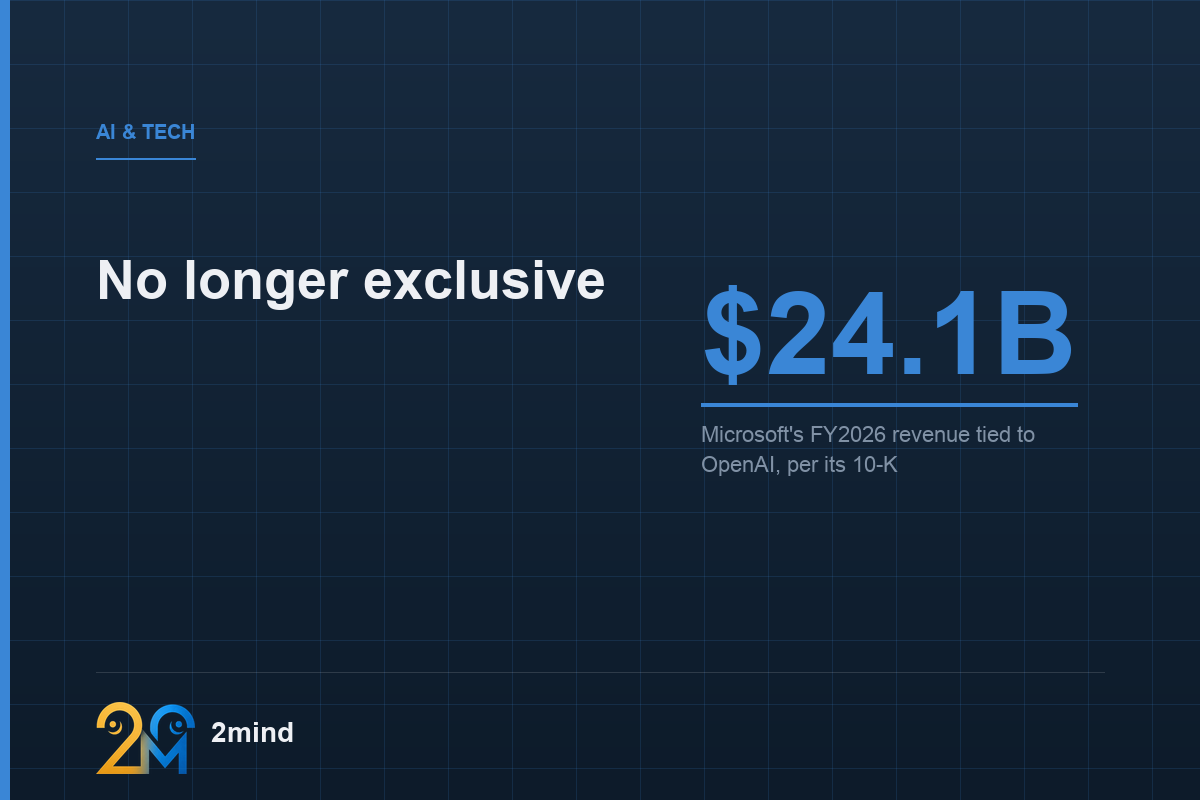
Microsoft and OpenAI are no longer exclusive partners under the terms either company has published. As of an amendment dated April 27, 2026, OpenAI can sell its products through any cloud provider, and Microsoft no longer holds an exclusive license to OpenAI’s models. What still binds them is mostly financial: Microsoft reported $24.1 billion in revenue tied to OpenAI in fiscal 2026, and OpenAI still owes Microsoft a capped share of its own revenue through 2030.
The two companies keep re-signing. Since January 2023 they have published at least four separate agreements, each one loosening a term the last had just confirmed.
The newest hedge is not about OpenAI at all — on August 10, 2026, Microsoft was reported to be negotiating with TSMC for more than 300,000 Maia 300 AI chips for 2027, a bid to depend less on Nvidia. It fits the same pattern Microsoft has applied to OpenAI: keep the relationship, reduce the exposure.
Key Takeaways
- Microsoft’s exclusive license to OpenAI’s IP ended April 27, 2026. The license is now non-exclusive but runs through 2032.
- Microsoft stopped paying OpenAI a revenue share in April 2026. OpenAI’s payments to Microsoft continue, capped, through 2030.
- OpenAI can now sell products on any cloud, but Azure still ships OpenAI’s own products first.
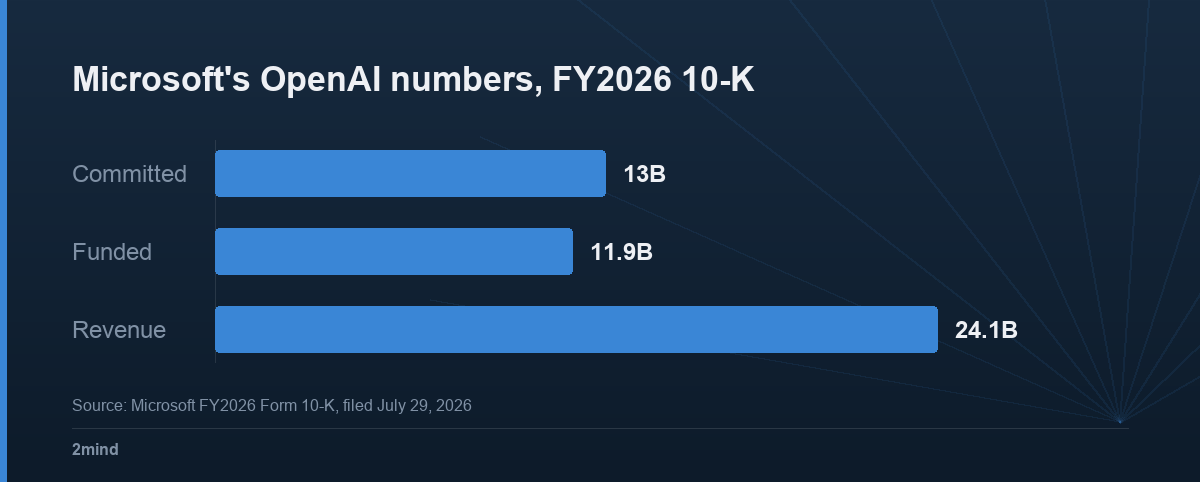
- Microsoft’s FY2026 Form 10-K, filed July 29, 2026, shows $24.1 billion in revenue tied to OpenAI — about 70% of Microsoft’s AI-attributed sales that year.
What happened
Four public documents mark the shape of this relationship, and each one narrowed what “exclusive” meant compared with the one before it.
| Date | Agreement | Cloud terms | IP license | Revenue share |
|---|---|---|---|---|
| Jan 23, 2023 | Multiyear investment extension | Azure named the exclusive cloud provider for all OpenAI workloads | Not detailed publicly | Not detailed publicly |
| Oct 28, 2025 | OpenAI converts to a public benefit corporation | Microsoft loses right of first refusal on OpenAI’s compute; OpenAI commits $250B to Azure | Exclusive through 2032, extended to post-AGI models | OpenAI pays Microsoft until AGI is verified or 2030 |
| Feb 27, 2026 | Joint statement, prompted by a new OpenAI funding round | Azure reaffirmed exclusive for stateless OpenAI API calls | Reaffirmed exclusive, unchanged from October | Reaffirmed unchanged |
| Apr 27, 2026 | Amended agreement | OpenAI may serve any cloud; Azure remains primary and first to ship | Non-exclusive, still through 2032 | Microsoft stops paying OpenAI; OpenAI’s payments to Microsoft capped through 2030 |
The newest data point is not about OpenAI directly. Microsoft was reported on August 10, 2026 to be negotiating with TSMC for capacity to produce more than 300,000 Maia 300 AI chips for delivery in 2027, aiming to cut its dependence on Nvidia. Microsoft has not confirmed the number, and the report describes ongoing talks rather than a signed order.
Read next to the April amendment, it fits a pattern: Microsoft is diversifying its dependencies — chips as much as models — while keeping the OpenAI relationship intact rather than replacing it outright.
Two Lenses
Lens one: Microsoft is cashing out an option, not backing away
One reading treats April’s amendment as confidence rather than retreat. Microsoft gave up an obligation that was getting expensive to hold — a revenue-share payment and an exclusivity claim OpenAI kept testing — while keeping the one term with real long-run value: model and product IP through 2032, now widened to cover whatever OpenAI trains after AGI, if that milestone is ever verified by the newly independent panel.
A company earning $24.1 billion a year from a single partner does not need an exclusivity clause to protect that relationship.
OpenAI has made comparable trades. The quiet concession behind its recent government win suggests a company willing to give up leverage on one front to gain reach on another — the same logic Microsoft applied here.
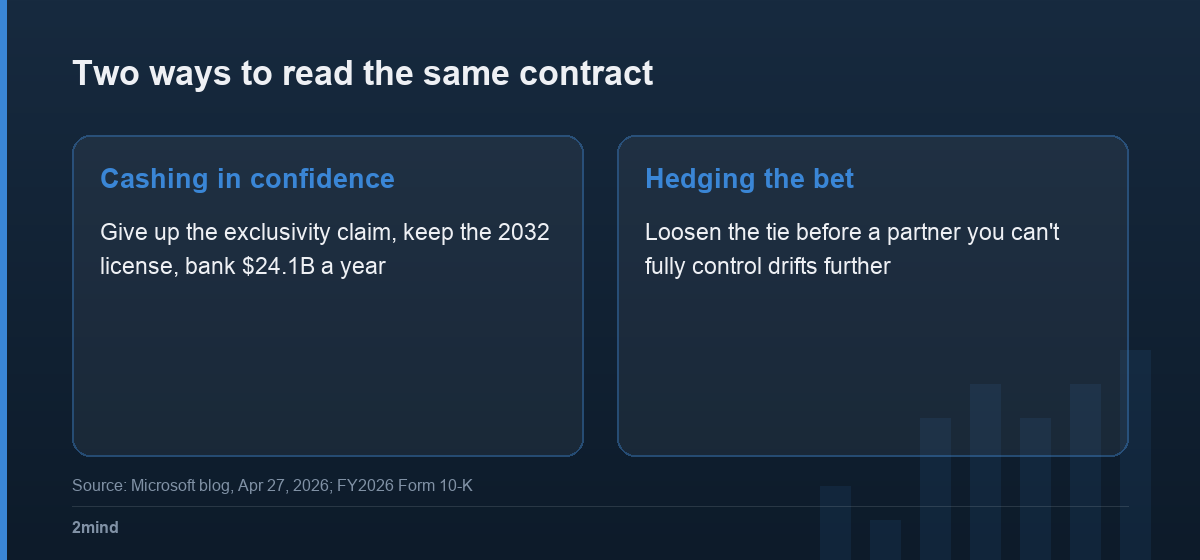
Lens two: Microsoft is hedging against a partner it can’t fully rely on
The other reading treats the same facts as risk management. Microsoft has reportedly weighed swapping ChatGPT for a cheaper Chinese model, Kimi K3, inside its own products — the kind of shopping a company does when it isn’t sure its main supplier stays the best option.
Giving up the compute right of first refusal in October 2025 let OpenAI build capacity elsewhere, including through the Stargate project. The Maia 300 push looks like Microsoft doing the same for chips it used to buy almost entirely from Nvidia.
Two companies loosening the terms that used to bind them together is what a slow, negotiated separation looks like from the outside, even while both keep calling the partnership “strong and central.”
Why it matters
For anyone building on Copilot, Azure OpenAI Service, or ChatGPT’s enterprise tools, the practical question isn’t who “wins” this relationship — it’s which commitments are actually contractual. Azure staying the first-ship platform for OpenAI’s own products is a real, current commitment. OpenAI’s ability to run elsewhere is now a real option, not a workaround.
Microsoft’s own AI infrastructure returns are already being tested by a hardware refresh cycle, so a Microsoft that owns more of its own chip supply has less reason to protect OpenAI’s exclusivity even if it wanted to keep it.
How to read the next Microsoft-OpenAI headline
News about this relationship keeps arriving as single data points. A quick way to sort the next one:
- Does it change who can sell — a cloud or vendor term, like April’s multi-cloud clause?
- Does it change who owns access — an IP-license term, like the 2032 date or its exclusivity?
- Does it change who pays whom — a revenue-share term, like April’s one-way flip?
- Does it change who owns equity — Microsoft’s 27% stake, or a new OpenAI funding round that dilutes it?
- Or is it neither — a product or execution story, like Microsoft’s own 570-flaw security patch batch, that says more about delivery than about the contract?
What would change our view
We would read this as OpenAI drifting away for good if it signed a comparably sized compute commitment with a rival cloud provider, or if Microsoft’s fiscal 2027 10-K showed OpenAI-linked revenue shrinking as a share of Microsoft’s AI sales rather than growing.
We would read it as a stable, mature partnership if the 2032 IP license renewed early, or if Microsoft’s Maia chip ramp proceeded without any reduction in the Azure capacity OpenAI actually draws on.
The clearest signal will be Microsoft’s fiscal 2027 Form 10-K, expected around July 2027: whether the OpenAI-linked revenue figure grew, shrank, or Microsoft stopped naming a specific number at all.
FAQ
Q. Is Microsoft still OpenAI’s exclusive cloud provider?
A. No, not since the amendment the two companies published on April 27, 2026. OpenAI can now serve its products through any cloud provider. Azure remains OpenAI’s primary partner and the first platform for OpenAI’s own products, but that is no longer an exclusivity clause.
Q. Does Microsoft still share OpenAI’s revenue, or is it the other way around?
A. Only one direction continues. Microsoft stopped paying OpenAI a revenue share in April 2026. OpenAI’s payments to Microsoft continue at the prior percentage through 2030, now subject to a total cap.
Q. How dependent is Microsoft’s AI business on OpenAI?
A. Substantially. Microsoft’s fiscal 2026 Form 10-K, filed July 29, 2026, disclosed $24.1 billion in revenue from commercial arrangements with OpenAI — about 70% of Microsoft’s AI-attributed sales that year — with $6 billion still owed as accounts receivable as of June 30, 2026.
Sources
- Microsoft, “Microsoft and OpenAI extend partnership” (Jan 23, 2023) — Azure exclusivity, investment framing
- Microsoft, “The next chapter of the Microsoft-OpenAI partnership” (Oct 28, 2025) — equity stake, $250B Azure commitment, IP through 2032, AGI panel
- Microsoft, “Microsoft and OpenAI joint statement on continuing partnership” (Feb 27, 2026) — exclusivity reaffirmed
- Microsoft, “The next phase of the Microsoft-OpenAI partnership” (Apr 27, 2026) — non-exclusive license, revenue-share flip, multi-cloud terms
- Techzine, “Microsoft earned 24 billion from OpenAI, but it’s unclear exactly how” — FY2026 10-K figures, receivables, funding commitment
- CryptoBriefing, “Microsoft reveals OpenAI accounts for 70% of AI sales, with $24B revenue run rate” (Aug 5, 2026) — revenue share of AI sales, cloud backlog
- The Next Web, “Microsoft is ordering 300,000+ Maia 300 AI chips from TSMC…” (Aug 10, 2026) — Maia 300 TSMC talks, publish time
Leave a Reply