Key Takeaways
- Muse Glimmer (Meta, Aug 10, 2026) ships under Apache 2.0. No revenue cap, no user threshold.
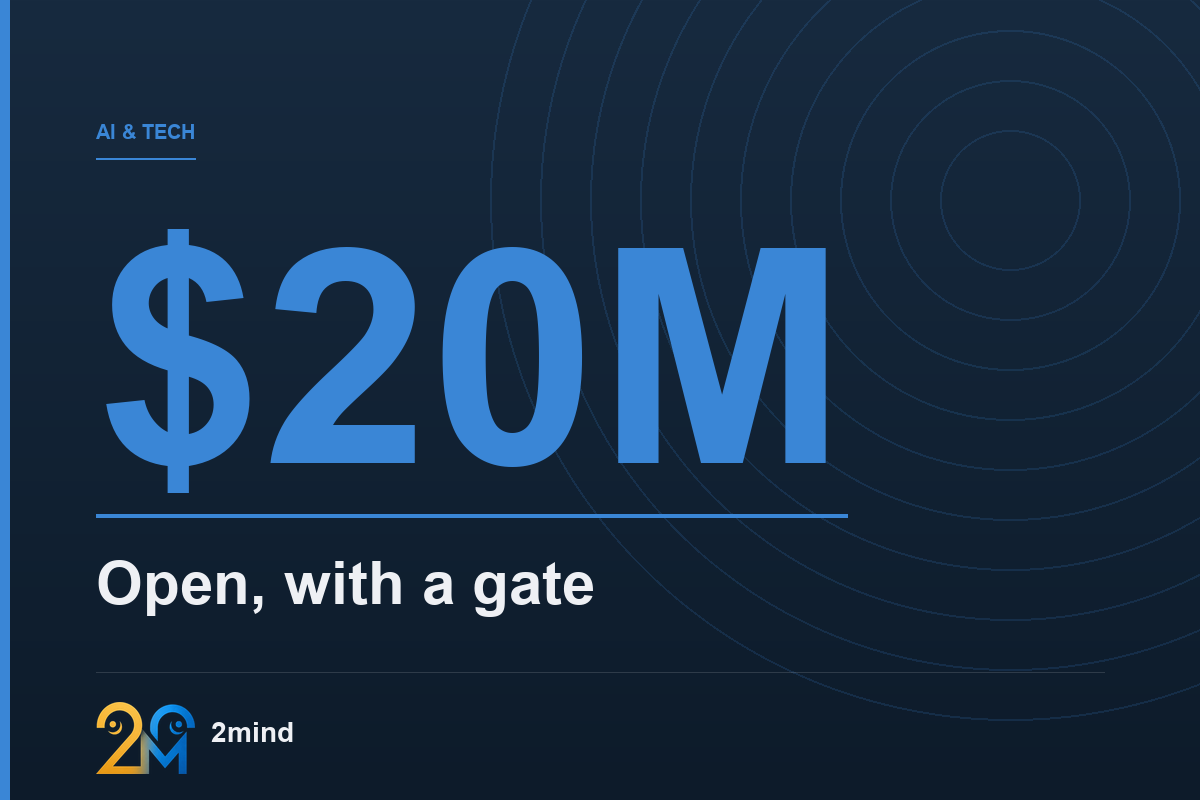
- Kimi K3 (Moonshot AI, Jul 27, 2026) is the only one of the five with a gate: a separate commercial agreement once a Model-as-a-Service operator’s aggregate revenue (with affiliates) tops $20 million in any 12 months.
- DeepSeek V4-Pro, Qwen3.6-35B-A3B, and Nemotron 3.5 Lightning carry no revenue or user gate in their published terms.
- Meta’s older Llama models still keep the 700-million-MAU clause. Glimmer’s license does not replace them.
- The label “open weight” now covers five different sets of obligations. Only the license file tells you which one applies.
The difference between open weight and open source is not a wording debate. It decides whether you owe someone money later.
Meta’s newest model, Muse Glimmer, shipped under Apache 2.0 on August 10, 2026. No revenue cap. No user-count threshold. No approval to request.
That is a real change from Meta’s own Llama line, which has carried a 700-million-monthly-active-user gate since Llama 2.
But “open weight” does not mean the same thing across the five models that have shipped this way since April. Some genuinely have no strings. One turns into a paid negotiation at a specific dollar figure.
Is DeepSeek Open Source or Open Weight? What Each License Actually Says
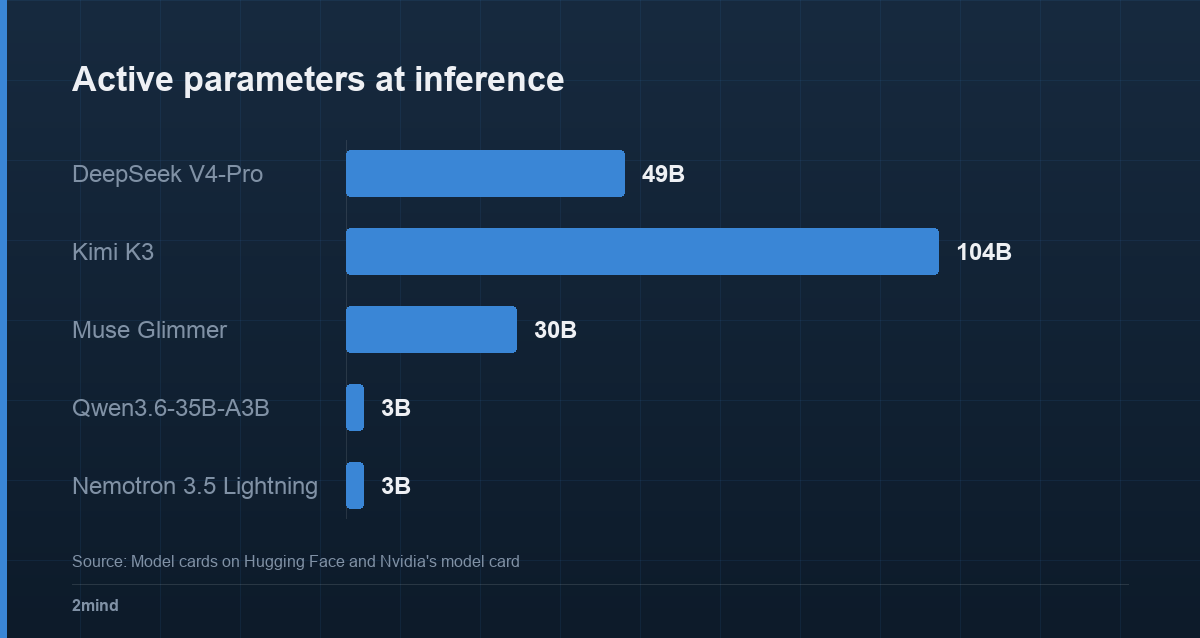
Five open-weight models shipped between April and August 2026. Each is licensed differently.
The table below links each organization’s license or model card.
| Model | License | Commercial gate |
|---|---|---|
| DeepSeek V4-Pro | MIT | None |
| Qwen3.6-35B-A3B | Apache 2.0 | None |
| Muse Glimmer | Apache 2.0 | None |
| Nemotron 3.5 Lightning | OpenMDW-1.1 | None stated |
| Kimi K3 | Kimi K3 License | Separate agreement past $20M/12mo MaaS revenue |
The gap in that table is the whole story.
MIT and Apache 2.0 are OSI-approved open-source licenses. No company gets to revoke your right to use them later.
OpenMDW-1.1, the license Nvidia uses, is a Linux Foundation text rather than an OSI license. Its published terms carry no revenue or user threshold either.
Moonshot’s Kimi K3 License is the one that reads like an open license right up until a specific dollar figure — at which point it stops being one. We covered what running Kimi K3 actually costs when it launched; the license is the second half of that bill.
Two Lenses
Wanting to build without asking anyone first
Muse Glimmer’s Apache 2.0 license is a real shift for Meta.
Llama models have required companies over 700 million monthly active users to request a separate license “at Meta’s sole discretion” since Llama 2. A developer who read that clause and stopped has reason to look again.
Apache 2.0 makes no distinction between a weekend project and a product with a billion users. That is the entire point of it.
The reaction to Glimmer and Nemotron landing within a day of each other was upbeat for the same reason. Box CEO Aaron Levie, on Meta’s push into open weights, told CNBC there is “a very firm flag in the ground” that America will have near-frontier open-source models.
Reading the fine print before scaling
That relief runs into Kimi K3, released two weeks earlier.
Its license reads almost like MIT until you reach the $20-million-revenue clause. A team could build on it, grow for a year, and find the free ride ends exactly when the product starts working.
Nothing in Moonshot’s license is hidden. It sits in plain text on Hugging Face.
The risk is not deception. It is that “open weight” has become a label five organizations use to mean five different sets of obligations — and only the words after “License” tell you which set is yours.
Why Does “Open Weight” Mean Five Different Things?
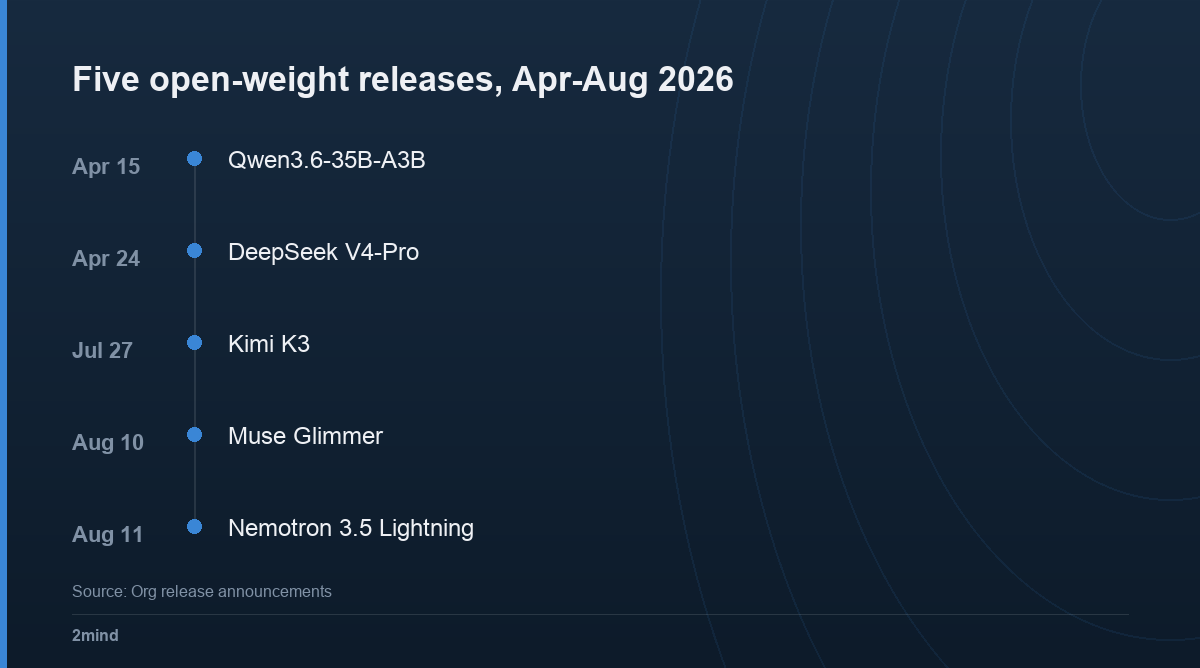
Press coverage framed this week’s Meta and Nvidia releases as an answer to Chinese labs. DeepSeek, Alibaba’s Qwen, and Moonshot’s Kimi have led open-weight releases through most of 2026.
That framing is about who ships open weights first. It says nothing about what any single license permits.
The five licenses split into two real categories.
OSI-style licenses — MIT and Apache 2.0 — carry no revenue or user threshold at all. They are standardized documents you can read once and trust across models.
Organization-specific licenses are the other category: Meta’s older Llama terms, Moonshot’s Kimi K3 License, Nvidia’s OpenMDW-1.1. Each sets its own conditions. Some have a gate, some do not.
The only way to know which you are in is to open the file. That is also why Meta’s broader assistant strategy and its license terms have to be read separately — they move on different timetables.
A Checklist Before You Build on Any “Open” Model
- Find the actual license name. Not the press release’s word “open.” MIT and Apache 2.0 are standardized; anything else is a custom document you need to read in full.
- Search the license text for a number. A dollar figure or a user count is the tell for a revenue or MAU gate.
- Check who the gate applies to. Meta’s 700M-MAU clause and Kimi K3’s $20M clause both count your company’s affiliates, not just the product.
- Check what happens at the gate. Kimi K3 requires a separate agreement. Older Llama versions require requesting a license Meta can grant or deny “at its sole discretion.”
- Recheck before every major version bump. Meta changed its own approach between Llama 4 (April 2025) and Muse Glimmer (August 2026), under the same company.
What would change our view
We cannot verify how Moonshot intends to enforce the $20-million clause. The license states the threshold; it does not describe the process, and no enforcement case has surfaced yet.
What breaks if we are wrong here is specific. A team that reads this comparison and picks Kimi K3 for a commercial product would have to renegotiate mid-build rather than at launch.
Three things would change this reading.
If Meta publishes the final Muse Spark 1.2 license with a gate closer to the older Llama terms than to Glimmer’s Apache 2.0, then Meta has not settled on one approach — Glimmer was the exception.
If Moonshot applies the $20-million threshold more broadly than the license text states, the gate is lower than it reads.
If Nvidia adds conditions to a later OpenMDW version, this comparison has to be rebuilt against the license actually shipped rather than the one announced.
FAQ
Q. Is Meta’s Muse Glimmer really open source, or does it have the same restrictions as Llama?
A. Different. Muse Glimmer ships under Apache 2.0, a standard OSI-approved license with no revenue or user-count gate. Meta’s Llama models (2 through 4) use a separate Community License that requires companies over 700 million monthly active users to request Meta’s permission.
Q. What happens if my product using Kimi K3 crosses $20 million in revenue?
A. If you run it as a Model-as-a-Service business, Moonshot’s license requires a separate commercial agreement once revenue — combined with any affiliates — passes $20 million in any rolling 12 months. Below that, no agreement is required. Above 100 million monthly users or $20 million monthly revenue, a “Kimi K3” credit is required.
Q. Which of these five models has zero commercial-use restrictions?
A. DeepSeek V4-Pro (MIT), Qwen3.6-35B-A3B (Apache 2.0), Muse Glimmer (Apache 2.0), and Nemotron 3.5 Lightning (OpenMDW-1.1, as published) carry no revenue or user-count gate. Kimi K3 is the one model here that does.
Sources
- Muse Glimmer release notes — Hugging Face, Aug 2026
- Llama 4 Community License — Meta
- Nemotron 3.5 Lightning release — CNBC, Aug 11, 2026
- US labs answer China on open weights — CNBC, Aug 12, 2026
Each model’s license file is linked directly in the comparison table above.
Correction, October 2, 2026. An earlier version said Meta changed its approach between Llama 4 and Muse Glimmer in the same year; Llama 4 dates to April 2025 and Muse Glimmer to August 2026.
It also called OpenMDW-1.1 Nvidia’s own text (it is a Linux Foundation license), said no agreement was needed below 100 million monthly users for Kimi K3 (that threshold triggers an on-screen credit, not an agreement), and misplaced a Box CEO quote.
Leave a Reply