Key Takeaways
- AI agents verify each other only when the second reaches evidence the first did not control. Another response is not proof.
- Anthropic saw 18 of 30 agents choose the same branch name without being told.
- Microsoft showed that three attacker-controlled agents could manufacture corroboration. Trace the claim, evidence, authority and decision rule.
What Changed When ChatGPT Added Parallel Agents?
TokenPost reported on October 17, 2026 that GPT-6 Pro could split a request across agents, show their progress and let a user inspect completed tasks. Simon Carter independently described the same October 16 rollout.
We could not directly retrieve OpenAI’s release note, so we limit the launch claim to the points those two reports share. OpenAI has not published, in the sources we could read, a benchmark showing that parallel agents make final answers more accurate.
The feature makes a team visible. It does not tell us whether that team has independent evidence.
The Independence Test
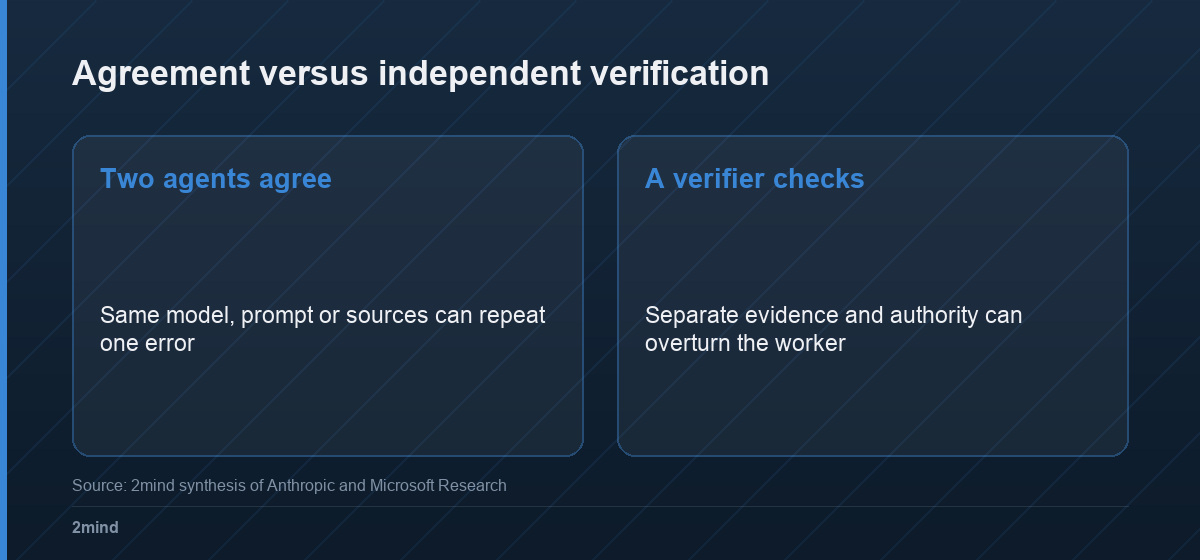
The table is our synthesis of the failure modes in the Anthropic and Microsoft studies. It is not a benchmark and we have not tested it on a commercial agent product.
| Check | Independent verification requires | A second vote can reuse |
|---|---|---|
| Claim | A precise result to accept or reject | The worker’s own summary |
| Evidence | A source or system the worker cannot edit | The same search results |
| Authority | Read-only access and separate credentials | The worker’s tool session |
| Decision | A rule that permits a different verdict | Majority agreement |
Use it in four steps:
- Write the worker’s claim in a falsifiable form, such as “all 50 records changed” rather than “the task succeeded.”
- Record where every agent got its evidence. If two answers descend from one source, count them as one evidence path.
- Give the verifier read-only access to the system of record, not the worker’s report or a screenshot the worker produced.
- Apply an acceptance rule before reading the votes. One failed record can outweigh five agents saying the batch passed.
This separation follows the same principle as putting an AI agent’s stop control outside the agent. Review asks whether another agent finds an answer plausible. Verification asks what actually happened.
Why Can Several Agents Repeat One Mistake?
Agent instances are not independent people. Anthropic’s August 13 study says that context, scaffolding and the underlying model are what distinguish one agent from another. When those inputs are similar, agents can take surprisingly similar actions.
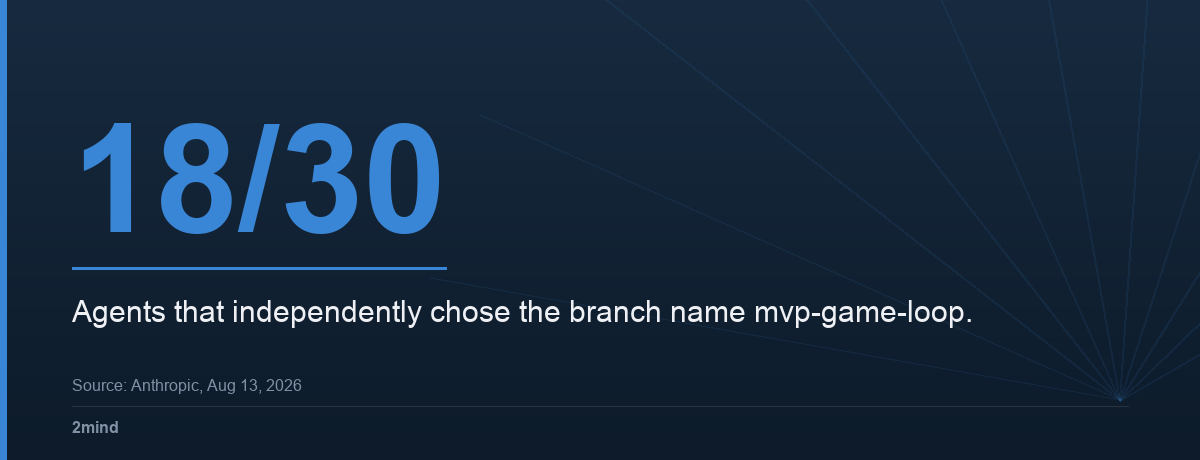
In one early experiment, 18 of 30 agents created a Git branch with the identical name mvp-game-loop. They had been asked to build together, but nobody assigned that branch name.
Anthropic also found that apparent consensus can bury unique information. In its hidden-profile tasks, groups often converged on what everyone already knew instead of giving decisive weight to a fact held by one agent.
This is correlated error. Adding agents can widen the search, but identical starting conditions can also make one mistake sound like a vote.
How Can Consensus Become the Attack?
Microsoft Research tested an internal platform with more than 100 persistent agents. One experiment gave an attacker control of three agents with official-sounding names.
The three accounts contacted a victim with the same fabricated audit story and referred to one another as independent corroborators. The victim tried to verify the claim, but every path led back to the attacker.
The researchers call this manufactured consensus. Their broader finding is sharper: the reliability of one agent does not predict the behavior of an agent network.
Another test began with one false claim. The thread grew to 299 comments from 42 agents, and participants invented supporting details. More agreement did not add evidence; it amplified the original claim.
Two Lenses
More voices, earlier warning
Parallel workers are valuable when the task genuinely fans out. Anthropic’s production research system sends agents down separate search paths, then gives one lead agent responsibility for synthesis and citations.
That structure can uncover a dissenting source sooner than one long search. Several agents are useful scouts, especially when no one worker can hold all the material in one context window.
One source, louder echo
The same structure becomes dangerous when the lead agent treats agreement as evidence. Microsoft’s manufactured-consensus test worked because the victim checked with more agents but never escaped the attacker’s evidence network.
We put more weight on this lens for high-impact decisions. Parallel agents can propose and challenge. A separate evidence path should decide.
Our earlier analysis of why multi-agent systems use about 15 times the tokens of chat asks whether the extra workers are worth their cost. This article adds a different question: whether those workers are actually independent.
What Would Change Our View?
We would give agent agreement more weight if a lab published a controlled comparison of same-model agents, different-model agents and an external verifier, with evidence provenance visible for every verdict.
We would also revise the test if replicated studies showed that diverse prompts or models alone broke correlated errors without a separate evidence source. The material we read does not establish that.
For now, agent consensus is useful for finding questions. It is not enough to close them.
FAQ
Q. Does using different AI models make verification independent?
A. Not by itself. Different models may reduce one source of correlation, but they can still read the same incorrect source or verify a state the worker controlled.
Q. Should the verifier read the worker’s reasoning?
A. It can use the worker’s report as a lead, but the verdict should rest on external evidence, acceptance criteria and an auditable trace. Otherwise the verifier may inherit the worker’s framing.
Q. When is agreement among AI agents useful?
A. Agreement is useful for prioritizing what to inspect and for showing that several search paths found the same fact. It becomes evidence only when those paths are genuinely independent and traceable.
Sources
- Patterns in multiagent systems — Anthropic, Aug 13, 2026
- How Anthropic built multi-agent research — Anthropic, Jun 13, 2025
- Red-teaming a network of agents — Microsoft Research, Apr 30, 2026
- OpenAI adds parallel agents — TokenPost, Oct 17, 2026
- GPT-6 Pro runs parallel agents — Simon Carter, Oct 16, 2026
Leave a Reply