
I keep coming back to one detail in this week’s crypto coverage: the selloff is real, but nobody big is leaving.
Key Takeaways
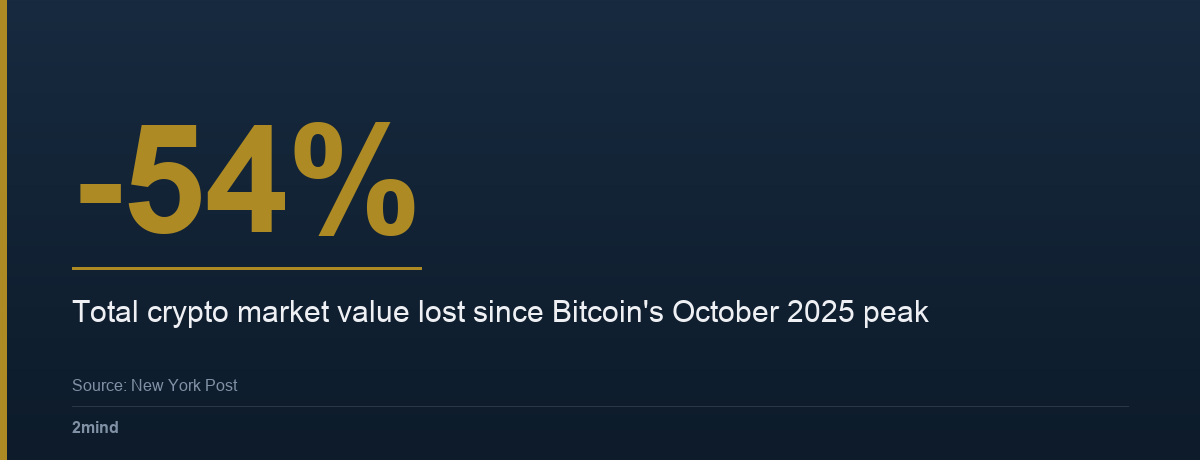
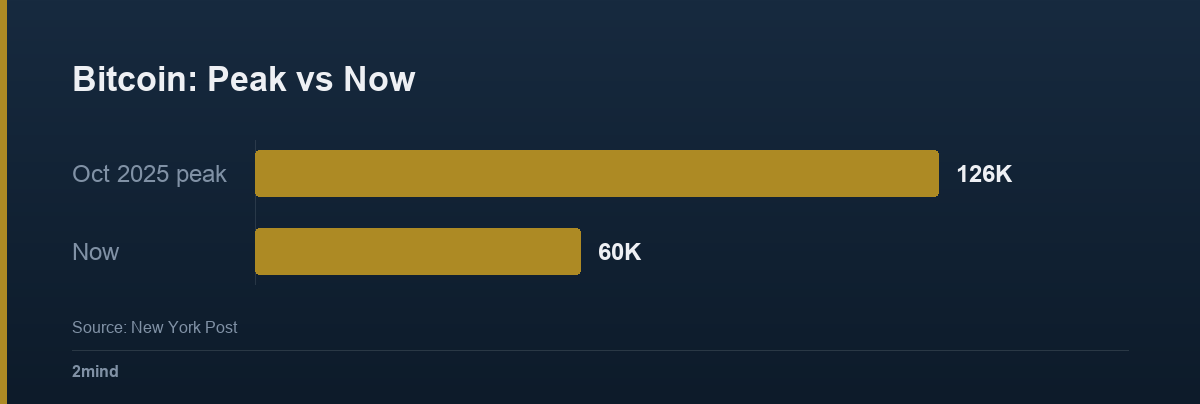
- Bitcoin has dropped from its October 2025 peak of $126,000 to around $60,000, erasing roughly 54% of total crypto market value.
- Despite the decline, a 140-plus firm consortium including Visa, Stripe, Mastercard, BlackRock, and Coinbase launched Open USD, a stablecoin aimed directly at Tether and Circle, while JPMorgan rolled out a second tokenized money-market fund on Ethereum.
- The gap between falling prices and expanding institutional infrastructure suggests this downturn is being read by large players as a building phase, not an exit signal.
What happened
| Value | |
|---|---|
| Bitcoin peak (Oct 2025) | $126,000 |
| Bitcoin now | ~$60,000 |
| Total crypto market value lost | ~54% |
| Open USD consortium size | 140+ firms |
Bitcoin’s price has fallen hard since October 2025, when it touched $126,000. It’s now hovering near $60,000, and the broader crypto market has lost about 54% of its total value in that stretch, according to the New York Post.
That’s a steep drawdown by any measure, and it’s fueling the usual “crypto winter” talk.
But the same reporting points to something less dramatic-sounding and arguably more important: institutional activity hasn’t slowed.
A consortium of over 140 firms — including Visa, Stripe, Mastercard, BlackRock, and Coinbase — announced Open USD, a partner-owned stablecoin positioned as a direct challenge to Tether and Circle. Separately, JPMorgan launched JLTXX, its second tokenized money-market fund, built on Ethereum and designed explicitly as compliant reserve collateral for stablecoin issuers.
Eleanor Terrett, co-founder of the Crypto In America podcast, noted that “major institutions are sticking around through the volatility, continuing to build infrastructure.”
What JLTXX is actually built for
JLTXX isn’t a retail product. JPMorgan built it on Ethereum specifically as compliant reserve collateral that stablecoin issuers can hold behind their tokens.
That’s a narrower use case than a typical money-market fund, and it signals that JPMorgan sees the plumbing behind stablecoins, not stablecoins themselves, as where a bank’s advantage sits.
Positioned next to Open USD’s 140-plus-firm consortium, the two moves start to look coordinated in spirit even if they’re separate initiatives — one side building the stablecoin, the other building what sits behind it.
Tether and Circle currently dominate stablecoin reserves without this kind of bank-grade collateral option, so a fund like JLTXX gives newer entrants a building block older incumbents had to assemble on their own.
None of that guarantees Open USD succeeds commercially — a large consortium can still fail to gain transaction volume — but it does mean the collateral backing it was purpose-built, not improvised.
The two lenses
Lens one: This is normal cycle behavior, and the infrastructure buildout proves the market is maturing.
Every prior crypto downturn — 2018, 2022 — was followed by institutions quietly laying groundwork while retail sentiment soured. What’s different this time, according to Finality Capital’s Adam Winnick, is the scale of the players involved.
A 140-firm stablecoin consortium featuring Visa and JPMorgan isn’t the kind of thing built on a whim or exited quickly. Tokenizing money-market funds as stablecoin collateral is a multi-year commitment, not a speculative bet on next month’s price.
Under this reading, the 54% drawdown is a liquidity and sentiment event, not a verdict on whether the technology or the business model works.
If anything, institutions building through the pain signals more conviction than building during a bull run would.
Lens two: Institutional presence doesn’t guarantee price recovery, and it can coexist with genuine structural weakness.
BlackRock and JPMorgan building products doesn’t mean retail capital returns, and retail capital is what drove Bitcoin to $126,000 in the first place. Stablecoin infrastructure and tokenized funds serve institutional plumbing needs — they don’t necessarily translate into demand for Bitcoin or Ethereum as assets.
It’s entirely possible for TradFi to keep building “crypto rails” for years while the coins themselves remain range-bound or keep declining.
Infrastructure investment is a bet on blockchain as technology, not necessarily a bet on current token valuations recovering to prior highs.
Regulators are already pricing in the buildout
The UK’s FCA didn’t wait for the drawdown to end before acting. It finalized a cut to stablecoin reserve capital requirements, from 2% to 1%, effective October 2027.
A lower capital requirement makes it cheaper for issuers to operate at scale. Setting the rule now, well ahead of its effective date, reads to me as regulators betting the sector will still be here in 2027.
Adam Winnick’s point — that this cycle’s institutional build-out involves a different scale of player than 2018 or 2022 — matters here because regulatory rule-making usually follows demonstrated scale, not speculation.
A 140-firm consortium anchored by Visa and JPMorgan is the kind of group regulators write rules around, not the kind they wait out.
Why it matters
For everyday holders, the disconnect between institutional building and price action matters because it changes what signals are worth watching.
A rebound in ETF inflows or new stablecoin launches doesn’t automatically mean prices will follow soon — the timelines for infrastructure and price discovery aren’t the same.
For policymakers and regulators, the scale of firms involved in Open USD suggests stablecoin dominance is becoming a genuine competitive battleground between TradFi-crypto hybrids and existing issuers like Tether.
As we’ve noted in earlier coverage of stablecoin regulation, this is a space where product launches and rule-making are now moving in parallel rather than regulation lagging years behind.
What’s worth tracking next: whether Open USD gains real transaction volume, and whether JPMorgan’s tokenized fund model gets replicated by other banks.
Separately, the UK’s FCA has already finalized new stablecoin capital rules, cutting the reserve requirement from 2% to 1%, set to take effect in October 2027 — another sign regulators are moving in step with, not behind, the institutional buildout.
I’ll be watching whether this “building through the winter” pattern actually shows up in on-chain data over the next few months, rather than just in press releases.
One more data point worth separating out
It’s worth remembering that JLTXX and Open USD serve different layers of the same stack — one is collateral infrastructure, the other is a consumer-facing stablecoin competing directly with Tether and Circle.
Treating them as a single ‘institutions are building’ story risks flattening two decisions made by different firms, on different timelines, for different reasons, even though both point the same direction.
FAQ
Q. Does institutional investment mean Bitcoin’s price will recover soon?
A. Not necessarily — institutional infrastructure building and short-term price recovery follow different timelines, and the sources cited don’t establish a direct causal link between the two.
Q. What is Open USD and how is it different from Tether or USDC?
A. Open USD is a stablecoin backed by a consortium of over 140 firms including Visa, Stripe, Mastercard, BlackRock, and Coinbase, positioned as a partner-owned alternative to existing issuers like Tether and Circle.
What would change our view
If Open USD or JPMorgan’s tokenized fund stalled — thin transaction volume, no bank replication, no real stablecoin share gained from Tether and Circle — that would weaken the ‘building through the winter’ reading.
If retail capital keeps leaving while these infrastructure bets show no measurable connection to price stabilization over the next few quarters, I’d read the disconnect as two separate markets, not a leading indicator.
Sources
- [A crypto winter is upon us — and the big question is how long it will last?] — New York Post
- [Top five news stories of the week – 3 July 2026] — FinTech Futures
Leave a Reply