
I’ve noticed that political proximity to crypto doesn’t seem to buy immunity from a brutal mining downturn.
Key Takeaways
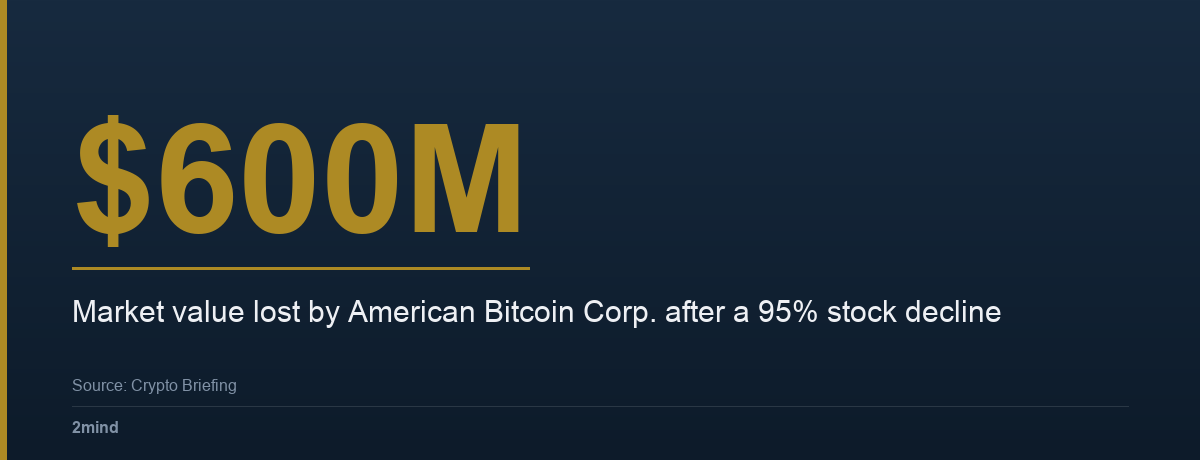
- American Bitcoin Corp., co-founded by Eric Trump, has lost more than $600 million in market value after a 95% decline in its stock price.
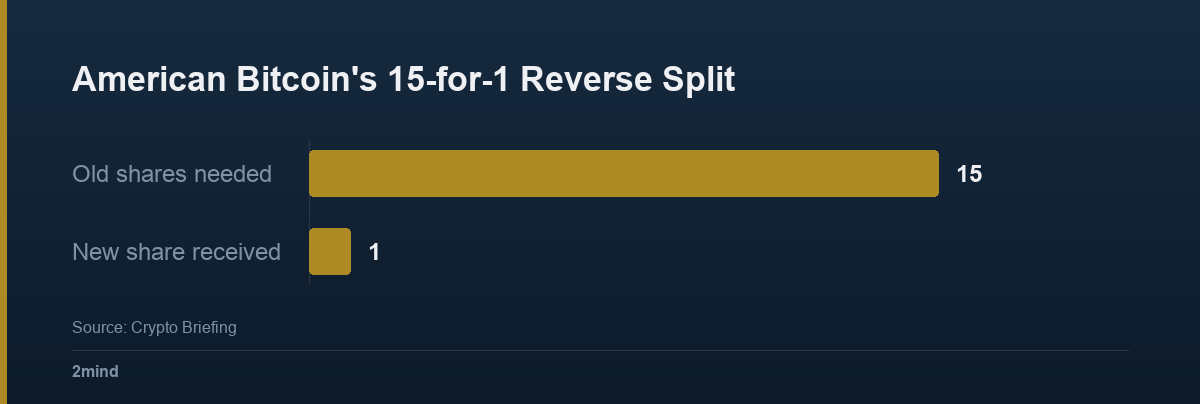
- The company still holds a large Bitcoin treasury but executed a 15-for-1 reverse stock split just to maintain its Nasdaq listing.
- The 2mind view: this shows that political branding cannot offset weak mining economics or investor skepticism once momentum turns.
What happened
American Bitcoin Corp., the mining venture co-founded by Eric Trump, has reportedly lost over $600 million as its market value collapsed by 95%, according to Crypto Briefing.
The company has continued accumulating Bitcoin — domestic reporting places its treasury at roughly 8,000 BTC — but the stock’s slide forced management to pursue a 15-for-1 reverse split just to stay compliant with Nasdaq listing requirements.
This isn’t happening in isolation. The broader mining sector has been squeezed by falling Bitcoin prices, rising energy and hardware costs, and shifting infrastructure economics. Margin compression has been building across the industry for months, and American Bitcoin’s situation appears to be one of the more visible casualties of that trend.
| Metric | Detail |
|---|---|
| Market value loss | Over $600 million |
| Stock decline | 95% |
| Bitcoin holdings | ~8,000 BTC |
| Corporate action | 15-for-1 reverse split |
A 15-for-1 reverse split doesn’t create or destroy value on its own. It consolidates existing shares into fewer, higher-priced units to satisfy a listing rule.
What draws attention is what it signals: a stock that fell far enough, fast enough, that management needed a mechanical fix rather than waiting for a recovery.
A 95% decline is also a magnitude usually associated with a going-concern scare, not routine sector rotation. That’s part of why the split registered as news rather than housekeeping.
The broader mining sector context matters too. Falling Bitcoin prices, rising energy and hardware costs, and shifting infrastructure economics have been squeezing margins across the industry for months, not just at this one company.
The two lenses
Lens one: the political-brand risk lens. One reading is that this episode punctures the idea that political connections provide a durable moat for crypto ventures. American Bitcoin carried significant public attention because of the Trump family’s involvement, and that attention likely helped it raise capital and attract early investor interest.
But attention is not the same as operational resilience. Once mining margins compressed and the broader market turned cautious, the stock behaved like any other undercapitalized miner — it simply fell, regardless of who sat on the cap table.
For investors, this is a reminder that headline-driven valuations can unwind just as fast as they inflate, especially when the underlying business — Bitcoin mining — is inherently commodity-like and margin-sensitive.
Lens two: the balance-sheet resilience lens. A different reading focuses on what the company still has: a substantial BTC treasury. Even after a 95% equity collapse, holding thousands of Bitcoin gives American Bitcoin optionality that a company without a treasury wouldn’t have.
If Bitcoin’s price recovers, the treasury could partially offset equity damage, and the reverse split — while often viewed negatively — is a mechanical tool to preserve listing status rather than a signal of insolvency.
Some analysts might argue this is simply a difficult mining cycle that many public miners are navigating, not a unique failure specific to this company or its founders.
It’s worth separating two different questions. One is whether political branding attracts capital — it clearly did, early on. The other is whether it protects that capital once mining economics turn.
This episode answers the second question more than the first, and the two shouldn’t be conflated when reading what happened here.
Attention-driven capital tends to be the first capital to leave once a story stops being about growth and starts being about survival. Political proximity generated attention, but that isn’t the same as a loyal shareholder base.
The roughly 8,000 BTC figure matters less as a fixed cushion and more as an option. At current mining-sector prices, holding onto it beats liquidating into a depressed stock and a depressed coin market at once.
None of this guarantees a turnaround. A treasury only protects the company if it resists selling at depressed prices to fund operations — exactly the pressure a delisting-risk company tends to feel most.
Some analysts view this as simply a difficult mining cycle most public miners are navigating, rather than a company-specific or founder-specific failure.
Why it matters
This matters to a few distinct groups. Retail shareholders in politically-branded crypto vehicles should note that celebrity or political association doesn’t substitute for operational fundamentals — mining margins, energy costs, and Bitcoin price all still dominate outcomes.
Institutional observers watching the mining sector broadly should track whether other public miners face similar reverse-split pressure in coming quarters, since that would suggest a sector-wide capital crunch rather than a company-specific story.
And crypto-market watchers should keep an eye on how treasuries like this one are managed going forward — whether the company sells BTC to cover losses, which could add modest sell-side pressure, or holds through the cycle.
It’s a quiet story in some ways, but it says something concrete about how far political branding can carry a crypto business before the underlying economics take over.
If other publicly traded miners disclose similar reverse splits in coming quarters, that would reframe this from an Eric Trump story into a sector-wide capital-adequacy story.
For institutional observers, the more useful comparison isn’t to other politically branded ventures — there aren’t many direct comparisons. It’s to non-political public miners facing similar margin pressure over the same period.
Retail shareholders in politically branded crypto vehicles are the group most directly exposed here. Celebrity or political association doesn’t substitute for mining margins, energy costs, and Bitcoin’s price — those still dominate outcomes.
FAQ
Q. Did Eric Trump personally lose $600 million?
A. The loss refers to the market value decline of American Bitcoin Corp., the company he co-founded, not necessarily his personal net worth directly, though his family’s stake would be affected proportionally.
Q: Why did the company do a reverse stock split?
A: The 15-for-1 reverse split was executed to maintain compliance with Nasdaq’s minimum share price listing requirements after the stock’s steep decline.
What would change our view
If American Bitcoin’s treasury shrinks materially in coming filings — meaning BTC is being sold to cover losses rather than held through the cycle — the balance-sheet resilience reading in Lens two would need dropping.
We’d also revisit this if the stock stabilizes post-split without further mining-sector reverse splits elsewhere, which would suggest this was a company-specific problem rather than an industry one.
It’s also worth watching whether the company frames future disclosures around BTC treasury management or operational turnaround — that framing choice would tell us which story management believes it’s in.
Sources
- [Eric Trump’s Bitcoin mining venture loses over $600M amid market downturn] — Crypto Briefing
- [Eric Trump’s Bitcoin mining firm loses $600M amid crypto market slump] — Pluang (citing Crypto Briefing)
Leave a Reply