I keep coming back to this chart because it doesn’t behave the way I expected it to.
Key Takeaways
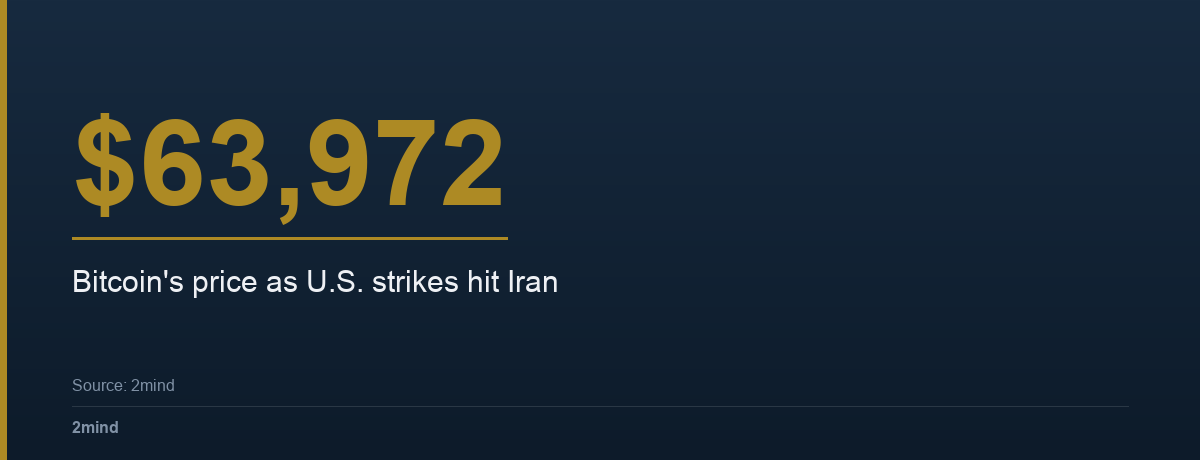
- Bitcoin held near $63,972, up 1.84%, even as U.S. strikes on Iran and Hormuz Strait tensions pushed oil prices sharply higher.
- Nasdaq-listed miner Bitdeer sold all 244.3 BTC it mined this week, maintaining zero net Bitcoin holdings.
- The market’s calm reaction suggests regulatory catalysts, not geopolitical shocks, are currently driving crypto sentiment more directly.
What happened
Over the past 24 hours, U.S. forces resumed strikes on Iranian military sites, and Iran expanded retaliation to Gulf allies, according to reporting cited by Bloomberg and domestic outlets.
Oil prices jumped on the news, and Washington issued heightened Middle East travel advisories. Iraq reportedly accelerated work on a 1,600km pipeline route to reduce its exposure to a potential Hormuz Strait blockade.
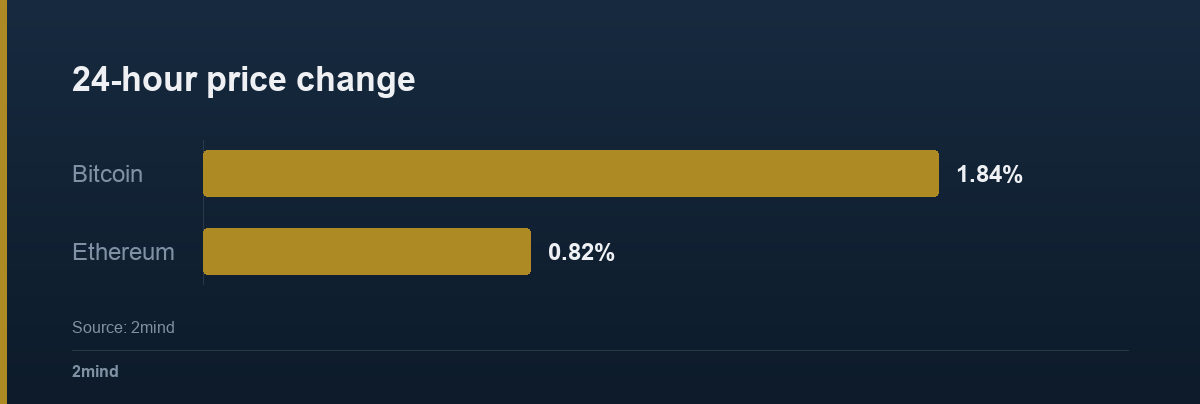
Against that backdrop, Bitcoin didn’t sell off. It sat around $63,972.64, up 1.84% on the day, while Ethereum traded near $1,843, up 0.82%. Domestic Korean coverage framed this as Bitcoin “holding the $64,000 line” even as traditional energy and equity markets absorbed the geopolitical shock.
Separately, Bitdeer — a Nasdaq-listed Bitcoin mining company — disclosed via X that it mined 244.3 BTC this week and sold the exact same amount, keeping its net Bitcoin treasury at zero.
This isn’t new behavior for Bitdeer, but it’s a useful data point on how some public miners are choosing to manage balance sheet risk right now: mine, convert to cash, repeat, rather than hold.
| Asset | Price | 24h Change |
|---|---|---|
| Bitcoin (BTC) | $63,972.64 | +1.84% |
| Ethereum (ETH) | $1,843.42 | +0.82% |
The 1,600km pipeline detail is worth sitting with. A project of that scale doesn’t get accelerated overnight.
It reflects a government-level judgment that Hormuz Strait access can’t be assumed safe for the foreseeable future — a heavier signal than one day of oil price movement.
Bitdeer’s zero-holdings pattern recurring here is a useful anchor point. The company sold the same volume it mined — 244.3 BTC — during a week when Bitcoin itself rose.
That timing matters: the sale wasn’t a reaction to falling prices. It looks more like a standing policy than a one-off risk call.
Domestic Korean coverage framing this as Bitcoin ‘holding the line’ is itself a data point. It reflects how retail sentiment in one of Bitcoin’s more active markets read the same 24 hours.
Ethereum trading near $1,843 while Bitcoin held its own level is also worth noting as a smaller supporting data point — the broader crypto market wasn’t uniformly panicking that day.
The two lenses
Lens one: Bitcoin as an uncorrelated hedge. One reading is that Bitcoin is starting to behave less like a risk-on tech proxy and more like an independent asset class during geopolitical stress. Oil spiked, equities wobbled on defense-sector volatility, and yet Bitcoin didn’t crack.
If this pattern holds across multiple Middle East flare-ups rather than just one weekend, it would support the long-standing argument that Bitcoin can act as a hedge against traditional-market shocks — not gold’s replacement, necessarily, but a genuinely separate risk bucket institutional allocators watch.
The timing also matters: this resilience comes right as markets are pricing in potential U.S. regulatory clarity next week, which may be doing more heavy lifting for sentiment than the war headlines are.
Lens two: it’s just calm before repricing. The other reading is more cautious. A single weekend of stability during an escalating conflict is a thin sample size. Oil markets, currency markets, and safe-haven flows often take days to fully reprice geopolitical risk, especially when a conflict is still expanding rather than resolving.
If Hormuz Strait shipping is genuinely disrupted — which would be a much bigger economic shock than air strikes alone — risk assets across the board, including crypto, could still see delayed selling pressure. Reading too much “decoupling” narrative into one steady weekend risks getting ahead of the actual data.
The comparison that matters most isn’t Bitcoin versus gold. It’s Bitcoin versus the Nasdaq and the defense-sector volatility that typically accompanies a Middle East escalation.
If Bitcoin’s price increasingly tracks its own supply-demand dynamics rather than moving with equities during geopolitical stress, that’s the kind of decoupling institutional allocators actually watch for.
Shipping data has historically lagged geopolitical headlines by days, sometimes weeks, before insurance premiums and freight rates fully reprice risk.
That lag means a market can look calm right up until tanker traffic through Hormuz actually slows — at which point repricing tends to happen fast, not gradually.
This also isn’t the first time this kind of divergence has been floated. What’s different this time is the size of the shock relative to how little Bitcoin moved.
Why it matters
Traders, institutional desks, and anyone tracking Bitcoin’s evolving correlation profile should watch two things over the coming days: whether Hormuz Strait shipping disruptions materialize in a way that hits global energy supply directly, and whether the U.S. “CLARITY” market-structure bill discussion next week produces anything concrete.
Regulatory catalysts have repeatedly moved crypto sentiment more than macro headlines this year. Bitdeer’s zero-holdings strategy is also worth monitoring as a bellwether for how public miners are managing treasury risk amid uncertain rate and regulatory conditions.
It’s a quiet signal, not a loud one. But quiet signals are sometimes the ones worth watching most closely.
The CLARITY bill discussion deserves more weight in this story than the geopolitical headlines are currently getting.
Regulatory catalysts have moved crypto sentiment more directly than macro shocks through much of this year, which is part of why one steady weekend shouldn’t be read as proof of a new correlation regime.
Bitdeer’s treasury policy is also a signal for a narrower audience — anyone pricing miner-stock risk rather than Bitcoin itself.
A company with zero net holdings has less balance-sheet exposure to a BTC price swing than a miner that stockpiles, which changes how its equity should trade relative to spot moves.
None of this settles whether Bitcoin’s calm reaction was about geopolitics specifically, or about markets already looking past the war headlines toward next week’s regulatory news instead.
FAQ
Q. Does Bitcoin holding steady mean it’s now decoupled from macro risk?
A. Not conclusively — one weekend of stability during a geopolitical event is not enough data to confirm a lasting decoupling; it needs to be observed across multiple stress events.
Q. Why is Bitdeer selling all the Bitcoin it mines instead of holding it?
A. Bitdeer has disclosed maintaining zero net Bitcoin holdings by selling mined output as it’s produced, a treasury approach that avoids balance-sheet exposure to BTC price swings, though the company hasn’t detailed its full strategic rationale publicly.
What would change our view
If Hormuz Strait shipping is disrupted in a way that shows up in actual freight or insurance data — not just headlines — and Bitcoin still holds steady, the decoupling reading in Lens one gets meaningfully stronger.
Conversely, if Bitcoin sells off once holiday-thin liquidity clears and full trading volume returns, that looks more like Lens two’s ‘calm before repricing’ than a genuine hedge pattern.
Leave a Reply