
There’s a pattern forming in major AI infrastructure announcements, and Korea’s latest move fits it almost too neatly.
Key Takeaways
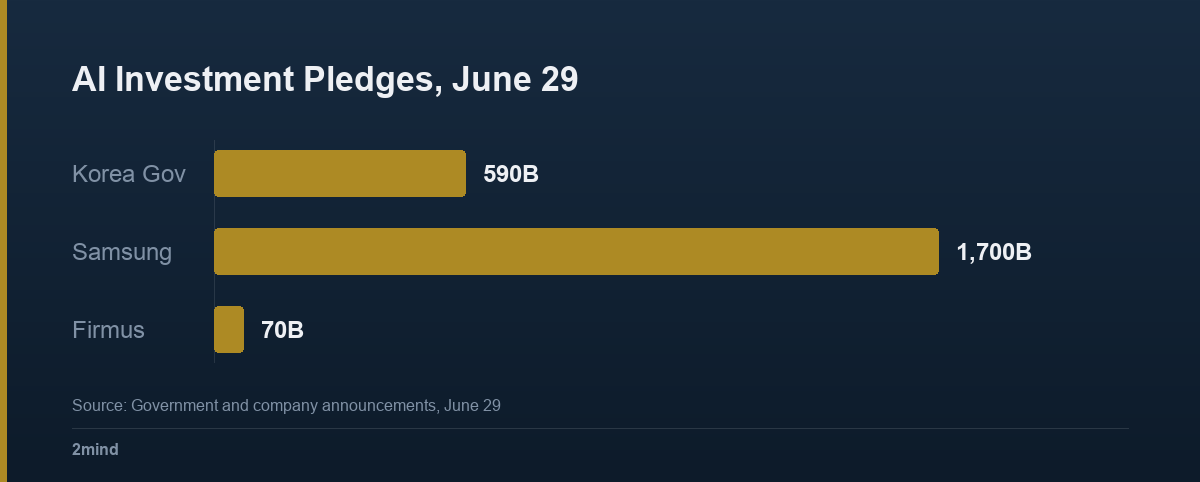
- Korea’s government announced a combined ~$590 billion (911 trillion won) plan on June 29, covering semiconductor fabs, AI data centers, robotics, and batteries.
- Samsung separately committed roughly $1.7 trillion domestically across AI and semiconductors, expanding in Pyeongtaek and Yongin.
- The same day, former Bitcoin miner Firmus Technologies announced a $70 billion AI infrastructure partnership with Nvidia, backed by $1.35 billion in equity and $10 billion in debt.
- Announced capital and deployed capital aren’t the same thing — the real test is whether Gwangju’s fab and Firmus’s Project Southgate get built on schedule.
What Happened
| Announcement | Amount | Focus |
|---|---|---|
| Korea government plan | $590B (911T won) | Semiconductor fabs, AI data centers, robotics, batteries |
| Samsung’s own plan | $1.7T (2,655T won) | AI & semiconductors (Pyeongtaek, Yongin) |
| Firmus–Nvidia (Australia) | $70B | GPU clusters, Project Southgate (~18,400 GPUs) |
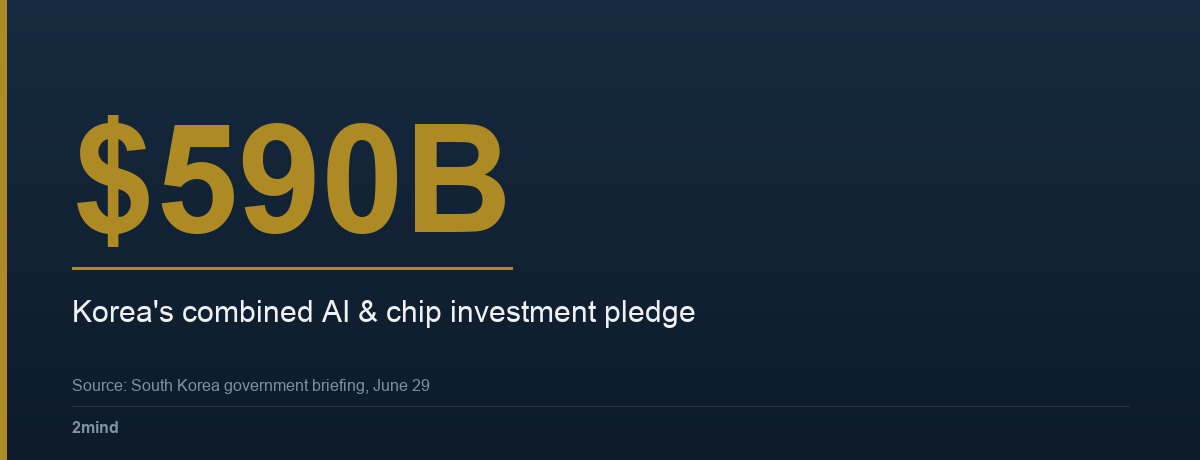
On June 29, South Korea’s government held a national briefing — attended by President Lee Jae-myung, Samsung Electronics Chairman Lee Jae-yong, and SK Group Chairman Chey Tae-won — and announced a combined investment plan totaling approximately 911 trillion Korean won, roughly $590 billion, in AI and semiconductor infrastructure.
The plan covers new semiconductor fabrication facilities in regions outside Seoul, including a new cluster in Gwangju, AI data centers, physical AI and robotics, and battery manufacturing. Samsung separately announced a mid-to-long-term domestic investment plan of 2,655 trillion won (roughly $1.7 trillion) across AI and semiconductors, with expansions in Pyeongtaek and Yongin.
On the same day, Firmus Technologies — originally a Bitcoin mining company — announced a partnership with Nvidia to supply GPU clusters in Singapore and Australia via Nvidia’s DGX Cloud Lepton marketplace.
Firmus plans to invest over $70 billion in AI infrastructure across Australia, backed by $1.35 billion in equity and a $10 billion debt facility.
Its Project Southgate targets approximately 18,400 Nvidia GPUs in Melbourne, with construction beginning in 2026, according to Crypto Briefing.
Two announcements, different geographies, same underlying logic: AI compute demand is being treated as a multi-decade infrastructure bet.
The DGX Cloud Lepton detail worth noticing
Nvidia isn’t just selling Firmus hardware — it’s onboarding Firmus as a supplier on its own DGX Cloud Lepton marketplace.
That’s the same platform Nvidia is using to build a distributed network of regional GPU providers beyond its own data centers.
That’s a different relationship than a one-time hardware sale. Nvidia has a continuing interest in Firmus succeeding, since Firmus’s capacity becomes part of what Nvidia can offer marketplace customers.
For smaller, regionally focused operators, that marketplace access matters more than a single hardware order would, since it opens a channel to Nvidia’s broader customer base over time.
The Two Lenses
Lens one: The strategic necessity argument
Korea’s 911 trillion won (about $590 billion) commitment is not happening in a vacuum. Global AI compute demand — driven by hyperscalers in the U.S. and increasingly by state-backed initiatives in China — is putting pressure on every country that wants a seat at the table.
Samsung and SK Hynix supply the high-bandwidth memory that goes into Nvidia’s most advanced AI chips. If that supply chain shifts, or if competitors close the gap, Korea’s position in the global AI stack weakens considerably.
The geographic diversification embedded in the plan — moving investment away from the Seoul metro area into Gwangju and other regions — also reflects a supply chain resilience logic.
Concentration risk is real, as the semiconductor industry learned during the pandemic. Spreading fabrication capacity is less about efficiency and more about survival in a world where geopolitical disruption is now a baseline assumption.
The Firmus-Nvidia partnership tells a similar story from a different angle.
A mining company pivoting to AI GPU infrastructure is not surprising — the hardware overlap is real, and the margin profile of AI compute leasing is more attractive than Bitcoin mining at current prices.
What’s notable is that Nvidia is actively onboarding these partners through its DGX Cloud Lepton marketplace, effectively building a distributed GPU supply network that extends well beyond its own data centers.
Lens two: The execution gap
Announced investment and deployed capital are not the same thing. Korea’s semiconductor megaprojects have a history of ambitious timelines meeting slower realities — permitting, labor, supply chain coordination, and global demand cycles all introduce friction.
The 911 trillion won figure spans multiple years and multiple entities, and the political commitment visible at a presidential briefing does not automatically translate into on-time fab construction.
For Firmus, the execution question is sharper. A $70 billion infrastructure commitment from a company that started as a Bitcoin miner, backed by $1.35 billion in equity and a $10 billion debt facility, is a highly leveraged bet on sustained AI compute demand.
If enterprise and government contracts materialize at the scale needed to service that debt, the model works. If the AI infrastructure build-out slows — as some analysts have begun to suggest, citing overcapacity concerns in the U.S. market — the leverage becomes a liability.
This connects to what we’ve been tracking in Coinbase CEO Brian Armstrong’s public comments this week: even inside AI-native organizations, cost discipline is now an active priority. The tokenmaxxing era is giving way to efficiency mandates. That shift, if it broadens, affects the demand side of the infrastructure equation.
Why It Matters
The Korea announcement matters for anyone tracking where the next generation of AI hardware supply will come from.
Samsung and SK Hynix are not just chip companies — they are the primary suppliers of HBM memory to Nvidia’s H100 and B200 series.
A sustained, government-backed investment commitment signals that Korea intends to hold that position rather than cede ground to emerging competitors.
For the broader AI infrastructure market, the Firmus-Nvidia partnership is a signal worth watching: Nvidia is building a marketplace model that allows smaller, regionally focused operators to plug into its ecosystem. That’s a distribution strategy, not just a hardware sale.
What to watch: whether the Gwangju fab timeline holds, how quickly Project Southgate secures enterprise contracts, and whether the U.S. AI infrastructure build-out shows signs of overcapacity that could ripple into Asia-Pacific demand projections.
The capital is committed. The question is always what gets built — and when.
What would change our view
If the Gwangju fab timeline or Project Southgate’s GPU rollout slipped meaningfully behind schedule, that would support Lens two’s execution-gap reading over the strategic-necessity case.
The same is true if enterprise contracts for Firmus’s leased compute failed to materialize at a pace that services its $10 billion debt facility.
Conversely, if Samsung and SK Hynix visibly expanded their share of Nvidia’s HBM supply chain over the next year, that would be a concrete sign the government’s investment thesis is translating into actual position, not just an announcement.
FAQ
Q. Why did a former Bitcoin mining company pivot to AI infrastructure?
A. Firmus said the shift reflects overlapping hardware needs between mining and AI compute, and a more attractive margin profile for leasing GPU capacity than mining bitcoin at current prices, according to the reporting on its Nvidia partnership.
Q. What’s the difference between Korea’s government plan and Samsung’s own investment plan?
A. The 911 trillion won ($590 billion) figure is the government’s combined national plan across fabs, AI data centers, robotics, and batteries. Samsung’s separate 2,655 trillion won (about $1.7 trillion) commitment is the company’s own domestic spending on AI and semiconductors, layered on top of the government total.
Sources
- Firmus Technologies partners with Nvidia to expand AI GPU infrastructure — Pluang / Crypto Briefing
- Coinbase’s CEO outlined 5 strategies to keep AI spend low — Business Insider
Leave a Reply